
BSA/AML Program Modernization: Beyond Traditional Transaction Monitoring
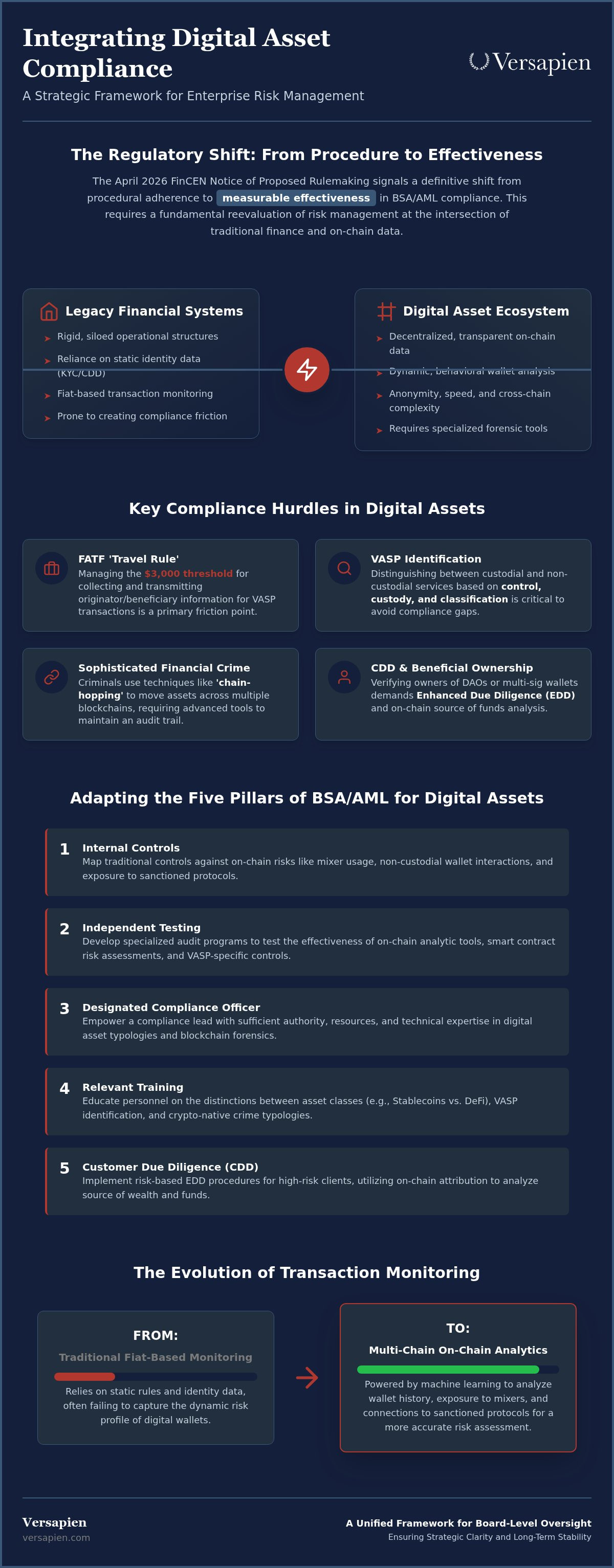
Regulatory ambiguity, legacy friction, and resource strain often define the current struggle with digital asset integration. The April 2026 FinCEN Notice of Proposed Rulemaking signaled a definitive shift from procedural adherence to measurable effectiveness in BSA/AML compliance. For senior leaders, this transition isn't merely a technical update; it's a fundamental reevaluation of how institutions manage the intersection of traditional finance and on-chain data. Legacy systems frequently struggle to reconcile decentralized transparency with the rigid structures of historical monitoring, creating operational silos that hinder institutional growth.
Most executive teams recognize that separate compliance workflows for digital assets introduce significant risk and unnecessary complexity. This analysis provides a strategic framework for integrating digital asset risks into your enterprise risk management strategy without compromising institutional innovation. We'll examine how to align with the FATF Travel Rule and the GENIUS Act while satisfying the latest supervisory expectations for effectiveness-based programs. By bridging the gap between legacy infrastructure and crypto-forensics, your institution can establish a regulator-ready posture that provides both strategic clarity and long-term stability.
Table of Contents
The Regulatory Friction Point: Aligning Digital Assets with the Bank Secrecy Act
Financial institutions face a structural misalignment between traditional oversight and decentralized finance. While the Bank Secrecy Act (BSA) provides the foundational framework for financial transparency, its application to virtual asset service providers (VASPs) requires a more nuanced interpretation than traditional banking models. The 2019 FinCEN guidance remains a cornerstone for digital asset compliance; however, the 2026 regulatory environment demands greater precision in managing the friction between on-chain anonymity and regulatory visibility.
One of the most persistent operational hurdles is the 'Travel Rule' under FinCEN 31 CFR 1010.410(f). In the United States, the $3,000 threshold for collecting and transmitting originator and beneficiary information remains a significant friction point for cross-border transactions. Traditional KYC and CDD processes often fail to capture the full risk profile because they prioritize static identity data over the dynamic behavior of a digital wallet. A wallet's historical interactions, exposure to mixers, and connections to sanctioned protocols provide a more accurate risk assessment than a simple identity check alone.
Defining the VASP in a Decentralized Economy
Control, custody, and classification serve as the primary determinants for VASP status. Identifying when an entity qualifies as a VASP depends largely on the concept of control. Financial institutions should distinguish between custodial services, which hold private keys for users, and non-custodial software providers. Regulatory classification hinges on whether the entity facilitates the exchange, transfer, or safekeeping of virtual assets. Misidentifying these roles can lead to significant gaps in BSA/AML compliance programs, particularly as decentralized protocols continue to blur the lines of financial intermediation.
The Evolution of Financial Crime Risks
Criminal typologies have moved beyond simple layering into more sophisticated, crypto-native obfuscation techniques. Investigative efficiency is often challenged by 'chain-hopping,' where illicit actors move assets across multiple blockchains to break the audit trail. Effective monitoring requires tools that can track value across disparate protocols rather than focusing on a single ledger. Modernizing these investigative workflows ensures that suspicious activity reports reflect the actual complexity of the underlying financial crime.
Engineering a Risk-Based Framework for Crypto Assets
Modernization requires a shift from static checklists to dynamic risk mapping. Institutions can't rely on the standard four-pillar approach to manage the complexities of decentralized finance. By integrating these requirements into a specialized Regulatory Compliance Advisory structure, firms can align their risk appetite with technical reality. A Crypto-BSA Integration Matrix serves as a vital tool for this alignment. It maps traditional controls, such as transaction monitoring, against on-chain risks like mixer usage or non-custodial wallet interaction.
Risk assessments must distinguish between specific asset classes. Stablecoins, often centralized and fiat-backed, present different risk profiles than decentralized finance (DeFi) protocols. While stablecoins may allow for issuer-level freezes, DeFi relies on smart contracts that function without a central intermediary. This distinction is critical for maintaining robust BSA/AML compliance across diverse product offerings.
The Fifth Pillar: Customer Due Diligence and Beneficial Ownership
Customer Due Diligence (CDD) and beneficial ownership requirements face unique challenges in the digital asset space. Verifying the ultimate beneficial owner of a complex decentralized autonomous organization (DAO) or a multi-signature wallet requires specialized forensics. Following the FinCEN guidance on virtual currencies, institutions should implement Enhanced Due Diligence (EDD) for high-risk crypto-native clients. This includes analyzing the source of wealth and the source of funds through on-chain attribution.
Internal Controls and Independent Testing
Establishing thresholds for Suspicious Activity Reports (SARs) is difficult in a high-velocity environment. Traditional fiat thresholds often fail to capture the rapid micro-transactions typical of certain protocols. Independent testing must also evolve. Specialized audits should evaluate the technical efficacy of blockchain analytics tools rather than just the existence of a policy. If your team requires assistance in refining these specialized controls, you may discuss your framework with a strategic advisor.
Modernizing Transaction Monitoring for On-Chain Transparency
Legacy transaction monitoring systems often fail to detect the non-linear flow of value across decentralized networks. While traditional fiat-based alerts prioritize velocity and volume, on-chain analytics provide visibility, provenance, and auditability. The common objection that blockchain anonymity makes BSA/AML compliance impossible is factually incorrect. In reality, the public ledger offers a level of transparency that traditional banking systems cannot match, provided the institution employs the correct forensic layers. Modernizing BSA/AML compliance protocols requires moving from retroactive reporting to proactive risk mitigation.
Advanced machine learning identifies suspicious patterns across disparate protocols, surfacing anomalies that manual reviews frequently overlook. These automated systems can detect peeling chains or the use of nested exchanges in real time. Aligning these technical capabilities with a broader roadmap for Financial Crime Compliance modernization allows firms to scale their digital asset offerings with confidence.
Operationalizing Blockchain Forensics
Selecting forensic tools isn't enough; they must integrate with legacy core systems to be effective. Success depends on data orchestration. Forensic data should flow directly into the case management system to ensure a unified risk view. Training compliance personnel is equally vital. Staff must move beyond simple identity verification and learn to interpret on-chain attribution and wallet clustering.
Red Flags in Digital Asset Transactions
Identifying illicit activity requires a specific set of crypto-native red flags. Institutions should monitor for interactions with mixers, tumblers, or high-risk jurisdictions that lack robust regulatory oversight. Managing OFAC sanctions risk in a 24/7 trading environment is particularly demanding. Aligning internal controls with Treasury's digital asset priorities ensures that the program remains responsive to national security concerns.
Strategic Takeaways: Integrating Crypto Compliance into Enterprise Risk
Effective oversight requires the Board to move beyond general awareness toward active supervision of emerging technology risks. While regulators emphasize that the Board is ultimately responsible for BSA/AML compliance, traditional reporting often fails to capture the nuances of digital asset exposure. Governance shouldn't be viewed as a restrictive cost center but as a catalyst for institutional innovation. A robust framework allows a firm to enter the digital asset market with the confidence that its structural integrity is protected. Measurable efficacy replaces guesswork when the Board receives data-driven insights into on-chain exposure.
Executive Governance and Board Reporting
Reporting should translate complex on-chain metrics into strategic business impacts. Boards need to understand how wallet clustering or chain-hopping affects the firm's overall risk profile. Ensuring direct alignment between the Digital Asset Compliance team and the Chief Risk Officer (CRO) creates a unified defense. This integration prevents the formation of operational silos that often lead to regulatory criticism during examinations. Strategic clarity is achieved when technical risks are mapped directly to enterprise-wide risk appetite statements.
Building a Sustainable Compliance Culture
A sustainable culture fosters a mindset where technology strengthens governance rather than replacing human judgment. While AI and machine learning enhance detection, the final determination of risk remains a human-led process. Senior-led advisory from partners like Versapien assists institutions in navigating complex regulatory examinations by providing the necessary technical depth and strategic foresight. Program modernization is an iterative process that relies on continuous improvement and specialized expertise.
Establish measurable KPIs, such as false positive rates for on-chain alerts compared to legacy fiat systems.
Monitor the time-to-resolution for investigations involving cross-chain transactions to ensure investigative efficiency.
Track the percentage of high-risk wallets successfully identified through automated attribution versus manual discovery.
Senior leaders should focus on a structured implementation path. This begins with a comprehensive gap analysis of current BSA/AML compliance monitoring capabilities against VASP requirements. Following the assessment, firms can design an integrated framework that maps traditional controls to digital asset risks. The final phase involves a disciplined implementation of blockchain forensic tools and the associated staff training programs to ensure the program remains regulator-ready.
Establishing a Future-Ready Compliance Posture
Adapting to the digital asset landscape requires a deliberate shift from reactive monitoring to proactive, risk-based oversight. As regulatory expectations move toward effectiveness, the ability to synthesize on-chain data with traditional financial controls becomes a strategic necessity. Success depends on a unified governance model. This model treats BSA/AML compliance as an enabler of institutional growth rather than a mere procedural hurdle.
Versapien provides the senior-led advisory required to navigate these technical and regulatory complexities. Our approach is informed by 30+ years of Big-Four regulatory experience and Columbia Business School credentials in AI governance. We assist institutions in designing frameworks that are both technically robust and regulator-ready, ensuring that your program remains durable under scrutiny.
Establishing a modernized program today provides the structural integrity needed to lead in tomorrow's financial markets.
Frequently Asked Questions
What are the primary BSA/AML requirements for crypto firms in 2026?
Primary requirements in 2026 center on program effectiveness and the integration of stablecoin oversight. Following the April 2026 FinCEN Notice of Proposed Rulemaking, institutions must demonstrate that their programs produce actionable intelligence for law enforcement rather than just satisfying procedural checklists. Additionally, the GENIUS Act now treats permitted payment stablecoin issuers as financial institutions, requiring them to maintain full BSA/AML compliance protocols similar to traditional banks.
How does the FATF Travel Rule apply to decentralized finance (DeFi) transactions?
The Travel Rule applies to DeFi transactions whenever a regulated Virtual Asset Service Provider facilitates the transfer. While pure peer-to-peer transfers between unhosted wallets remain a complex area for enforcement, regulators are increasingly focusing on entities that exercise significant control or influence over decentralized protocols. In the European Union, the 2026 Transfer of Funds Regulation has removed the reporting threshold entirely, requiring data collection for all transfers regardless of the transaction value.
Can traditional AML software monitor crypto transactions effectively?
Traditional AML software is generally insufficient for monitoring the non-linear and pseudonymous nature of on-chain transactions. These legacy systems are designed for fiat velocity and don't provide visibility into wallet clustering, peeling chains, or mixer usage. Achieving robust BSA/AML compliance in the digital asset space requires a hybrid approach that integrates specialized blockchain forensics into existing enterprise case management workflows.
What are the consequences of non-compliance with FinCEN crypto guidance?
Non-compliance with FinCEN guidance leads to severe civil money penalties, restrictive consent orders, and the potential loss of banking charters. Regulators have established that "willful blindness" toward on-chain activity is an operational deficiency that carries the same weight as traditional money laundering failures. Beyond financial costs, institutions face significant reputational damage and may be excluded from key digital asset partnerships or market opportunities.
How should a board of directors oversee a firm's digital asset risk?
Board oversight should focus on the strategic alignment of the digital asset program with the firm's overall risk appetite. Directors need to supervise exposure to high-risk protocols and ensure that the institution has allocated sufficient resources for specialized forensics and staff training. Regular reporting to the board should include the performance metrics of forensic tools and the results of independent testing specifically designed for crypto-native controls.


Comments