
Building a Defensible Financial Crime Risk Assessment Framework
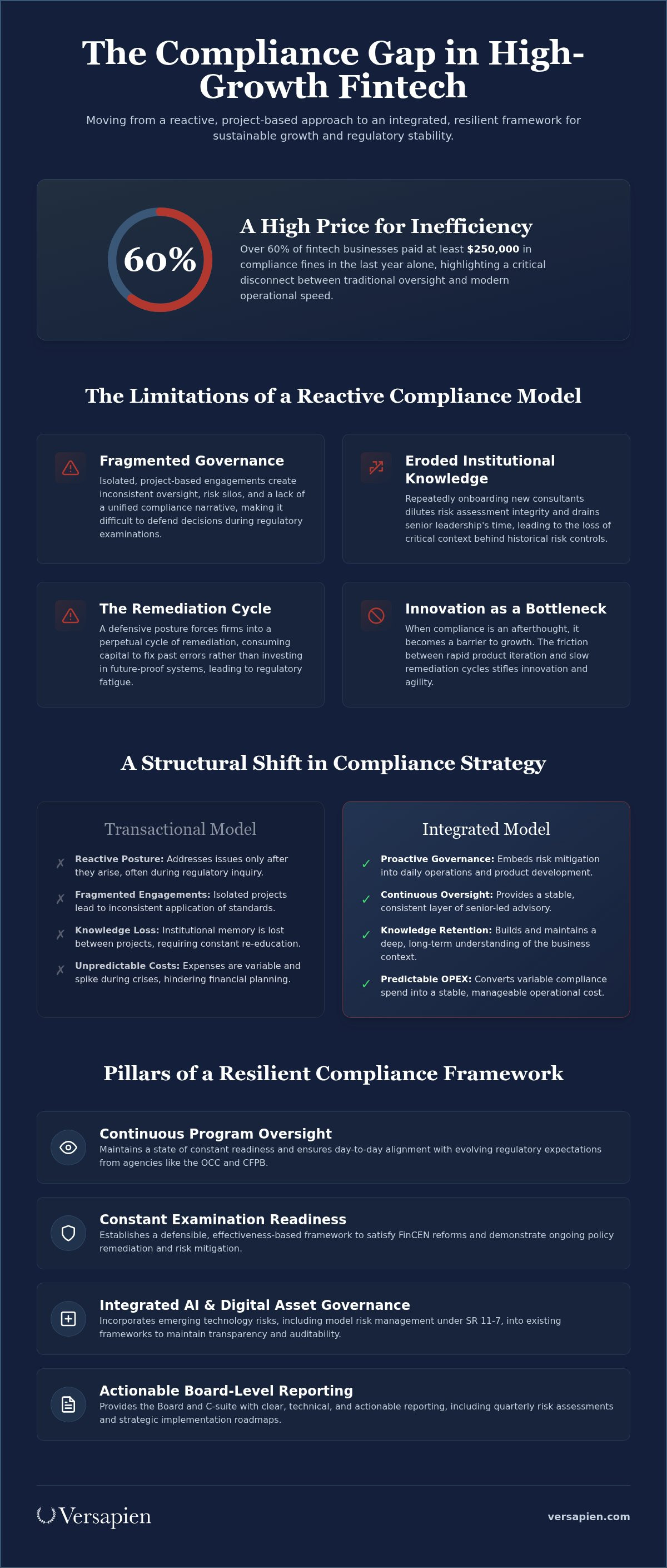
Over 60% of fintech businesses paid at least $250,000 in compliance fines last year, a statistic that underscores the growing gap between traditional oversight and modern operational reality. Regulatory fatigue, fragmented oversight, and talent scarcity now define the compliance landscape, driving an urgent need for more durable fintech compliance retainer services. Most executive leaders understand that relying on transactional consultants leads to a recurring loss of institutional knowledge, yet the difficulty of finding senior talent with both Big Four pedigree and fintech agility remains a persistent hurdle. It's a cycle that leaves institutions vulnerable to the shifting expectations of the OCC and CFPB.
This guide provides a strategic roadmap for optimizing regulatory oversight by building a defensible, effectiveness-based risk framework. By shifting from reactive project work to an integrated advisory model, leadership teams can achieve predictable costs and accelerated time-to-market for new products. We will examine the governance considerations, model risk management requirements under SR 11-7, and the practical implementation steps necessary to satisfy the latest FinCEN effectiveness standards while maintaining the agility required for innovation.
Table of Contents
The Limitations of Reactive Compliance in High-Growth Fintech
Eroded institutional memory, fragmented governance structures, and compounding compliance debt often characterize the regulatory landscape for high-growth firms. When compliance is managed through isolated, project-based engagements, the result is a disconnect between strategic ambition and operational reality. Transactional consulting models prioritize immediate deliverables but often neglect the long-term continuity required to maintain a robust Anti-money laundering (AML) framework. This fragmented approach forces internal teams to spend excessive time re-educating external advisors on product nuances and historical risk appetites.
The friction between rapid product iteration and the slow, heavy cycles of traditional remediation creates a defensive posture. Instead of supporting growth, compliance becomes a bottleneck. By shifting toward fintech compliance retainer services, institutions can align their regulatory strategy with their innovation roadmap. This transition allows for a proactive governance model where risk mitigation happens concurrently with product development, rather than as an afterthought. Modern fintechs operate in an environment where regulatory scrutiny is constant and exam cycles are compressed. A reactive posture leads to a cycle of perpetual remediation, where resources are consumed by fixing past errors rather than building future-proof systems. This systemic inefficiency can be addressed by integrating specialized expertise into the daily fabric of the organization.
The Institutional Knowledge Gap
Repeatedly onboarding new consultants dilutes the integrity of risk assessments. Every new engagement requires a discovery phase that drains senior leadership's bandwidth and risks overlooking subtle, cumulative vulnerabilities. A consistent advisory partner ensures a coherent regulatory narrative, preventing the project silos that lead to inconsistent applications of consumer protection standards or UDAAP considerations. Without this continuity, the institutional "why" behind specific risk controls is lost, making it difficult to defend legacy decisions during intensive regulatory examinations.
Regulatory Fatigue and the Remediation Cycle
Relying on reactive responses to OCC or CFPB inquiries is an inefficient use of capital. The shift toward "effectiveness-based" standards, as highlighted by recent FinCEN reforms, demands a baseline of continuous readiness. "Check-the-box" compliance is no longer a defensible strategy. Firms must demonstrate ongoing technical oversight and policy remediation to mitigate reputational exposure and maintain market trust. Establishing this baseline reduces the operational shock of rapid-fire exam cycles and allows the board to focus on strategic growth rather than crisis management.
Structural Components of an Advisory Retainer Model
Stability, foresight, and integration define the architecture of a resilient compliance program. An advisory retainer model replaces the fragmented nature of project-based work with a structured governance layer, aligning regulatory obligations with business objectives. By converting variable, often unpredictable, compliance costs into a stable operational expenditure, executive leadership can achieve the fiscal clarity required for long-term strategic planning. This structural shift ensures that senior-level guidance is available not just during a crisis, but as a continuous presence that informs daily decision-making. Unlike transactional engagements, fintech compliance retainer services provide a dedicated advisory capacity that maintains a state of constant readiness for regulatory inquiries.
Defining the scope of such an arrangement requires a balanced approach. It must encompass both the rigorous oversight of existing programs and the flexibility to provide ad-hoc strategic advisory as new market opportunities arise. Clear deliverables, including quarterly risk assessments and updated implementation roadmaps, serve as the tangible evidence of program health. These outputs provide the Board of Directors with the technical assurance they require while offering the C-suite a practical framework for resource allocation. Optimizing these pillars requires a regulatory compliance advisory partner who understands the intersection of technical controls and executive strategy.
Retainer vs. Project-Based Consulting
Project-based consulting often focuses on a narrow set of objectives, leaving gaps in accountability once the engagement concludes. A retainer model, conversely, fosters a deeper level of integration and accountability. Reserved capacity ensures that response times are minimized during high-priority regulatory changes, such as new rulemaking from the CFPB. This model also alleviates the burden on internal teams, allowing them to focus on core operational tasks while benefiting from the professional development that comes from working alongside seasoned experts with Big Four pedigree. The ROI is realized through the prevention of remediation spikes and the preservation of institutional knowledge.
Core Pillars of Ongoing Support
Continuous monitoring of BSA/AML program health remains the primary pillar of the retainer. The 2024 National Money Laundering Risk Assessment serves as a critical benchmark for these ongoing evaluations, ensuring that risk frameworks remain aligned with the latest federal findings. Beyond financial crime, the retainer must address the evolving landscape of consumer protection. Regular updates to compliance management systems in response to UDAAP developments ensure that consumer harm is mitigated proactively. Additionally, robust third-party risk management and vendor oversight frameworks are essential, particularly for firms operating in the Banking-as-a-Service (BaaS) ecosystem, where the OCC increasingly demands granular visibility into partner activities.
Bridging Traditional Compliance with Emerging AI and Digital Asset Risks
The July 18, 2026, rulemaking deadline for the GENIUS Act has shifted the focus of executive leadership from theoretical adoption to rigorous, federal-level oversight. This regulatory milestone requires firms to demonstrate not only financial backing but also the technical integrity of the underlying systems. Traditional compliance frameworks often struggle with this convergence, treating emerging technologies like AI and digital assets as isolated technical challenges rather than core components of a defensible risk posture. Integrating these domains into fintech compliance retainer services allows for a unified governance approach that satisfies both technical and strategic requirements.
Effective oversight now requires aligning emerging technology with established standards like SR 11-7 model risk management. Whether an institution is deploying AI-driven credit scoring or managing digital asset custody, the expectations for transparency and auditability remain consistent. A fragmented approach, where one firm manages BSA/AML while another handles AI governance, creates blind spots that regulators like the OCC and CFPB are increasingly adept at identifying. Consolidating these responsibilities under a single advisory umbrella ensures that the "why" behind a control isn't lost between technical silos.
Responsible AI Governance
Deploying AI in financial services introduces unique challenges regarding transparency and fair lending. Establishing human-in-the-loop controls isn't just a best practice; it's a fundamental requirement for mitigating UDAAP risks in automated decisioning models. Regular AI risk assessments must be integrated into the broader compliance lifecycle to ensure that model outputs remain explainable to examiners. This proactive stance ensures that as regulatory guidance evolves, the institution's model governance protocols already satisfy the necessary transparency requirements.
Digital Asset and BaaS Oversight
The complexity of AML and sanctions governance for cryptocurrency entities demands a specialized understanding of on-chain analytics and decentralized protocols. Similarly, Banking-as-a-Service (BaaS) partnerships—such as those facilitated by infrastructure layers like Gemba—require robust third-party risk frameworks that provide granular visibility into the partner's operations. Monitoring these emerging technology risks is critical for preventing operational failures that could lead to significant reputational damage. By maintaining a continuous oversight model, firms can meet the Digital Asset Banking Act of 2026 requirements for quarterly audits and full reserves without disrupting their growth trajectory.
Operationalizing the Retainer: From Exam Readiness to Board Reporting
Financial institutions in the US now spend 32% of their operations budgets on client lifecycle management, yet many struggle to translate this expenditure into a defensible regulatory posture. Effective operationalization requires moving beyond the static documentation of a one-time audit toward a model of continuous evaluation. By utilizing fintech compliance retainer services, firms can ensure that their internal controls are not just designed correctly but are operating effectively in real-time. This ongoing technical oversight allows the advisor to act as a strategic navigator, guiding the firm through the complexities of model risk management under SR 11-7 and the evolving expectations of the CFPB regarding UDAAP.
Translating technical risk findings into strategic recommendations is a critical function of the modern compliance advisor. High-level advice often fails to provide the board with the clarity needed for capital allocation or product expansion decisions. A structured retainer provides the framework to develop actionable roadmaps that move beyond theoretical risk to measurable business outcomes. This approach ensures that governance remains an enabler of innovation, providing the necessary guardrails for growth without the friction of reactive remediation cycles. To achieve this level of operational maturity, leadership must partner with a regulatory compliance advisory firm that understands the nuances of executive-level reporting.
Examination Readiness and Remediation
Establishing rigorous documentation and controls well in advance of a regulatory site visit remains a fundamental requirement for ensuring a streamlined examination process. A retainer model allows for the continuous refinement of the compliance manual and testing protocols, reducing the operational shock of an OCC or CFPB inquiry. When findings from previous exams exist, senior-led remediation plans provide the technical rigor required to satisfy regulatory mandates. This ongoing dialogue with regulatory bodies, supported by informed advisory insights, demonstrates a level of institutional maturity that transactional consultants cannot provide. It shifts the relationship with the regulator from one of defense to one of professional transparency.
Strategic Board and Executive Reporting
Boards of Directors require concise, evidence-based reports that highlight systemic risks rather than granular technical failures. Effective reporting provides an objective perspective on the firm’s compliance maturity, benchmarking internal progress against industry standards and peer performance. By leveraging the technical depth of the retainer, executive leadership can present a unified narrative that aligns risk mitigation with the firm's broader digital transformation goals. This clarity is essential for maintaining model governance protocols that satisfy both internal audit requirements and external regulatory expectations, ensuring that strategic vision is never compromised by unforeseen compliance gaps. To support your broader digital strategy, you can check out Big Drop Inc to see how a strategic web design partner can help your platform meet the demands of the future.
Strategic Continuity with Versapien Advisory Services
Strategic continuity, institutional memory, and technical rigor form the foundation of a defensible risk posture. In an environment where regulatory expectations shift with the speed of technological innovation, the traditional reliance on fragmented, project-based consulting often fails to provide the necessary stability. This fragmentation leads to a recurring loss of context, forcing internal teams to spend valuable cycles re-educating external advisors rather than advancing their compliance maturity. By adopting a model centered on fintech compliance retainer services, institutions can secure the dedicated senior-level attention required to navigate complex digital transformations without sacrificing regulatory integrity.
The Versapien approach identifies these systemic inefficiencies and offers a direct, senior-led remedy. By combining the technical pedigree of the Big Four with the agility and focus of a boutique advisory firm, we provide executive leadership with a steadying force in a high-stakes environment. Our model integrates AI governance, financial crime compliance, and consumer protection under a unified framework, ensuring that strategic decisions are informed by a holistic view of the firm's risk profile. This commitment to practical, implementation-focused roadmaps reduces regulatory exposure while supporting the accelerated time-to-market that growth-stage firms require.
A Partnership Built on Expertise
Accessing advisors with decades of experience at the intersection of finance and technology is no longer a luxury but a strategic necessity. Every engagement at Versapien is led by a senior practitioner who has navigated the intricacies of the OCC, CFPB, and federal examiners. Our team provides specialized oversight in areas ranging from BSA/AML program health to the human-in-the-loop controls required for responsible AI deployment. This level of technical depth ensures that governance remains a durable asset rather than a temporary fix, providing the board with the technical assurance needed for long-term health.
Next Steps for Executive Leadership
To move beyond reactive remediation and toward a state of continuous readiness, leadership teams should consider the following actionable steps:
Conduct a gap analysis of current compliance oversight to identify where institutional knowledge is being lost through transactional consulting engagements.
Evaluate the fiscal impact of variable compliance costs against the stability and predictability of a retainer-based expenditure model.
Identify the core risk pillars, such as AI model governance or digital asset custody, that require continuous senior-level monitoring to satisfy SR 11-7 or UDAAP requirements.
Assess the firm's current board reporting structures to ensure they provide technical evidence of effectiveness rather than just process-based design.
Engage with Versapien to develop a tailored advisory roadmap that aligns your regulatory strategy with your long-term innovation goals.
Building a defensible framework is a deliberate process that requires foresight and a commitment to structural integrity. By prioritizing strategic continuity through an integrated advisory model, executive leadership can transform compliance from a defensive necessity into a proactive enabler of sustainable growth.
Securing Long-Term Regulatory Resilience
The shift toward effectiveness-based regulation demands a departure from the fragmented nature of project-based consulting. Successful executive leadership depends on the ability to maintain strategic continuity while integrating emerging risks from AI and digital assets into a unified governance framework. By prioritizing institutional memory and technical rigor, firms can move beyond the cycle of reactive remediation and establish a state of continuous examination readiness. This transition doesn't just reduce regulatory exposure; it ensures that compliance serves as a stable foundation for innovation.
Utilizing senior-led fintech compliance retainer services provides the stability required for this level of maturity. Versapien offers a partnership rooted in Big Four pedigree and specialized expertise in both traditional financial crime and modern AI governance. Our implementation-focused roadmaps are designed to deliver measurable business outcomes and clear board-level reporting. Explore strategic compliance retainer services with Versapien to align your regulatory oversight with your long-term growth objectives. Establishing a defensible framework is the first step toward sustainable success in an increasingly complex landscape.


Comments