
Managing AI Vendor Risk: Questions Every Financial Institution Should Ask
Updated: Sep 22
Table of Contents
The Evolution of Third-Party Ecosystems in Modern Financial Services
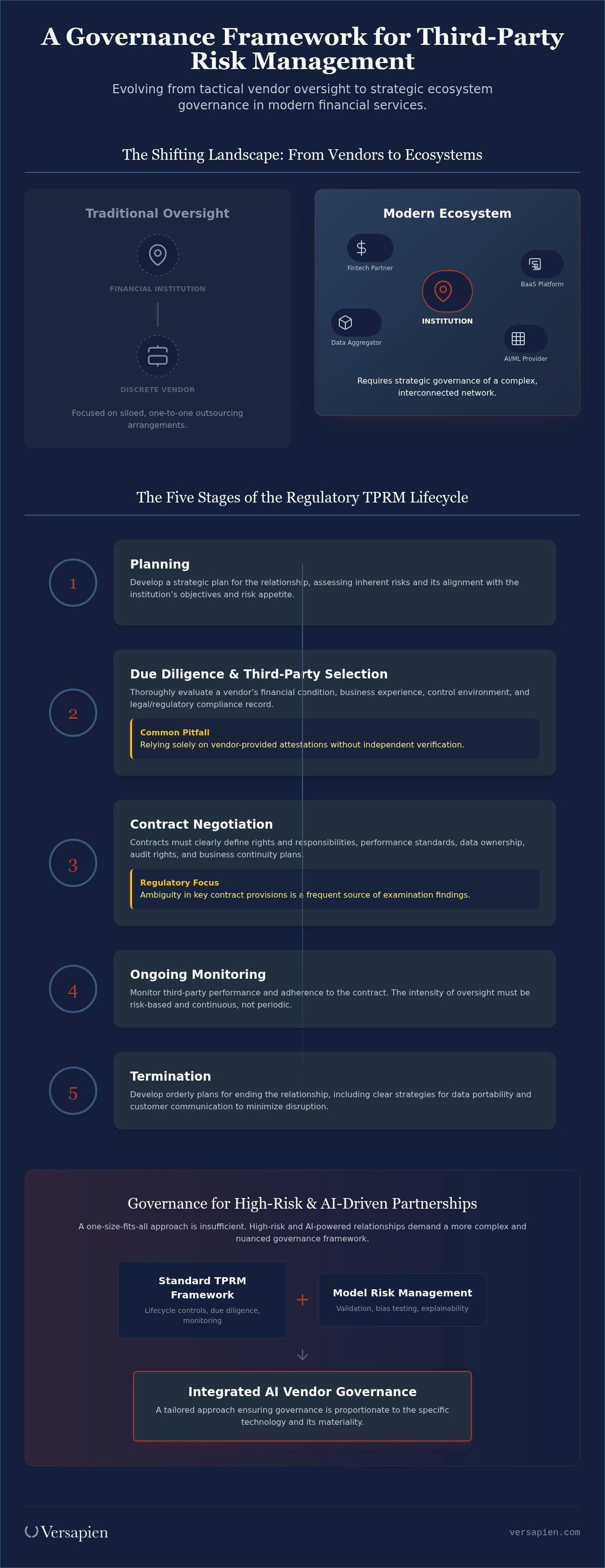
The traditional model of third-party risk management, once focused on discrete outsourcing arrangements, is inadequate for the modern financial services ecosystem. Institutions now operate within a complex network of fintech partnerships, data aggregators, and Banking-as-a-Service (BaaS) platforms. This shift has moved vendor oversight from a tactical procurement function to a strategic, enterprise-wide governance imperative. For regional and community banks in particular, fragmented oversight of these relationships creates systemic challenges, heightening regulatory focus on the substance and effectiveness of their governance programs.
The expansion of these interconnected ecosystems means that operational, compliance, and reputational risks are no longer siloed. A failure at a single third party can trigger cascading events, creating significant operational disruptions or raising fair lending and consumer protection issues. Consequently, regulatory expectations have moved beyond periodic, point-in-time assessments toward a model of ongoing monitoring, where the intensity and frequency of oversight are aligned with the criticality of the third-party relationship.
The Interconnectedness of Operational and Reputational Risk
In a highly integrated environment, the line between a third party's operational failure and the financial institution's reputational damage is exceptionally thin. A data breach at a cloud service provider, a service outage at a payment processor, or the discovery of embedded bias in a vendor's underwriting algorithm can have immediate and severe consequences. Effective third-party risk management requires institutions to map these dependencies and understand how a single point of failure could impact business continuity, customer trust, and regulatory standing.
Aligning TPRM Programs with Interagency Regulatory Expectations
The 2023 Interagency Guidance on Third-Party Relationships (including OCC 2023-17 and FDIC FIL-29-2023) reinforces the principle that a financial institution’s board and senior management are ultimately responsible for risks arising from all third-party relationships. This responsibility is non-delegable and extends through the entire lifecycle of the relationship, from initial planning and due diligence to contract negotiation, ongoing monitoring, and eventual termination. Demonstrating a robust and well-documented program is a central component of examination readiness. This includes maintaining clear records of due diligence, risk assessments, contract provisions, and performance monitoring.
A critical challenge in modern vendor oversight is the integration of specialized risk types, such as model risk, into the broader third-party risk management framework. When a vendor provides a service that uses artificial intelligence or other complex quantitative tools, institutions should begin with a disciplined, risk-based assessment to determine the appropriate governance path. The initial question is not which regulation applies, but whether the vendor’s capability meets the institution’s own definition of a "model." Where the capability meets the institution's applicable definition of a model, appropriate model risk management practices should be integrated with third-party oversight and tailored to the model's risk.
Where a third-party capability meets the institution's applicable definition of a model, model risk should be managed through the institution's model risk management framework, informed by the risk-based principles outlined in SR 26-2 and tailored to the model's purpose, use, materiality, and potential impact
The Five Stages of the Regulatory TPRM Lifecycle
A sound third-party risk management program follows a structured, continuous lifecycle. Each stage requires distinct controls and documentation to withstand regulatory scrutiny.
Planning: This initial phase involves developing a strategic plan for the third-party relationship, assessing its inherent risks, and understanding how it aligns with the institution’s overall objectives and risk appetite.
Due Diligence and Third-Party Selection: This stage requires a thorough evaluation of a potential vendor’s financial condition, business experience, control environment, and legal and regulatory compliance record. A common pitfall is relying solely on vendor-provided attestations without independent verification.
Contract Negotiation: Contracts must clearly define the rights and responsibilities of each party, including performance standards, data ownership, audit rights, default provisions, and business continuity planning. Ambiguity in these areas is a frequent source of regulatory findings.
Ongoing Monitoring: The institution must monitor the third party’s performance and adherence to the contract. The nature and frequency of this monitoring should be risk-based, with more critical vendors subject to more intensive oversight. This involves tracking key performance indicators, reviewing control attestations, and assessing any changes in the vendor’s risk profile.
Termination: The final stage involves developing orderly plans for terminating the relationship, including transitioning the service to another provider or bringing it in-house. This requires clear strategies for data portability and customer communication to minimize disruption.
Institutions preparing for regulatory reviews should ensure their documentation at each stage is robust and readily accessible. For a deeper look at common compliance gaps, leaders can review practical steps for improving examination readiness.
A Governance Framework for High-Risk and AI-Driven Partnerships
As financial institutions increasingly rely on third parties for critical operations and AI-driven solutions, a one-size-fits-all approach to oversight is insufficient. A structured governance framework is necessary to differentiate risk levels and apply proportionate controls. The first step is to categorize vendors based on their operational impact and regulatory sensitivity. This allows the institution to focus its most intensive oversight resources on the relationships that pose the greatest potential risk.
When these high-risk relationships involve AI, the governance challenge becomes more complex. The institution must move beyond standard due diligence to assess the vendor's capacity for responsible AI development and deployment. This requires a nuanced approach that integrates principles of model risk management with traditional third-party oversight, ensuring that governance is tailored to the specific technology and its intended use.
The Third-Party Criticality Matrix
A Third-Party Criticality Matrix provides a structured framework for classifying vendors and tailoring oversight activities. This tool helps institutions move from a static inventory to a dynamic, risk-based system. The matrix maps vendors against two primary axes: operational impact and regulatory/compliance sensitivity.
Critical: Vendors whose failure would cause significant disruption to the institution’s business operations, impact a large number of customers, or result in a material financial loss. These relationships require the most comprehensive due diligence and intensive ongoing monitoring.
Significant: Vendors that support important business activities but whose failure would not cause a material disruption. These relationships require robust oversight, but the intensity may be less than that for critical vendors.
Low: Vendors providing services that have a minimal impact on operations or customers. Oversight for these relationships can be streamlined and less resource-intensive.
By placing each vendor on this matrix, management can define appropriate monitoring frequencies, testing requirements, and reporting protocols for each tier.
Applying Proportionate Governance to AI Vendors
For third parties providing AI capabilities, effective governance begins with a fundamental classification question: does the system meet the institution’s definition of a "model"? The answer dictates the specific oversight framework to be applied.
First, the institution must determine if the AI system uses complex quantitative methods based on statistical, economic, or financial theory to process data into quantitative estimates. If it does, it likely falls within the scope of the institution's model risk management program. However, many AI-powered tools, including those based on deterministic rules or certain generative AI applications, may not meet this definition. For a deeper analysis of AI governance, see our related article on how AI is transforming BSA/AML compliance.
If the system is classified as a model, the institution must apply its model risk management practices. This does not mean that vendor models must be treated identically to internally developed ones. While the institution remains fully responsible for the associated risks, the validation approach can be tailored. Effective challenge may focus on the vendor’s development and validation processes, testing of model outputs, and analysis of model limitations, rather than a line-by-line code review. The intensity of validation and ongoing monitoring should be proportionate to the model's purpose, materiality, and potential impact.
If the AI system is not classified as a model, it may still require oversight through other established risk management frameworks. The nature and intensity of that oversight should reflect the system's use, potential impact, and associated risks and should be governed through other established risk management frameworks. These include technology and cybersecurity risk assessments, data privacy and governance reviews, operational resilience planning, and consumer compliance evaluations to address risks like unfair or deceptive practices. In high-risk use cases, such as automated decisioning in lending, implementing appropriate human oversight as a control remains a sound practice to mitigate potential harm.
Strengthening Board Oversight and Strategic Remediation
The Board of Directors holds ultimate accountability for the effectiveness of an institution's third-party risk management program. Its role is not to manage individual vendor relationships but to provide strategic direction and credible challenge. This includes approving the enterprise-wide third-party risk management policy and setting a clear risk appetite that defines the level and types of risk the institution is willing to accept in pursuit of its objectives. Board-level reporting should therefore move beyond tactical vendor scorecards to provide strategic insights into aggregate risk exposures.
Effective reporting emphasizes residual risk levels, highlights concentrations in critical service areas or with specific third parties, and tracks the progress of remediation efforts for any identified control weaknesses. Independent audit and testing play a crucial role in validating the program's effectiveness and providing the board with objective assurance. When regulatory examinations identify deficiencies, the board is responsible for overseeing management’s response and ensuring that corrective actions are timely, sustainable, and fully address the root cause of the findings.
Next Steps for Senior Risk and Compliance Leaders
To ensure their programs are aligned with current expectations, senior leaders should initiate a comprehensive gap analysis of existing third-party risk management policies and procedures against the interagency guidance. This process helps identify areas for enhancement and forms the basis for a prioritized remediation roadmap, focusing first on high-risk vendor relationships and any significant concentrations. Integrating a clear AI governance protocol into the existing enterprise risk framework is critical for managing the next generation of third-party risks.
Strategic Considerations
As boards and senior management refine their oversight of third-party relationships, they should consider the following questions:
How does our current third-party risk classification system account for the unique operational, compliance, and reputational risks introduced by AI and automated decisioning vendors?
What is our documented process for determining whether a third-party AI system qualifies as a "model" under our internal governance framework, and who is responsible for making that determination?
For vendor-provided AI tools that are not classified as models, how do we demonstrate and document sufficient oversight through our operational, technology, consumer compliance, and cybersecurity risk programs?
For vendor tools that are classified as models, are our validation, testing, and ongoing monitoring activities appropriately scaled to the model’s materiality, complexity, and potential consumer impact?
Does our board-level reporting provide a clear and aggregated view of third-party risk, particularly concentrations in AI-driven services that support critical business functions?


Comments