
Model Risk Management in the Age of Artificial Intelligence
The traditional boundaries of model risk management are currently being tested by the non-linear nature of artificial intelligence. When institutions apply static validation protocols to dynamic, black-box models, they often face a choice between slowing innovation or accepting unquantified risks. This tension is particularly evident as the Federal Reserve and the OCC increase their scrutiny of AI explainability and algorithmic bias. Most executive leaders recognize that existing frameworks, while robust for traditional credit scoring, often lack the agility required for the rapid iteration of machine learning systems.
Strategic clarity, operational efficiency, and regulatory precision represent the necessary pillars for a modern oversight regime. It's clear that the objective is not to bypass oversight but to modernize it so that governance becomes a facilitator of growth. This analysis provides a roadmap for evolving your framework to handle AI complexity without sacrificing the rigor demanded by the FDIC or SR 11-7 guidelines. We will examine how to reduce time-to-market for AI-driven products by aligning technical innovation with a structured, continuous monitoring lifecycle and optimizing specialized validation talent.
Table of Contents
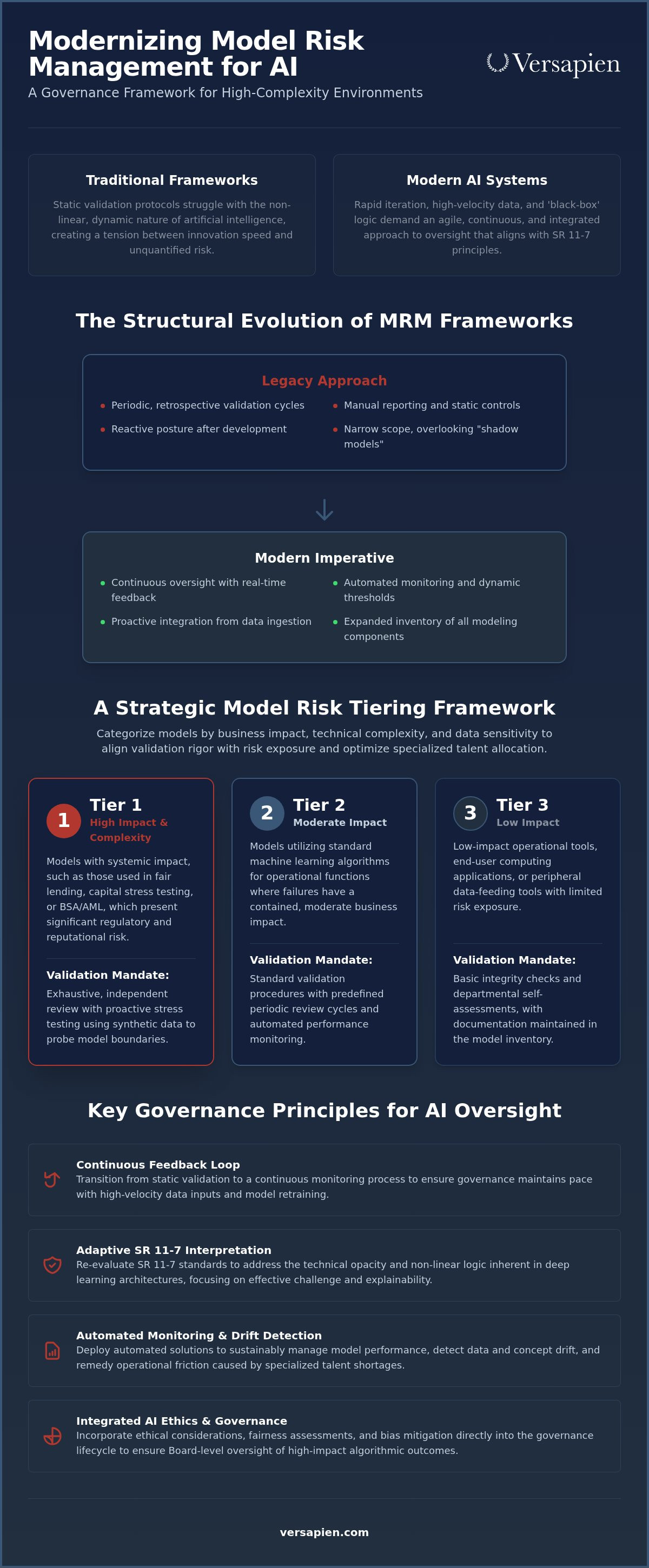
The Structural Evolution of Model Risk Management Frameworks
Static controls, manual reporting, and retrospective analysis define the legacy architecture that many institutions still rely upon. While these systems functioned during the era of traditional regression models, they struggle to contain the risks inherent in high-velocity AI environments. Modern model risk management requires a shift from linear, discrete validation events to a perpetual lifecycle of oversight. This evolution forces a re-evaluation of risk appetite statements, as increased model complexity often introduces hidden dependencies that traditional sensitivity analyses fail to capture. The reactive posture of the past, where validation occurred after significant development, is being replaced by a proactive integration of governance from the point of data ingestion.
Shifting from Periodic Validation to Continuous Oversight
The inefficiency of an annual validation cycle becomes evident when a model retrains on new data weekly or even daily. When the underlying data distribution shifts, a static validation report from six months ago offers little protection against model decay or algorithmic drift. Institutions are now adopting dynamic threshold setting within their risk management frameworks. This approach allows for real-time alerts when performance metrics deviate from established baselines. It ensures that oversight remains relevant to the model's current state rather than its historical performance at the time of launch.
The Expanding Scope of the Model Inventory
Governance gaps often emerge when end-user computing tools or simple spreadsheets are used to feed data into sophisticated AI architectures. These "shadow models" often bypass formal IT governance because they don't meet the historical definition of a high-impact model. However, if an unvalidated spreadsheet provides the primary input for a deep learning model, the entire output is compromised. Leading organizations are expanding their inventories to include these peripheral tools. This comprehensive view ensures that the integrity of the total modeling environment is maintained and that no component of the decision-making chain remains outside the view of the Chief Risk Officer.
Interpreting SR 11-7 Standards for Complex AI Environments
SR 11-7 remains the foundational standard for model risk management, yet its 2011 origins didn't anticipate the inherent opacity of modern neural networks. The core pillars of development, validation, and governance must now be reinterpreted for systems where feature engineering is automated and logic is non-linear. Traditional conceptual soundness depends on human-defined logic; however, deep learning models derive their own internal representations that are often difficult to audit. This shift creates a transparency gap that regulators at the Federal Reserve and OCC expect institutions to close through rigorous documentation and proxy modeling. Aligning these advanced architectures with regulatory expectations often requires comprehensive risk management consulting to bridge the gap between technical capability and supervisory standards.
The Model Risk Tiering Matrix
Strategic oversight, technical rigor, and regulatory alignment provide the foundation for a modern tiering system. A 3x3 risk assessment matrix provides a structured remedy for the operational friction caused by manual review processes. By plotting models across three distinct axes, business impact, technical complexity, and data sensitivity, institutions can determine the appropriate depth of validation. This framework typically categorizes models into structured tiers:
Tier 1: High-impact, high-complexity models, such as those used in fair lending or capital stress testing, demand exhaustive, independent review.
Tier 2: Moderate-impact models utilizing standard machine learning algorithms with predefined periodic validation cycles.
Tier 3: Low-impact operational tools or end-user computing applications subject to basic integrity checks and departmental self-assessments.
This tiered approach ensures that specialized talent is focused on systemic vulnerabilities rather than routine updates, optimizing resource allocation across the enterprise.
Effective Challenge in the Age of AI
An effective challenge now requires validators to look beyond code to the underlying data manifold. When logic is non-linear, traditional sensitivity testing is insufficient to capture potential model failures. Validators increasingly utilize synthetic data to probe model boundaries and identify edge case failures that historical datasets might miss. This proactive stress testing ensures that models remain resilient under volatile market conditions and meet the requirement for effective challenge set forth by the FDIC. If your institution is struggling to define these new validation parameters, you might consider discussing your governance framework with a strategic advisor.
Advancements in Automated Model Validation and Monitoring
Specialized talent, operational speed, and regulatory rigor represent the three primary pressures currently facing validation teams. The persistent shortage of qualified quantitative analysts has necessitated a shift toward automated compliance within financial services. Integrating automated drift detection directly into the model risk management dashboard allows for immediate intervention when a model deviates from its established performance baseline. Robotic process automation now handles the administrative burden of model inventory updates; this ensures that the Chief Risk Officer maintains a real-time view of the institution's total exposure. These automated validation reports provide a defensible audit trail that satisfies the Federal Reserve's expectations for ongoing monitoring and exam readiness.
Continuous Monitoring of Model Performance and Bias
Performance degradation often occurs silently as market conditions evolve. Real-time alerts function as an early warning system; they prevent the continued use of stale models that could lead to unquantified financial loss. Automated fairness testing is equally critical for preventing UDAAP violations. By scanning for disparate impact in real-time, these systems ensure that algorithmic decisions remain within the bounds of fair lending regulations, protecting the institution from both legal and reputational risk.
The Interplay of Data Quality and Model Integrity
Conceptual soundness is fundamentally tied to the integrity of the underlying data. Automated data lineage provides a clear map of how information flows from the source to the model, which strengthens the auditability of the entire system. Common failure points in automated data pipelines, such as unexpected schema changes or data latency, represent a significant source of model risk. Monitoring these pipelines ensures that the integrity of the inputs is verified before they ever affect the model's final output.
Integrating Responsible AI Governance into the MRM Lifecycle
Ethical considerations, algorithmic bias, and regulatory alignment constitute the new frontier of model risk management. Historically, ethics was treated as a qualitative overlay rather than a quantitative risk factor. However, as institutions deploy high-impact models for credit underwriting and fraud detection, the Board Risk Committee must take a more active role in overseeing the ethical implications of automated decisions. A failure in algorithmic fairness is no longer just a reputational issue; it is a direct violation of UDAAP and fair lending standards. We've seen how AI is transforming BSA/AML compliance, where the implementation of complex neural networks for transaction monitoring creates unique governance challenges. That case illustrates that without a robust framework, the efficiency gains of AI are quickly offset by regulatory scrutiny.
The AI Governance Checklist
Assessing the maturity of your oversight regime involves a methodical review of current operational controls. The following five-point checklist provides a baseline for evaluating AI governance:
Define specific human-in-the-loop requirements for high-risk algorithmic outputs to maintain decision integrity.
Perform comprehensive ethical impact assessments during the initial design phase to identify potential bias.
Establish quantitative metrics for fairness that align with CFPB and fair lending standards.
Validate third-party AI components for transparency and verify data lineage through the model lifecycle.
Verify training data integrity to prevent the propagation of historical biases into live environments.
Strategic Takeaways for Executive Leadership
The transition from compliance as a cost to governance as a differentiator requires a fundamental shift in executive perspective. Governance shouldn't be viewed as a hindrance to innovation but as the structural foundation that makes it possible. By fostering a proactive model risk management culture, senior leaders can reduce the time-to-market for AI-driven products while ensuring they remain within the bounds of safety and soundness. Versapien provides the strategic advisory necessary to navigate these regulatory complexities, helping institutions align their technical ambitions with board-level risk expectations. To advance your current framework, consider conducting a targeted review of your existing SR 11-7 protocols to identify AI-specific gaps and scheduling a briefing for your risk committee on emerging regulatory trends.
Strengthening the Pillars of AI Governance
Modernizing model risk management requires a transition from manual, periodic validation to automated, continuous oversight. This evolution ensures that institutions maintain pace with the rapid retraining cycles of deep learning architectures while satisfying the core requirements of SR 11-7. By integrating ethical impact assessments and real-time drift detection, organizations transform governance from a bottleneck into a strategic advantage. This proactive stance reduces time-to-market for AI-driven products and provides a defensible framework for regulatory scrutiny from the OCC and Federal Reserve.
Versapien assists institutions in navigating these technical and regulatory shifts with a focus on practical, regulator-ready implementation. Our advisory team, led by former Big-Four Directors with specialized certification in AI in Finance, provides the technical depth and strategic foresight needed to move through this complex landscape successfully.
Establishing a disciplined approach to AI oversight today secures the operational integrity of your institution for years to come.
Regulatory and Operational Inquiries
Addressing Technical Opacity in Supervisory Exams
Regulators from the OCC and Federal Reserve increasingly expect a granular explanation of model behavior even when using non-linear architectures. Documentation should focus on the relationship between inputs and outputs through local interpretable model-agnostic explanations or Shapley values. This provides the conceptual soundness required by SR 11-7 while acknowledging the technical complexity of deep learning. Providing these proxies for logic allows examiners to verify that the model's decision-making process aligns with the institution's stated risk appetite and economic reality.
Distinguishing Continuous Monitoring from Independent Validation
A common point of operational friction involves the overlap between real-time monitoring and independent validation. Monitoring serves as a primary control by identifying immediate performance decay or data drift. Independent validation remains a periodic, deep-dive assessment that challenges the model's fundamental assumptions and design. Maintaining a clear separation between these functions ensures that the second line remains truly independent as required by supervisory guidance. This distinction prevents the validation cycle from becoming a mere extension of routine operational checks.
Managing Third-Party and Open-Source AI Vulnerabilities
The integration of pre-trained third-party models introduces unique risks that traditional vendor management frameworks often miss. Institutions must verify that external models align with internal risk appetite and fair lending standards before deployment. This requires a specialized due diligence process that probes the vendor's training data and bias mitigation strategies to ensure the final output remains defensible. Without this level of scrutiny, an institution may inadvertently inherit the biases or technical flaws of an external developer, leading to unforeseen regulatory complications.


Comments