
Modernizing Compliance Management Systems for Consumer Lending
Financial institutions often treat the regulatory examination cycle as a disruptive hurdle to be cleared rather than a strategic diagnostic for institutional health. This reactive posture leads to a cycle of expensive remediation and persistent friction between innovation teams and oversight functions. Many organizations struggle with the weight of overlapping federal and state mandates that complicate even the most standard product updates. It's common to feel that the burden of consumer lending compliance serves as a primary inhibitor to digital transformation. Effective governance requires structural clarity, technical precision, and executive accountability to move beyond these systemic inefficiencies.
To achieve this structural clarity and navigate the complexities of evolving regulatory cycles, you can check out Engage Financial Solutions for expert consultancy and strategic support in modernizing your financial oversight.
This article provides a framework for modernizing your compliance management system to ensure it supports long-term growth. You'll learn how to pivot from a defensive stance to a proactive model that integrates regulatory requirements directly into the product lifecycle. We'll examine the specific governance structures, risk assessment methodologies, and oversight protocols necessary to satisfy the OCC and CFPB while maintaining a competitive pace in a digital-first lending environment.
Table of Contents
Understanding the Strategic Foundations of Consumer Lending Compliance
Precision, integration, and foresight define the modern approach to institutional oversight. When consumer lending compliance is treated as a fragmented collection of rules, it inevitably becomes a bottleneck for innovation. This disjointed perspective creates gaps in coverage, increases operational risk, and slows the deployment of new credit products. A mature governance framework views compliance as an integrated system that aligns regulatory expectations with executive strategy. By shifting from reactive monitoring to proactive, data-driven oversight, leaders can transform a traditional cost center into a mechanism for sustainable growth.
The supervisory environment for 2026 reflects a heightened focus on algorithmic fairness, fee transparency, and data privacy. The CFPB, OCC, and FDIC have indicated they'll prioritize examinations that scrutinize how automation impacts consumer outcomes. This shift requires organizations to move beyond periodic sampling toward continuous monitoring of lending portfolios. The consequences of failure extend past simple fines. Regulatory orders can lead to restricted market expansion, forced divestitures, and lasting damage to brand equity that takes years to rebuild; in such scenarios, leveraging the expertise of Phoenix Design can help an organization restore its identity and reclaim its status as a market leader.
The Core Regulatory Pillars: TILA, MLA, and Beyond
The Truth in Lending Act (Regulation Z) and the Military Lending Act establish the fundamental requirements for credit disclosures and protections. While these federal statutes are the baseline, executive oversight shouldn't stop there. State-level consumer protection laws are becoming increasingly aggressive, often introducing nuances that federal law doesn't address. A sophisticated regulatory compliance advisory strategy ensures that disclosure frameworks remain resilient across all jurisdictions. This prevents the technical errors that frequently serve as the catalyst for broader regulatory investigations.
Identifying the Modern Business Challenge
Rapid digital product cycles often outpace traditional oversight protocols. This creates a persistent friction between innovation teams and compliance departments. The solution is the adoption of "compliance by design," where regulatory requirements are baked into the initial stages of the development lifecycle. By leveraging tailored solutions from API Pilot, institutions can automate these controls within their core software architecture. This strategy reduces the need for expensive, late-stage remediation and ensures that digital lending products are regulator-ready at launch. It's about building a durable architecture that supports growth without compromising on structural integrity.
How to Build a Sustainable Compliance Management System (CMS)
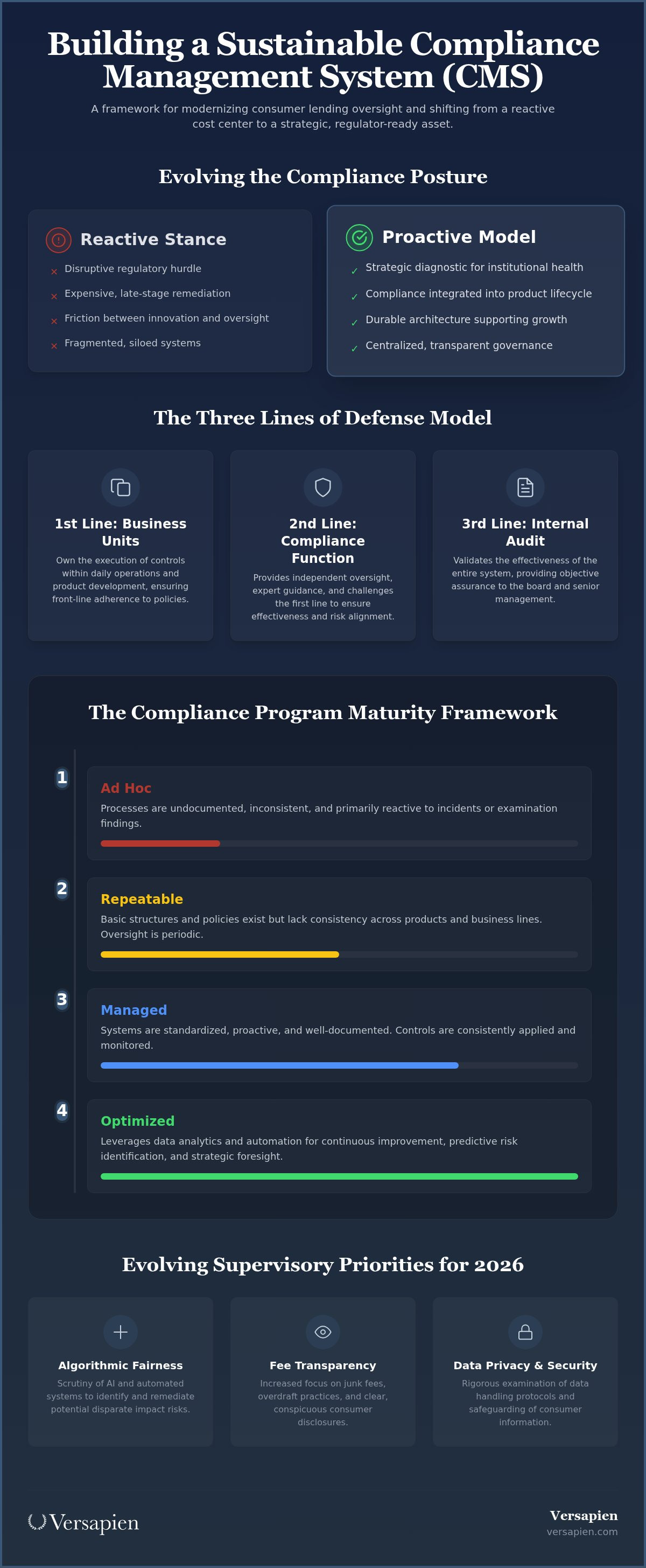
Governance, oversight, and accountability establish the bedrock of a regulator-ready program. Many institutions maintain fragmented systems that fail to communicate across business silos. This lack of integration creates blind spots that examiners from the CFPB or OCC identify during routine reviews. A sustainable framework requires a centralized repository to ensure that policies, training records, and monitoring results remain accessible and consistent. Organizations that consolidate these elements reduce the high cost of remediation and foster a culture of transparency.
The Three Lines of Defense model provides a clear structure for managing consumer lending compliance risks. Business units serve as the first line, owning the execution of controls within daily operations. The compliance function acts as the second line, providing independent oversight and guidance. Finally, internal audit provides the third line by validating the effectiveness of the entire system. This layered approach ensures that no single failure compromises the institution's integrity. A centralized repository is essential for maintaining the integrity of your consumer lending compliance program during rigorous examinations.
In complex internal investigations where verifying information is critical to protecting institutional integrity, professional services can be an invaluable resource; find_out_more about how Morgan Polygraph provides specialized examinations to resolve sensitive corporate matters.
The Versapien Compliance Program Maturity Framework
Organizations typically progress through four stages: Ad Hoc, Repeatable, Managed, and Optimized. At the Ad Hoc level, processes are undocumented and reactive. Repeatable programs have basic structures but lack consistency across products. Managed systems are standardized and proactive, while Optimized programs leverage data for continuous improvement. Assessing your current stage involves reviewing the documentation of your controls and the frequency of your monitoring cycles. You can develop a roadmap for advancement through specialized regulatory compliance advisory services.
Board-Level Reporting and Governance
Executive leadership requires clarity to fulfill its fiduciary duties. Board-level reporting should focus on Key Risk Indicators (KRIs) such as consumer complaint volatility, fair lending disparate impact scores, and UDAAP risk metrics. Rather than presenting raw data, compliance leaders should translate these figures into strategic insights. This allows the Board to understand how compliance performance directly impacts the firm's risk appetite and long-term health. If your current reporting structure lacks this strategic depth, it's often beneficial to consult with a senior advisor to refine your governance protocols.
Operationalizing Fair Lending and UDAAP Oversight
Modern marketing strategies, algorithmic underwriting, and automated servicing workflows introduce new vectors for regulatory risk. When organizations fail to synchronize their consumer lending compliance efforts with these digital operations, they risk significant UDAAP violations. Unfair, deceptive, or abusive acts or practices aren't confined to traditional sales tactics; they often manifest in the subtle architecture of a digital platform. Transitioning from a subjective review process to a rigorous, data-driven oversight model is essential for maintaining institutional integrity.
This level of rigor is vital when institutions facilitate financing for high-end retailers like Aevitas UK that explore Direct Product Sales via E-commerce, as the intersection of luxury goods and digital finance requires impeccable governance.
Disparate impact remains a primary concern for the CFPB and OCC. Statistical analysis should be applied throughout the lending lifecycle to identify unintended bias in credit decisions before they become systemic. Evaluating third-party lending partners requires a similar level of scrutiny to ensure their operations align with your internal standards. A robust evaluation framework includes several critical checks:
Consistency in pricing and underwriting across demographic segments.
Documented evidence of periodic control testing and remediation efforts.
Alignment of the partner’s risk appetite with your corporate governance framework.
Transparency in the data sources used for alternative credit scoring.
When evaluating potential fintech partners, it is essential to ensure their models align with your institutional standards; for example, you can learn more about Zip-Loan and their approach to providing flexible consumer financing and payment plans.
Data-Driven Fair Lending Assessments
Robust data governance serves as the foundation for any defensible fair lending claim. Organizations often encounter regulatory red flags when automated underwriting models utilize proxy variables that inadvertently correlate with protected classes. Identifying these pitfalls requires deep technical oversight and specialized risk management services to validate model integrity. By integrating fair lending reviews into the initial stages of product development, institutions can mitigate risk before it scales.
UDAAP Prevention in Digital Channels
User interface design can trigger UDAAP scrutiny if it employs "dark patterns" that obscure material terms or manipulate consumer behavior. Transparency in digital disclosures and fee structures is a strategic necessity for building long-term trust and avoiding regulatory intervention. To see how these principles of clarity are applied in other financial sectors, you can learn more about LyrxPay’s transparent merchant services and lower-fee processing. Regulators increasingly focus on whether the digital experience provides a clear, unambiguous path for the consumer to understand the total cost of credit. Maintaining this clarity requires constant monitoring of digital workflows to ensure that speed doesn't compromise consumer protection.
Aligning Compliance with Digital Transformation and AI
Speed, scale, and complexity characterize the current digital shift in financial services. While AI and machine learning models offer significant operational efficiencies, they also introduce unique risks that traditional oversight frameworks aren't always equipped to manage. Aligning these technologies with consumer lending compliance requirements requires a rigorous adherence to model risk management standards, specifically those outlined in SR 11-7. Automated compliance monitoring facilitates a level of transparency and real-time oversight that manual sampling can't achieve, allowing institutions to identify and remediate anomalies before they escalate into systemic failures.
In the automotive lending sector, specialized cloud-based platforms like Verifacto provide the integrated Loan Management (LMS) and Dealer Management (DMS) systems necessary to maintain this level of transparency and operational integrity.
Responsible AI Implementation in Lending
Algorithmic transparency is a non-negotiable expectation in the current regulatory climate. Explainable AI (XAI) principles allow institutions to provide clear, actionable reasons for adverse actions, satisfying the requirements of the Equal Credit Opportunity Act. Governance considerations must also address the use of alternative data in credit scoring to ensure it doesn't serve as a proxy for protected classes. For broader insights into how these technologies impact other oversight functions, see our analysis of How AI Is Transforming BSA/AML Compliance.
Next Steps for Executive Leaders
A transition toward a modernized compliance management system requires a methodical, senior-led approach. Executive leaders should consider the following actions to ensure their organizations remain resilient in the face of technological and regulatory convergence:
Conduct a comprehensive gap analysis of current digital lending workflows against CFPB and OCC expectations.
Review AI governance protocols to ensure alignment with SR 11-7 and fair lending standards.
Assess examination readiness by simulating regulatory inquiries into automated decisioning models.
Evaluate the integration of compliance monitoring tools within the product development lifecycle.
Ensure back-office automation is robust enough to handle state-level complexities; you can discover PS WebSolution for insights into managing intricate PeopleSoft configurations.
Versapien provides the senior-led technical oversight and strategic guidance necessary to navigate these complex remediation and modernization projects. Our boutique model ensures that executive teams receive direct access to specialists who understand the intricacies of the modern regulatory landscape. To begin refining your framework, reach out to our team for a strategic assessment.
Establishing a Proactive Compliance Framework
Strategic alignment, technical precision, and executive accountability characterize a mature compliance function. While many institutions struggle with the friction between innovation and oversight, an integrated CMS offers a direct path to regulatory certainty. By embedding fair lending and UDAAP considerations into the product lifecycle, organizations can ensure their consumer lending compliance programs support rather than restrict growth. This evolution requires moving beyond reactive remediation toward a model that leverages data for continuous institutional improvement, as exemplified by the clear financial guides at pixieloans.co.uk.
Institutions can look to digital-first fintech portals like Paracini as examples of how to balance rapid product innovation with the clear, transparent disclosures necessary to maintain consumer trust.
Navigating this complex convergence requires a partner who understands the intricacies of the modern regulatory landscape. Versapien integrates over 30 years of Big Four regulatory experience with specialized expertise in AI governance and model risk management. Our senior-led advisory model ensures that your institution is prepared for the rigors of OCC and CFPB examinations while maintaining a competitive pace in the market. Establishing a resilient framework today provides the stability needed for the challenges of tomorrow.


Comments