
Modernizing Compliance Management Systems for Consumer Lending
Updated: Sep 22
Many consumer lenders have established compliance activities, policies, monitoring, and governance structures. These components, however, often operate in silos, creating gaps that can obscure emerging risks. As products, delivery channels, technology, and regulatory requirements change, the central challenge for leadership is ensuring the institution’s compliance management system (CMS) remains integrated and effective. A disconnected CMS cannot reliably identify, assess, monitor, and address risks, leaving the organization exposed to regulatory action, financial loss, and reputational damage.
Modernizing a CMS is not necessarily about replacing existing frameworks or implementing new technology. It is about improving how governance, risk information, controls, monitoring, and issue management work together as a cohesive system. This article provides a framework for senior executives at banks, fintechs, and other consumer lenders to evaluate and enhance their approach to consumer lending compliance, moving from a collection of siloed functions to an integrated, adaptable program.
Table of Contents
The Core Challenge: Integrating a Fragmented Compliance System
An effective consumer lending compliance program functions as an integrated governance system, not merely a checklist of disparate rules. Its purpose is to provide a comprehensive framework for managing consumer protection risk across the enterprise. The primary federal regulatory bodies, including the Consumer Financial Protection Bureau (CFPB), the Office of the Comptroller of the Currency (OCC), and the Federal Deposit Insurance Corporation (FDIC), expect institutions to maintain a CMS commensurate with their size, complexity, and risk profile. While supervisory priorities and examination focus can vary, financial institutions are generally expected to maintain a CMS commensurate with their size, complexity, products, and risk profile.
The consequences of non-compliance extend beyond fines and penalties. Examination findings can lead to public enforcement actions, costly remediation projects, and restrictions on business activities, such as launching new products or entering new markets. A fragmented system, where different departments manage compliance obligations independently, is a significant source of this risk.
The Regulatory Framework: From Statutes to Systemic Oversight
Key federal statutes like the Truth in Lending Act (TILA), implemented by Regulation Z, and the Military Lending Act (MLA) form the foundation of consumer lending compliance. However, executive oversight cannot stop at the federal level. State-level consumer protection laws and regulations on matters such as interest rates, fees, and licensing add significant complexity. An integrated CMS must ensure that both federal and state requirements are consistently incorporated into the institution’s policies, procedures, and controls.
The Modern Business Challenge: Product Speed vs. Regulatory Diligence
The tension between rapid digital product development and the rigors of regulatory scrutiny is a primary operational challenge. When compliance is not embedded into the product development lifecycle, a concept often called "compliance by design", significant risks can be introduced. For example, a new product feature or marketing campaign may be launched without a thorough review for potential Unfair, Deceptive, or Abusive Acts or Practices (UDAAP) risks. An integrated CMS addresses this by establishing clear governance and control checkpoints throughout the product and business change process, ensuring compliance expertise is engaged early and effectively.
Building an Integrated Compliance Management System (CMS)
A well-structured CMS provides the foundation for identifying and managing consumer compliance risk. For example, the CFPB's Compliance Management System framework identifies four interdependent components: Board and Management Oversight, a Compliance Program, Consumer Complaint Response, and Compliance Audit. The "Three Lines of Defense" model remains a fundamental structure for assigning risk and control ownership within these components, with business lines as the first line, independent risk and compliance functions as the second, and internal audit as the third.
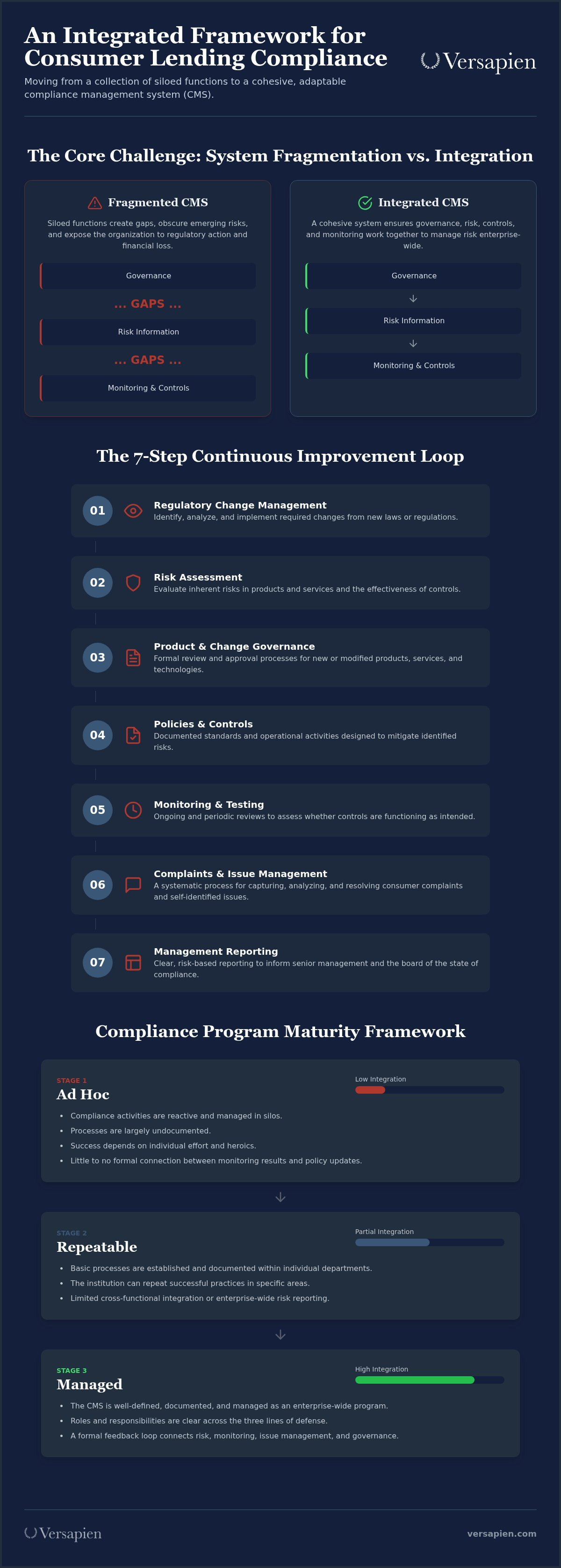
Modernization focuses on strengthening the connections between these components to create a continuous improvement loop. This process can be visualized as a cycle:
Regulatory Change Management: A process to identify, analyze, and implement required changes from new laws or regulations.
Risk Assessment: The evaluation of inherent risks in products and services and the effectiveness of controls.
Product & Change Governance: Formal review and approval processes for new or modified products, services, and technologies.
Policies & Controls: The documented standards and operational activities designed to mitigate identified risks.
Monitoring & Testing: Ongoing and periodic reviews to assess whether controls are functioning as intended.
Complaints & Issue Management: A systematic process for capturing, analyzing, and resolving consumer complaints and self-identified issues.
Management Reporting: Clear, risk-based reporting to inform senior management and the board of the state of compliance.
When this cycle is broken, significant issues can arise. For example, monitoring that identifies a recurring exception but lacks an effective escalation path for root-cause analysis fails to prevent future problems. Similarly, complaint trends revealing a systemic servicing or disclosure issue must feed back into risk assessments and policy updates to be effective.
The Compliance Program Maturity Framework
To help leadership assess the integration of their CMS, it can be useful to visualize its current state. The Versapien Compliance Program Maturity Framework outlines four stages of development, focusing on the system's integration and adaptability.
Stage 1: Ad Hoc. Compliance activities are reactive and managed in silos. Processes are undocumented, and success depends on individual effort. There is little to no formal connection between monitoring results and policy updates.
Stage 2: Repeatable. Basic processes are established and documented within individual departments. The institution can repeat successful practices, but there is limited cross-functional integration or enterprise-wide risk reporting.
Stage 3: Managed. The CMS is well-defined, documented, and managed as an enterprise-wide program. Roles and responsibilities are clear, and there is a formal feedback loop connecting risk assessment, monitoring, issue management, and governance.
Stage 4: Optimized. The CMS is fully integrated into business strategy and operations. The organization uses data analytics and key risk indicators (KRIs) for predictive risk identification and continuous process improvement. Compliance is a shared responsibility, enabling the institution to adapt quickly to business and regulatory changes.
Assessing an organization’s current maturity level can help prioritize improvements, whether in strengthening board-level reporting or implementing more effective change management controls. For organizations preparing for heightened supervision, a thorough self-assessment is a critical step. A readiness checklist can help identify common gaps before an OCC or FDIC examination.
Board-Level Reporting and Governance
For the board and senior management to provide effective oversight, they need clear, concise, and risk-focused information. Reporting should move beyond activity metrics and provide decision-useful information about significant risks, control weaknesses, emerging trends, and remediation progress. Instead of simply listing the number of completed training modules, for example, reporting should analyze whether training has reduced the rate of specific compliance errors identified in monitoring. Key Risk Indicators (KRIs) that the board should monitor might include complaint volumes by product and theme, the number and age of open high-risk compliance issues, and trends from fair lending statistical analysis.
Operationalizing Fair Lending and UDAAP Oversight
Fair lending and UDAAP continue to be areas of intense regulatory focus, and they are also areas where a siloed compliance approach can quickly lead to significant risk. Effective oversight requires deep integration with product development, marketing, underwriting, servicing, and collections.
For example, a product or pricing change that proceeds without an effective compliance review can inadvertently introduce fair lending risk or create UDAAP concerns around deceptive marketing claims. An integrated CMS ensures that a formal risk review is a required step in the change management process. This includes analyzing marketing materials for clarity and transparency and conducting statistical analysis to identify potential disparate impact in lending portfolios resulting from changes to underwriting or pricing models.
When evaluating third-party lending partners, such as auto dealers or fintech platforms, the institution’s CMS must extend to cover the risks presented by those relationships. This includes due diligence on the partner’s compliance program, ongoing monitoring of their activities, and clear contractual obligations for compliance with all applicable laws.
Data-Driven Fair Lending Assessments
Robust data governance is a prerequisite for a defensible fair lending program. Without reliable and complete data on applicants and borrowers, including data required by Regulation C (HMDA) and Regulation B (ECOA), an institution cannot perform credible statistical analysis to detect potential discrimination. These considerations also intersect with broader model risk management and data governance practices. Where automated or model-based decisioning is used, coordination between model risk management, data governance, and fair lending compliance can help identify and manage potential consumer compliance risks.
UDAAP Prevention in Digital Channels
In digital lending and servicing, UDAAP risk can arise from user interface designs that create confusion or manipulate consumer behavior, sometimes referred to as "dark patterns." Examples include making it difficult for consumers to cancel a service, obscuring key disclosures, or using pre-checked boxes for optional products. An effective CMS includes a specific control process for reviewing digital user experiences to ensure that disclosures are presented clearly and that consumers can make informed decisions without being subjected to potentially deceptive or unfair practices.
Key Considerations for Management
Modernizing a consumer lending compliance program is an ongoing process of enhancing integration and effectiveness. It requires commitment from senior leadership to break down organizational silos and foster a culture where compliance is viewed as a shared responsibility. As a conclusion, executives and board members should consider the following questions to assess the state of their own institution's CMS:
Where are our compliance-related activities, such as risk assessment, monitoring, and training, operating in functional or business-line silos?
Do we have a consistent and reliable process for translating regulatory changes into updates to our products, processes, controls, and employee training?
Is the compliance function involved early enough in the development process for significant product, technology, and marketing initiatives?
What are the trends from our complaints, monitoring, testing, and audit results indicating about potential systemic risks or control weaknesses?
Does our management and board reporting clearly articulate the most significant consumer compliance risks, the status of remediation efforts, and emerging threats?
Are recurring issues being addressed at their root cause, or are we repeatedly fixing the same symptoms?
Addressing these questions can help leadership identify critical gaps and prioritize efforts to build a more integrated and resilient compliance management system capable of supporting the institution’s objectives in a complex regulatory environment.



Comments