
Modernizing Consumer Lending Compliance Without Increasing Regulatory Risk
Updated: Jul 22
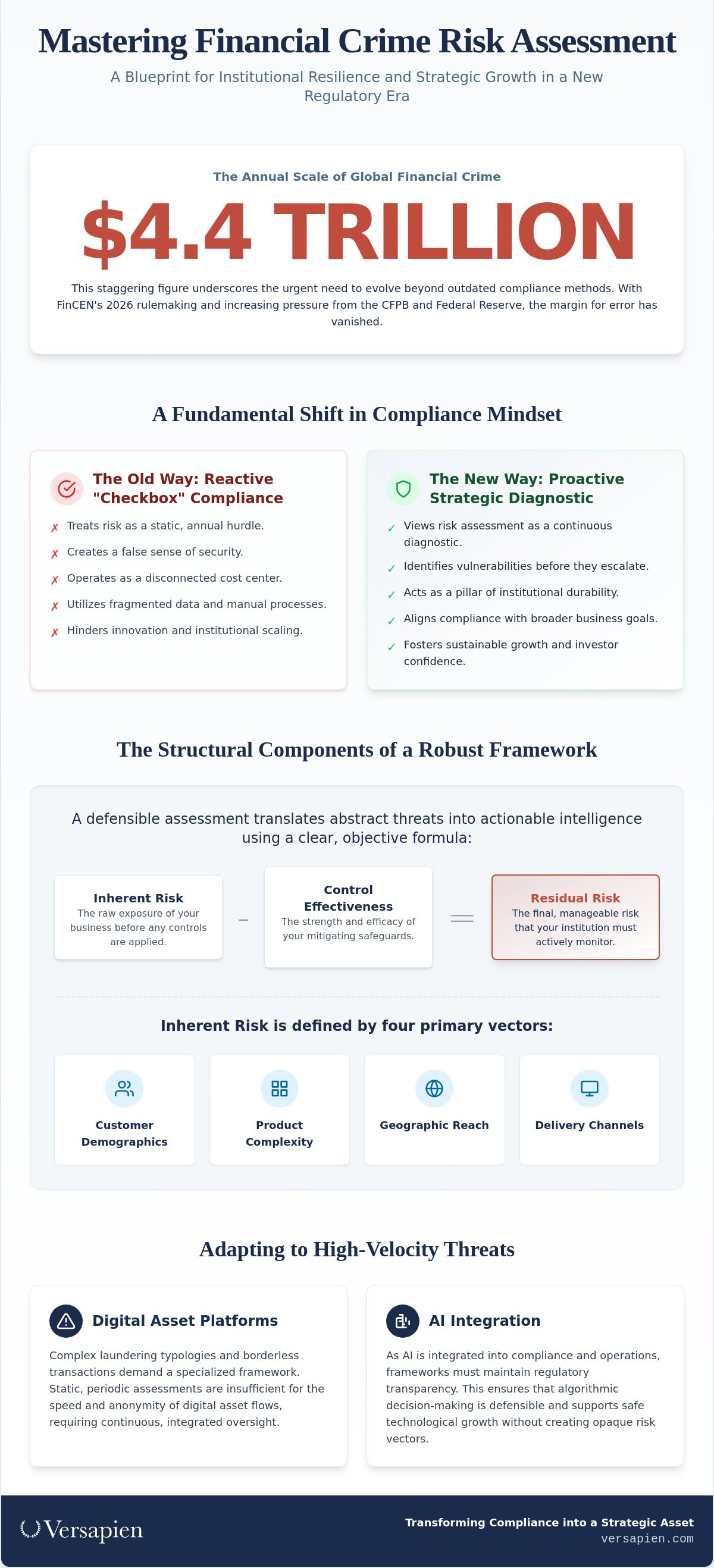
Precision, foresight, and structural integrity. These are the essential pillars of a resilient institution in an era where global financial crime has reached a staggering $4.4 trillion. As FinCEN moves toward mandating a formal, documented financial crime risk assessment through its 2026 rulemaking, the margin for error has effectively vanished. You likely feel the mounting pressure of evolving mandates from the CFPB and the Federal Reserve, where manual processes and fragmented data no longer suffice to meet the rigorous new threshold of program effectiveness.
It's natural to view these shifting requirements as a bottleneck that hinders product innovation and institutional scaling. We're here to help you bridge that gap. This guide examines the strategic nuances of risk methodologies to ensure your framework is both defensible and scalable. We will explore how to align your compliance architecture with broader business goals, transforming a mandatory regulatory exercise into a blueprint for durable, long-term growth.
Table of Contents
The Strategic Imperative of Financial Crime Risk Assessment
Integrity, stability, and growth. These core attributes define institutions that view compliance as a strategic advantage rather than an operational burden. A financial crime risk assessment isn't a mere document to be filed away; it's a sophisticated diagnostic of institutional health. It maps the intersection of business operations and illicit activity, identifying where vulnerabilities exist before they invite enforcement actions. With global financial crime reaching an estimated $4.4 trillion, the stakes for institutional oversight have never been higher. By aligning with international anti-money laundering standards, firms don't just satisfy examiners. They build a foundation of transparency that attracts investors and reassures stakeholders. Proactive risk management reduces the long-term cost of remediation. It's far more efficient to build a secure house than to repair a foundation after a collapse. This strategic posture ensures that capital and human resources are directed toward product innovation rather than reactive legal defense.
Beyond Regulatory Checkboxes
Traditional compliance often suffers from a "checkbox" mentality that treats risk as a static hurdle to be cleared. This approach creates a false sense of security while leaving the back door open to sophisticated actors. We prefer to view the assessment as a strategic asset. There's a direct correlation between analytical rigor and institutional valuation. When a firm can demonstrate a deep, data-driven understanding of its risk profile, it signals to the market that its growth is sustainable and its leadership is disciplined. A culture of compliance isn't built on fear of the regulator; it's built on the disciplined application of foresight. This mindset transforms compliance from a cost center into a pillar of institutional durability.
The Evolving Threat Landscape
Illicit actors move at the speed of the internet. Modern vectors, ranging from synthetic identity fraud to complex digital asset laundering, require a response that's equally agile. Static, once-a-year assessments fail because they capture a moment in time that's already passed. In a 24/7 financial ecosystem, oversight must be continuous and integrated. Digital asset flows and high-velocity fintech platforms demand a framework that evolves alongside the technology. If your risk posture is frozen in a manual, periodic cycle, you're essentially flying blind in a high-stakes environment. True resilience requires a dynamic model. It anticipates shifts in the landscape and adapts to new criminal methodologies rather than reacting to them after the damage has already been done.
Structural Components of a Robust Assessment Framework
Organization, precision, and objectivity. A high-functioning financial crime risk assessment relies on these three pillars to translate abstract threats into actionable intelligence. Without a clear structural hierarchy, institutions often conflate baseline vulnerabilities with operational failures. This leads to misallocated resources and avoidable regulatory friction. By segmenting the analysis into distinct layers, you create a defensible map of your institutional exposure. This process begins with a rigorous evaluation of your inherent risks, followed by a critical audit of your control environment. This structured approach ensures that every dollar spent on compliance is a targeted investment in institutional durability.
Inherent Risk Identification
Inherent risk represents the raw exposure of your business model before any safeguards are implemented. You must evaluate this baseline by analyzing four primary vectors: customer demographics, product complexity, geographic reach, and delivery channels. In a borderless digital economy, traditional geographic boundaries often blur. A fintech offering instant cross-border payments to high-risk jurisdictions inherently carries a higher risk profile than a domestic retail bank. You shouldn't rely on generic industry averages. Instead, you need to quantify how your specific target market and product features invite illicit actors. This analytical rigor ensures that your subsequent controls are built to address specific, documented threats rather than vague assumptions. If you're managing complex digital asset portfolios, specialized financial crime compliance advisory can help align these inherent risks with evolving regulatory expectations.
Control Efficacy and Residual Risk
Once you've identified your inherent vulnerabilities, you must assess the durability of your defensive layers. This involves more than just verifying that a policy exists. It requires testing whether your AML, KYC, and transaction monitoring systems actually function under stress. There's a significant difference between regulatory adequacy and operational effectiveness. A system might meet the technical letter of the law while failing to detect sophisticated laundering patterns. Residual risk is the exposure remaining after the application of internal controls. Your goal isn't to eliminate this risk entirely, as doing so would likely paralyze business operations. Instead, you must determine your institutional risk appetite and ensure that residual levels stay within acceptable bounds. This requires a shift from subjective qualitative descriptions to objective, data-driven metrics that provide the board with a clear view of the firm's true standing.
Navigating High-Velocity Risks: Digital Assets and AI Integration
Innovation, velocity, and complexity. These three forces drive the modern financial landscape, yet they also create fertile ground for sophisticated illicit activity. Traditional frameworks often fail to capture the nuances of a borderless, 24/7 digital economy where transactions occur in milliseconds. A modern financial crime risk assessment must evolve beyond legacy parameters to address these high-velocity vectors. As of July 2026, the industrialization of financial crime has professionalized criminal syndicates, allowing them to bypass traditional defenses at scale. For institutions, the challenge lies in adopting transformative technology without compromising structural integrity or regulatory transparency. It's no longer enough to monitor traditional rails; you must now account for the intersection of decentralized finance and automated fraud.
Digital Asset Compliance Nuances
Virtual assets are no longer a peripheral concern for compliance officers. In April 2026, FinCEN and OFAC issued a joint proposed rule requiring permitted payment stablecoin issuers to establish formal AML/CFT and sanctions compliance programs. This regulatory shift necessitates the integration of blockchain analytics directly into your institutional risk framework. You must move beyond simple wallet screening to analyze the underlying flow of funds within decentralized ecosystems. Managing the anonymity risks inherent in DeFi requires a specialized approach that aligns with the latest FATF guidance on transnational organized crime groups. By formalizing these digital asset policies, you ensure that your institution isn't just reacting to new technology but is actively governing its implementation.
AI-Driven Solutions for Risk Management
Methodological Execution: From Data Collection to Board Reporting
Discipline, transparency, and accountability. These three principles transform a theoretical framework into a functional shield for your institution. A financial crime risk assessment is only as reliable as the data that feeds it and the methodology that interprets it. By establishing a repeatable, data-driven cycle, you ensure that your risk posture remains aligned with the latest regulatory mandates, such as the 2026 FinCEN proposed rule requiring documented assessments. This execution requires a shift from isolated compliance tasks to a centralized, cross-functional operation. When Legal, Operations, Product, and IT teams collaborate, the resulting insights provide a comprehensive view of institutional vulnerability. This synthesized intelligence then informs the Board, allowing for strategic resource allocation and targeted compliance training. It's the difference between a reactive posture and a proactive defense.
Data Aggregation and Integrity
Fragmented data creates blind spots. Most institutions struggle with data silos where transaction logs, customer profiles, and geographic data reside in incompatible systems. Overcoming these barriers is critical to achieving a single version of truth for your risk reporting. This involves identifying primary data sources across the enterprise and implementing periodic audits to verify accuracy. Without high-quality data, even the most sophisticated AI models will produce flawed results. Ensuring data integrity is a prerequisite for any meaningful regulatory compliance advisory engagement, as it forms the bedrock of a defensible program. A methodical approach to data collection ensures that your biennial or annual assessments are based on empirical evidence rather than anecdotal assumptions.
Executive Reporting and Governance
Technical metrics often fail to resonate in the boardroom. While a Chief Compliance Officer understands the nuances of SAR filing thresholds or CTR geographic targeting orders, executive stakeholders need a strategic narrative. It is important to translate technical risk indicators into language that addresses institutional longevity and growth. A well-structured report uses the risk assessment to justify compliance budgets and technology investments. It demonstrates how a proactive stance protects the firm's reputation and valuation. The Board's role is not passive; they must approve and oversee the framework to ensure it meets the Federal Reserve's 2026 expectations for effective AML/CFT programs. With the public comment period for these rules closing on September 8, 2026, the timeline for institutional readiness is accelerating. This top-down governance ensures that compliance is integrated into the very fabric of the business strategy, rather than existing as an isolated silo.
Institutional Resilience through Specialized Advisory
Standardization, stagnation, and vulnerability. These are the unintended consequences of relying on generic, off-the-shelf risk assessment templates. While templates provide a basic structure, they lack the granular depth required for high-stakes environments like digital asset platforms or consumer lending. A one-size-fits-all approach often misses the unique nuances of your specific product architecture or geographic footprint. This leads to a false sense of security that evaporates during a rigorous regulatory exam. Specialized advisory replaces these static tools with a dynamic, institutional-specific diagnostic that evolves alongside your business. It requires a partner who understands that compliance isn't a hurdle to be cleared, but a foundation to be built.
The Value of the External Perspective
Internal teams often develop institutional myopia. They become so accustomed to existing workflows that they overlook subtle systemic weaknesses. Bringing in an external advisor provides an objective lens that identifies these blind spots before they attract the attention of FinCEN or the CFPB. We leverage deep industry experience to benchmark your program against peers. This ensures your financial crime risk assessment isn't just compliant, but competitive. This proactive oversight reduces the friction of regulatory exams through pre-emptive, expert-led audits that demonstrate a commitment to effectiveness over mere activity. It's a method that prioritizes structural integrity over temporary fixes. By inviting an outside expert, you gain a trusted navigator who can identify the intricacies of a difficult landscape and provide the necessary tools to move through it successfully. For institutions looking to fortify their broader fiscal and legal standing, check out TaxLawAdvisory to address the complex tax law expertise required in high-stakes environments.
Securing Your Institutional Future
Compliance should never be a roadblock to progress. Instead, it must act as a strategic partner in product development and digital transformation. Versapien's approach integrates technical oversight with long-term strategic health, bridging the gap between innovation-led growth and regulatory stability. By establishing a measurable and sustainable risk management program, you protect your firm's reputation while enabling safe, rapid scaling in a volatile market. The goal is institutional durability. It's about building a framework that survives the current cycle and anticipates the next one. This forward-looking posture transforms compliance from a necessary expense into a core component of your firm's value proposition. Our boutique advisory model ensures that you receive the depth of expertise required for high-stakes financial environments, where generic solutions simply fail to protect your interests. Partner with Versapien to navigate your next financial crime risk assessment.
Cultivating Institutional Longevity through Strategic Oversight
Precision, foresight, and structural durability. These attributes distinguish institutions that thrive in the face of regulatory scrutiny from those that merely react to it. A robust financial crime risk assessment serves as more than a compliance obligation; it's a strategic diagnostic that enables your firm to innovate safely within a complex global landscape. By integrating data-driven methodologies with board-level accountability, you transform institutional vulnerability into a foundation for sustainable growth. Static templates and manual processes can't keep pace with the industrialization of financial crime. You need a framework that's as agile as the technology it monitors.
Versapien offers a boutique, high-touch consulting model designed to bridge the gap between AI-driven innovation and regulatory stability. With specialized expertise in consumer lending and digital assets, we provide the technical oversight necessary to secure your firm's future. Our proven track record in digital transformation and risk management ensures your program is both defensible and scalable. Explore Versapien’s Financial Crime Compliance Advisory Services to fortify your institutional resilience. We're ready to serve as your trusted navigator in this high-stakes environment.
Frequently Asked Questions
What is the primary purpose of a financial crime risk assessment?
Identification, mitigation, and governance. The primary purpose of a financial crime risk assessment is to serve as a strategic diagnostic that identifies an institution's vulnerabilities to illicit activity. It maps the intersection of business operations and criminal methodologies. By documenting these threats, a firm can allocate compliance resources with precision and establish a defensible program that satisfies the latest regulatory standards.
How often should a financial institution perform a risk assessment?
Most financial institutions perform a comprehensive financial crime risk assessment on an annual or biennial basis. However, static cycles are increasingly insufficient in high-velocity environments. You must update your assessment whenever significant trigger events occur, such as launching a digital asset platform, entering a high-risk geographic market, or experiencing a major shift in customer demographics.
What is the difference between inherent risk and residual risk?
Inherent risk represents the raw vulnerability of your business model before any defensive measures are implemented. Residual risk is the exposure that remains after your internal controls, such as transaction monitoring and KYC protocols, have been applied. A robust framework ensures that this residual exposure stays within your institution's defined risk appetite and strategic limits.
How does digital asset compliance differ from traditional AML assessments?
Digital asset compliance differs by requiring blockchain analytics to track decentralized fund flows that traditional banking rails don't capture. The 2026 FinCEN proposed rules for stablecoin issuers emphasize this distinction. Unlike traditional AML, virtual asset assessments must account for the rapid settlement speeds and the complex anonymity risks inherent in decentralized finance ecosystems.
Can AI be used to automate the financial crime risk assessment process?
AI enhances the financial crime risk assessment by identifying complex patterns in large datasets that manual processes often miss. While it automates data aggregation and anomaly detection, human expertise remains essential. You must ensure that any algorithmic decisions are transparent and explainable to examiners to avoid "black box" compliance failures during regulatory reviews.
What are the core risk categories examined in a FinCrime assessment?
Customers, products, geographies, and channels. These four pillars form the foundation of any rigorous assessment. Examiners evaluate the risk profile of your target demographic, the complexity of your product offerings, the jurisdictions where you operate, and the methods used to deliver services. Each category must be weighted based on empirical data rather than subjective assumptions to ensure a precise risk map.
Who is responsible for the oversight of the risk assessment within an organization?
While the Chief Compliance Officer manages the technical execution, the Board of Directors holds final responsibility for the framework's oversight. They must approve the methodology and ensure the findings inform the institution's broader strategic direction. This top-down approach ensures that risk management is integrated into the firm's culture rather than existing as an isolated silo.
How do regulators use a firm’s risk assessment during an examination?
Benchmarking, scrutiny, and validation. Regulators use your risk assessment as the primary roadmap for their examinations. They evaluate whether your internal controls are truly effective against your documented inherent risks. If your assessment fails to identify a specific vulnerability that later results in a suspicious activity filing, examiners will view your entire compliance framework as ineffective and poorly governed.


Comments