
Preparing for an OCC or FDIC Examination: A Readiness Checklist
The 2026 supervisory environment demands more than a reactive scramble before a scheduled site visit. With the OCC and FDIC now prioritizing risk-based outcomes over technical documentation, the margin for error in governance has narrowed significantly. Institutional leaders often face a difficult trifecta of regulatory fatigue, technological complexity, and inconsistent board-level reporting. These systemic challenges suggest that a traditional, episodic approach to regulatory exam readiness is no longer sustainable for organizations pursuing growth in a high-stakes environment.
It's likely that your leadership team feels the strain of continuous supervision while attempting to align innovations like agentic AI with established risk frameworks. Achieving a state of permanent maturity requires a shift from defensive posturing to a proactive, integrated governance model. To support this transition with robust technical oversight, discover CyberOne and their managed security services. This article provides a senior-level framework designed to move your institution beyond reactive compliance and establish a durable, regulator-ready posture. We'll examine a structured checklist for institutional health, focusing on seamless technology integration and the reduction of friction throughout the examination process.
Table of Contents
The Shift Toward Continuous Regulatory Exam Readiness
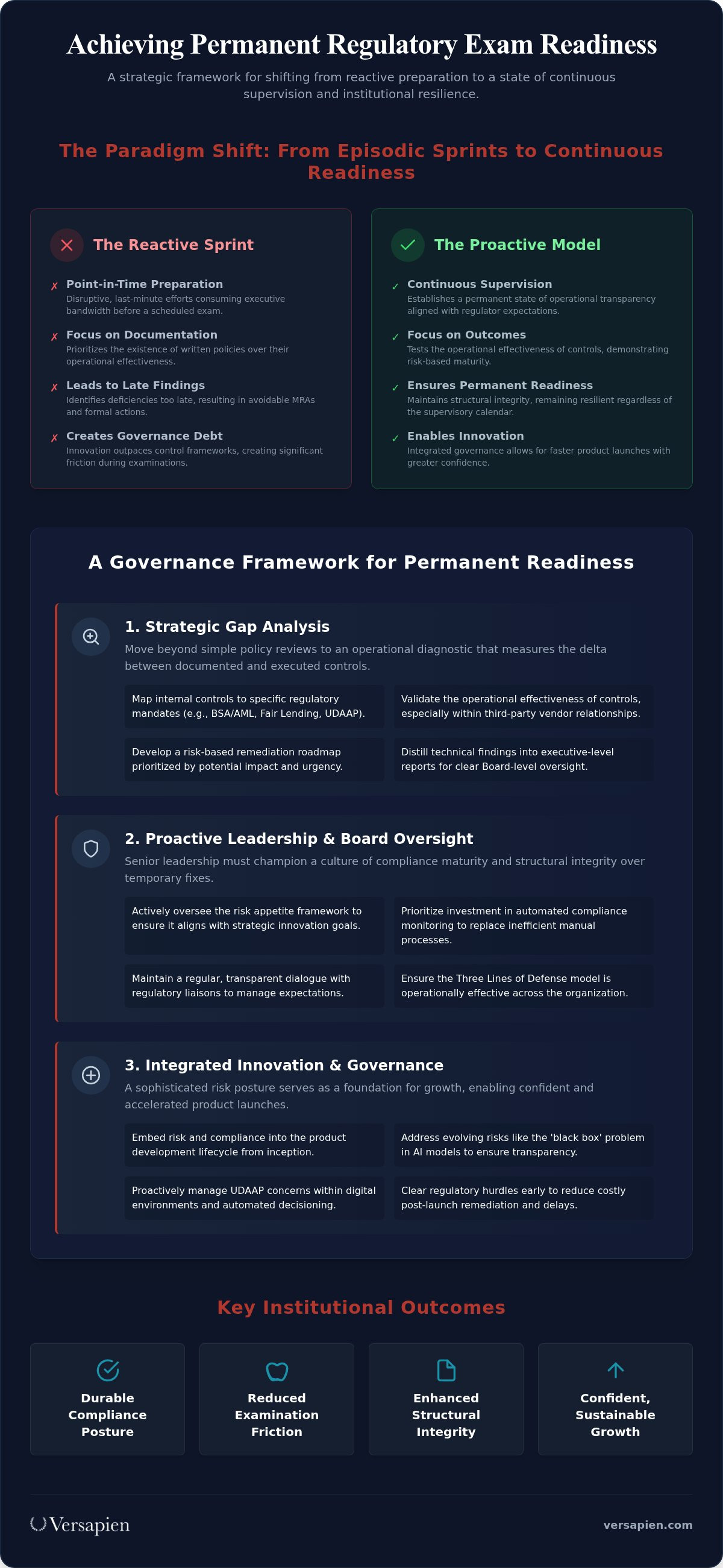
Precision, discipline, and foresight. These principles guide the supervisory cycle as the OCC and FDIC pivot from periodic audits to continuous, risk-based supervision. Many institutions still treat an examination as a disruptive, point-in-time sprint that consumes executive bandwidth and strains resources. This reactive posture often identifies deficiencies too late, leading to formal matters requiring attention (MRAs) that could have been avoided. As the OCC eliminates mandatory policy-based requirements to favor outcomes-based oversight, achieving regulatory exam readiness requires a transition toward a proactive governance model. Exam readiness is a state of permanent operational transparency.
High-growth firms frequently encounter a governance debt when their pace of innovation outstrips their internal control frameworks. When new digital products or payment rails are launched without commensurate risk oversight, the resulting friction during an examination can be significant.
Senior leadership plays a critical role here. Boards should focus on specific areas to foster compliance maturity:
Active oversight of the risk appetite framework to ensure alignment with innovation.
Investment in automated compliance monitoring to replace manual processes.
Regular engagement with regulatory liaisons to maintain transparent dialogue.
By prioritizing structural integrity over temporary fixes, leaders ensure that the institution remains resilient regardless of the supervisory calendar.
Evolving Expectations from the CFPB and OCC
Current supervisory priorities emphasize consumer protection and the prevention of Unfair, Deceptive, or Abusive Acts or Practices (UDAAP) within digital environments. Regulators are increasingly concerned with the black box problem found in automated decision-making. While the OCC issued Bulletin 2026-13 to update model risk guidance, the complexity of generative AI models requires a more robust approach to U.S. bank regulation. Transparency in how these models impact consumer outcomes is now a non-negotiable requirement for a successful examination.
Governance as a Catalyst for Innovation
A sophisticated risk posture doesn't act as a brake on growth; it serves as the foundation that allows firms to launch products with greater speed and confidence. When governance is integrated into the product development lifecycle, regulatory hurdles are cleared early, reducing the likelihood of costly delays or post-launch remediation. This alignment between innovation and oversight is central to modern regulatory compliance advisory, ensuring that institutional growth is supported by a state of permanent regulatory exam readiness.
Mechanics of Strategic Compliance Gap Analysis Services
Identification, measurement, and mitigation. A strategic gap analysis serves as the architectural blueprint for institutional stability, yet many leaders mistake a simple policy review for a true operational diagnostic. While having a documented framework is necessary, examiners prioritize how those controls function under stress. A robust state of regulatory exam readiness hinges on the delta between what is written and what is executed. By leveraging data-driven insights, institutions can uncover hidden systemic risks that traditional, manual audits frequently overlook.
The Diagnostic Phase: Scoping and Data Collection
The diagnostic process begins by mapping internal controls directly to specific mandates such as BSA/AML, Fair Lending, and UDAAP. This requires a granular evaluation of data flows and decisioning logic to ensure alignment with FDIC examination policies. Many organizations find their most significant vulnerabilities in blind spots within third-party and vendor risk management, where oversight often lacks the rigor applied to internal operations. Validating the operational effectiveness of these external dependencies is critical for maintaining a defensible risk posture.
Reporting and Prioritization of Findings
Once gaps are identified, the focus shifts to developing a risk-based roadmap that prioritizes remediation based on potential impact and regulatory urgency. Technical findings must be distilled into executive-level risk reports that provide the Board with a clear, actionable view of the institution's compliance health. Integrating specialized regulatory compliance advisory during this phase ensures that the remediation strategy is both practical and aligned with current supervisory expectations. This structured approach transforms raw data into a strategic asset, moving the organization closer to a state of permanent regulatory exam readiness. If your institution requires a tailored diagnostic to identify hidden vulnerabilities, consider engaging with a strategic advisor to refine your approach.
The Regulatory Exam Readiness Checklist: A Governance Framework
Ownership, accountability, and verification. A mature governance framework relies on the Three Lines of Defense to ensure that risk management isn't siloed within a single department. Many institutions struggle with blurred responsibilities between business units and compliance functions, leading to gaps in oversight that examiners quickly identify. By establishing clear ownership, the first line manages risk at the source, while the second line provides independent oversight and the third line offers objective assurance. This structural clarity is the bedrock of regulatory exam readiness, ensuring that every facet of the institution is prepared for scrutiny.
Updating the Compliance Management System (CMS) to meet 2026 standards requires a granular review of consumer protection protocols and UDAAP safeguards. This alignment should be cross-referenced with the FDIC Risk Management Manual of Examination Policies to ensure internal benchmarks match supervisory expectations. Comprehensive, evidence-based documentation serves as the primary mechanism for demonstrating the operational integrity of these controls to examiners. Without a clear trail of decisioning and testing, even the most sophisticated policies appear ineffective during a site visit.
Operational and Model Risk Readiness
Algorithmic transparency is now a focal point for regulators. As institutions integrate automated decisioning, they must ensure these models align with SR 11-7 and the updated guidance in OCC Bulletin 2026-13. While generative AI remains outside the current scope of 2026-13, traditional consumer-facing algorithms require rigorous validation to prevent disparate impact and ensure fair lending compliance. Engaging in specialized risk management consulting can help bridge the gap between technical innovation and regulatory expectations.
Board and Executive Oversight Protocols
The Board of Directors must move beyond passive reporting to provide a credible challenge to management's risk assumptions. Examiners look for specific evidence that the Board understands the institution's risk profile and actively participates in strategic decision-making. Establishing a protocol for real-time communication during the examination prevents information silos and ensures that leadership can respond to examiner inquiries with consistency and precision. This level of engagement signals a culture of compliance maturity that significantly reduces friction during the supervisory process.
Sustaining Readiness Through Strategic Remediation
Root cause analysis, documented execution, and institutional accountability establish the foundation for successful remediation. Patchwork fixes often provide temporary relief from supervisory pressure, yet they rarely address the underlying structural issues. When an institution treats a Matter Requiring Attention (MRA) as a checklist item rather than a systemic indicator, it risks the recurrence of the same deficiency in subsequent cycles. Strategic remediation requires a deep dive into the governance failures or technical gaps that allowed the risk to manifest initially.
A well-documented remediation plan serves as a roadmap for institutional fortification. It's not just about correcting the error; it's about proving the solution is durable and integrated into daily operations. Utilizing specialized project management expertise helps ensure that remediation efforts align with broader digital transformation goals. This creates a feedback loop where lessons learned from the examination process inform future innovation, ultimately strengthening the institution’s overall regulatory exam readiness.
Post-Exam Strategy and Board Reporting
The exit interview marks the beginning of the post-exam lifecycle rather than its conclusion. Maintaining institutional trust depends on how effectively leadership manages the relationship with regulators through transparent, consistent updates on remediation progress. For the Board, these reports provide the necessary assurance that management is addressing risks with appropriate rigor. A structured reporting cadence ensures that stakeholders remain informed and that the institution's commitment to safety and soundness remains evident to the OCC and FDIC.
The Versapien Approach to Institutional Fortification
Versapien offers a boutique, senior-led alternative to the high-volume advisory model, prioritizing practical, implementation-focused results over theoretical frameworks. Our team brings decades of experience in navigating complex supervisory environments to help firms move beyond reactive compliance. To establish a state of permanent regulatory exam readiness, leaders should consider the following next steps:
Conduct a comprehensive baseline assessment of current governance and risk frameworks.
Formalize a multi-year governance roadmap that accounts for AI and digital asset innovation.
Establish a centralized remediation office to track and validate the closure of supervisory findings.
By focusing on structural integrity and proactive oversight, your institution can navigate the 2026 regulatory landscape with confidence and stability.
Establishing a Durable Governance Trajectory
Strategic alignment, operational integrity, and proactive oversight. These principles transform the regulatory cycle from a period of high-stakes friction into a manageable byproduct of institutional maturity. Achieving regulatory exam readiness in 2026 requires moving beyond mere policy existence to verify the operational effectiveness of every control, particularly as AI and digital assets reshape traditional risk boundaries. Organizations venturing into tokenization can look to the STO Foundation for a compliant approach to asset-backed offerings. By prioritizing root-cause remediation and Board-level accountability, leaders can ensure their organizations remain resilient under continuous supervision.
Versapien offers a senior-led boutique model that delivers the specialized expertise of Big-Four leadership with the agile execution necessary for modern financial services. Our focus on practical, implementation-ready solutions helps your institution bridge the gap between legacy frameworks and emerging technological risks. Navigating the complexities of the OCC and FDIC landscape becomes a clear, structured process when supported by seasoned strategic navigators who understand the intricacies of the current environment.
A resilient governance posture is a significant competitive advantage in a shifting market. We look forward to helping you build a foundation of stability that supports your long-term strategic objectives and ensures institutional health. For organizations looking to secure their physical and corporate environments alongside their regulatory frameworks, Regal Security offers professional security solutions tailored to executive needs.
Regulatory Strategy and Implementation Insights
Distinguishing Compliance Audits from Strategic Gap Analysis
A compliance audit serves as a retrospective verification of adherence to existing policies and procedures. In contrast, a strategic gap analysis identifies the delta between current operations and the evolving supervisory standards of agencies like the OCC or FDIC. While audits confirm that established rules were followed, gap analyses determine if the internal control environment is sufficient to meet the expectations of modern regulatory exam readiness. By leveraging the accounting and consulting expertise of Wright CPAs, LLC, institutions can ensure their internal audit functions are fully aligned with these rigorous standards. This forward-looking diagnostic allows leaders to identify vulnerabilities before they manifest as formal findings during a site visit.
CFPB Examination Readiness for Fintech Institutions
Fintech firms often face unique challenges when preparing for an initial CFPB examination. Preparation involves mapping consumer data flows and automated decisioning logic to UDAAP and Fair Lending standards. Stress-testing consumer-facing algorithms ensures they don't produce discriminatory outcomes, a priority for the Bureau in 2026. Establishing a robust Compliance Management System that mirrors the rigor of traditional banking is essential for demonstrating institutional maturity and maintaining consumer trust.
Board Oversight and Credible Challenge Protocols
The Board of Directors provides the necessary oversight to validate management’s risk assumptions and the effectiveness of the compliance program. Examiners look for specific evidence that the Board understands the institution's risk profile and actively monitors the status of regulatory exam readiness. This level of engagement signals to regulators that safety and soundness are prioritized at the highest level of the organization. A Board that offers a credible challenge to management assumptions creates a stronger, more defensible risk culture.
Integrating AI Governance into Existing Risk Frameworks
Expanding existing model risk management frameworks to include algorithmic transparency and bias monitoring is a critical step for institutions adopting advanced technology. AI models should be treated as dynamic assets requiring continuous validation rather than static tools. For organizations looking for parallels in high-stakes validation, APS Compliance Consultants Inc. provides specialized guidance on maintaining technical compliance in similarly rigorous environments. This approach ensures that innovation remains aligned with the risk appetite and meets the expectations for responsible AI use as outlined in recent interagency guidance. Proper governance prevents the black box problem from becoming a significant supervisory liability.
Avoiding Common Supervisory Pitfalls
Frequent pitfalls include inconsistent documentation, fragmented ownership of risk, and a failure to remediate previous findings. Regulators view unaddressed matters requiring attention as a sign of weak governance, which can lead to downgraded ratings or formal enforcement actions. Successful examinations rely on a state of readiness where evidence of compliance is easily accessible and logically organized. Proactive identification of these issues allows for remediation before examiners arrive on site.


Comments