
Third-Party Risk Management for AI and Fintech Vendors
Updated: Sep 22
Table of Contents
The Evolution of Third-Party Risk Management in Regulated Environments
The discipline of third-party risk management (TPRM) has fundamentally shifted from a procurement-centric, vendor-management function to an integrated component of enterprise governance. Effective TPRM requires financial institutions to identify, assess, monitor, and manage risks arising from third-party relationships through a risk-based framework integrated with the institution's broader governance and risk management processes.
This transition is driven by increasing reliance on external partners for critical operations, technology, and customer-facing services. Regulatory bodies, through guidance such as the 2023 Interagency Guidance on Third-Party Relationships, have clarified that a bank’s board of directors and senior management are ultimately accountable for the risks arising from these partnerships. This includes identifying and managing concentration risk and the risks posed by fourth parties (i.e., the vendors of a bank’s vendors) which are now firmly established as board-level concerns.
The Rise of Banking-as-a-Service (BaaS) Risk Profiles
Banking-as-a-Service (BaaS) and other fintech partnership models present unique and complex risk management challenges. In these arrangements, a regulated financial institution provides its charter and access to the payment system to a fintech partner, which in turn manages the end-customer relationship. While these partnerships can drive innovation and expand market reach, they also extend the bank’s risk perimeter.
Regulators, including the OCC and CFPB, have intensified their scrutiny of these models, focusing on the adequacy of the bank’s oversight. Weaknesses in a fintech partner's compliance management system, information security controls, or consumer protection practices can expose the bank to significant regulatory, legal, and reputational risk. Such deficiencies may also be interpreted by examiners as an indication of systemic weaknesses in the bank’s own third-party oversight framework.
Shifting from Periodic to Risk-Based Monitoring
A uniform approach based solely on periodic or annual due diligence may not be sufficient to manage the evolving risks presented by fintech and technology vendors. Changes in a vendor's financial condition, control environment, service delivery, cybersecurity posture, or other risk factors may warrant reassessment outside the normal review cycle. Effective TPRM frameworks now incorporate dynamic triggers for out-of-cycle risk assessments, such as material changes in a vendor’s financial condition, control environment, or service delivery. This allows an institution to adjust its oversight activities in proportion to the evolving risk profile of the relationship.
Integrating Financial Crime Compliance into Third-Party Risk Frameworks
A mature TPRM program bridges the gap between traditional vendor due diligence and specialized domains like financial crime compliance. For third parties that touch customer onboarding, transaction processing, or data management, oversight must extend beyond operational and financial stability to include key financial crime risk considerations. This requires a nuanced, risk-based approach to evaluating a vendor’s role in the institution’s broader compliance ecosystem.
The nature of this due diligence should be directly relevant to the third party and the services it provides. Not every vendor is expected to maintain its own comprehensive BSA/AML, KYC, or sanctions screening program. For example, a core processing provider may require deep scrutiny of its transaction monitoring capabilities, while a marketing analytics firm may only require confirmation that the entity itself is not subject to sanctions. The key is to map the specific risks introduced by the vendor relationship to proportionate controls and oversight activities, including those related to sanctions and fraud risk within the technology supply chain.
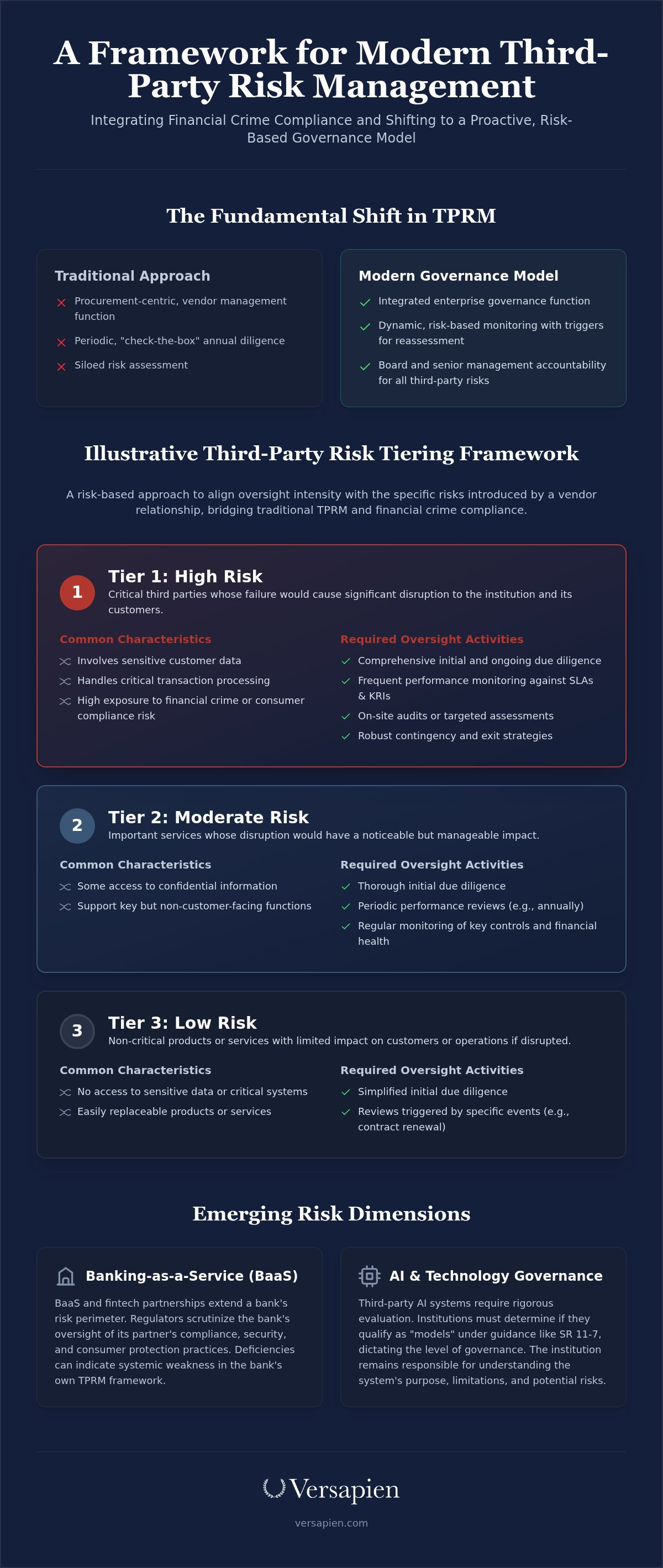
To structure this risk-based approach, many institutions use a tiering framework to categorize vendors. The following matrix is an illustrative example of how an organization might classify third parties to align oversight intensity with risk.
Illustrative Third-Party Risk Tiering Matrix
- **Tier 1 (High Risk):** Critical third parties providing services that could cause significant disruption to the institution and its customers if they failed. These often involve sensitive customer data, critical transaction processing, or activities with high exposure to financial crime and consumer compliance risk. - *Oversight Activities:* Comprehensive initial and ongoing due diligence, frequent performance monitoring against SLAs and KRIs, on-site audits or targeted assessments, and robust contingency and exit strategies. - **Tier 2 (Moderate Risk):** Third parties providing important services that, if disrupted, would have a noticeable but manageable impact. These vendors may have some access to confidential information or support key business functions that are not customer-facing. - *Oversight Activities:* Thorough initial due diligence, periodic performance reviews (e.g., annually or biennially), and regular monitoring of key controls and financial health. - **Tier 3 (Low Risk):** Third parties providing non-critical products or services with limited impact on customers or operations if disrupted. These relationships typically involve no access to sensitive data or critical systems. - *Oversight Activities:* Simplified initial due diligence, with subsequent reviews triggered by specific events like contract renewal or changes in service scope.
AI Governance and Third-Party Technology Risk
The integration of third-party artificial intelligence (AI) systems introduces another layer of complexity to risk management. When evaluating these vendors, institutions should determine whether a specific system meets the organization's applicable definition of a model and, where relevant, consider the revised interagency guidance on model risk management issued in April 2026 (SR 26-2). This determination should inform the appropriate governance approach, with the nature and rigor of oversight proportionate to the system's intended use, complexity, materiality, and potential impact.
Whether an AI system falls within a formal model risk management framework or is governed through broader technology and enterprise risk processes, effective oversight requires the institution to obtain sufficient information to understand the system's intended purpose, material limitations, performance, and relevant risks. Depending on the use case, these risks may include data privacy, algorithmic bias, cybersecurity, operational resilience, consumer protection, and third-party dependencies. Effective governance should ensure that third-party systems remain aligned with the institution's risk appetite, control environment, and applicable compliance obligations.
Addressing UDAAP and Fair Lending in Vendor Relationships
When third parties provide customer-facing platforms, marketing services, or underwriting algorithms, consumer compliance risks such as Unfair, Deceptive, or Abusive Acts or Practices (UDAAP) and fair lending violations become paramount. An institution cannot outsource its compliance responsibilities. Regulators expect banks to have a comprehensive understanding of how their vendors interact with consumers and to monitor those activities for compliance with applicable laws.
This does not necessarily require direct access to or validation of a vendor’s proprietary source code. Instead, institutions should ensure they have sufficient information, data access, testing capabilities, or other contractual mechanisms to evaluate material consumer compliance risks and outcomes. This includes reviewing vendor communications for potential UDAAP concerns and analyzing data outputs from third-party algorithms to ensure they remain compliant with fair lending standards and do not produce discriminatory outcomes.
Evaluating Third-Party Risk Management Consulting Partners
As regulatory expectations for TPRM intensify, many institutions seek external expertise to assess and enhance their programs. Selecting the right advisory partner is a critical decision that can significantly impact an organization's ability to meet supervisory standards and manage risk effectively. Rather than focusing on the size of a consulting firm, boards and senior management should evaluate potential partners based on a set of objective criteria tailored to their specific needs.
Key selection criteria include:
- **Relevant Experience and Technical Depth:** The partner should have demonstrable experience working with institutions of a similar size, complexity, and business model. Their team should possess deep technical expertise in areas like [financial crime compliance](https://www.versapien.com/fin-crime-compliance), AI governance, and consumer protection. - **Senior-Level Involvement:** The engagement should be led and executed by seasoned professionals who bring years of practical experience to the table. Management should clarify the level of involvement senior advisors will have in the day-to-day work. - **Regulatory Knowledge and Credibility:** The firm must have a strong understanding of the supervisory expectations of relevant agencies (e.g., OCC, FDIC, Federal Reserve, CFPB) and a track record of helping clients prepare for examinations and remediate findings. - **Practical Implementation Focus:** The ideal partner moves beyond theoretical assessments to provide actionable, regulator-ready recommendations. They should be able to help design and implement enhanced controls, policies, and governance structures that are both effective and sustainable.
Strategic Alignment: Choosing a Navigator, Not Just a Vendor
The most effective advisory relationships are strategic partnerships. A valuable advisor works to understand the institution’s unique business objectives, risk appetite, and organizational culture. They tailor their recommendations to fit the institution’s context, moving beyond "off-the-shelf" frameworks to develop bespoke enterprise risk management strategies. This approach ensures that the enhanced TPRM framework not only satisfies regulatory requirements but also supports the institution's long-term strategic goals, particularly in navigating the complexities of traditional banking and emerging fintech ecosystems.
Strategic Actions: Transitioning to a Proactive Governance Model
Modernizing a TPRM program is not simply a compliance exercise; it is a strategic imperative for sustainable growth. A proactive governance model enables an institution to leverage third-party relationships for innovation while effectively managing the associated risks. This requires a clear implementation roadmap focused on enhancing governance, reporting, and organizational alignment.
Key components of this transition include establishing clear Key Risk Indicators (KRIs) to monitor third-party performance, improving board-level reporting to better communicate risk appetite versus actual exposure, and developing a phased plan for implementing necessary enhancements. The goal is to embed robust third-party risk management principles into the broader organizational culture of compliance.
Executive Takeaways: Immediate Considerations
- **Conduct a Gap Analysis:** Audit the current inventory of fintech and BaaS relationships against the 2023 interagency guidance to identify potential gaps in governance, due diligence, or ongoing monitoring. - **Review Contractual Protections:** Examine key third-party contracts to ensure they provide adequate "right to audit" clauses, data protection provisions, and clear expectations for performance and compliance. - **Assess Board Reporting:** Evaluate the quality and clarity of reporting to the board and senior management. Does it effectively communicate the institution’s most significant third-party risks, including concentration risk and fourth-party exposures?
Building Long-Term Resilience
Ultimately, the objective is to build a TPRM framework that is resilient, adaptable, and aligned with the institution’s strategic objectives. By moving from a reactive, compliance-driven posture to a proactive, risk-based governance model, organizations can manage their extended enterprise with confidence. This focus on governance becomes a catalyst for sustainable, measurable growth, allowing the institution to innovate responsibly and maintain the trust of its customers and regulators.
How Versapien Can Help
Versapien provides senior-led advisory services for financial institutions seeking to strengthen their third-party risk management frameworks. With specialized expertise in AI governance, financial crime compliance, and regulatory exam readiness, our team helps clients move from assessment to regulator-ready implementation. We partner with boards and executive leaders to design and build durable governance models that enable innovation while managing complex risks in an evolving financial landscape. Whether your organization is assessing its current TPRM program, strengthening governance over critical fintech and AI providers, or preparing for heightened regulatory scrutiny, Versapien can help translate risk assessments into practical, sustainable implementation.


Comments