
AI Accountability in Financial Services: Who Owns the Risk When an Automated Decision Causes Consumer Harm?
Updated: Sep 22
When an automated decision causes consumer harm, the most important governance question is not whether the algorithm made the decision. It is whether the financial institution had clearly defined who was responsible for the system, how its risks were assessed, what controls governed its use, and how problems were identified and addressed.
AI can distribute decision-making across data, models, technology platforms, business processes, and third-party providers. That complexity can make accountability less clear, particularly when automated systems influence credit decisions, customer interactions, fraud detection, or other activities with consumer impact. But technological complexity does not eliminate the institution's responsibility to understand and manage the risks associated with its use of AI.
This article examines a practical framework for establishing accountability for automated decisioning, including how financial institutions can assign ownership, apply model risk management principles where relevant, incorporate consumer-protection considerations, oversee third-party AI, and establish appropriate human oversight and escalation mechanisms.
Table of Contents
The Accountability Gap in Automated Decisioning
In financial services, the adoption of complex algorithms creates a potential accountability gap. This occurs when the responsibility for an automated outcome becomes diffused across technical teams, business units, and vendors, leaving no single point of ownership. Closing this gap requires moving beyond technical assessments and establishing a clear institutional framework for responsibility.
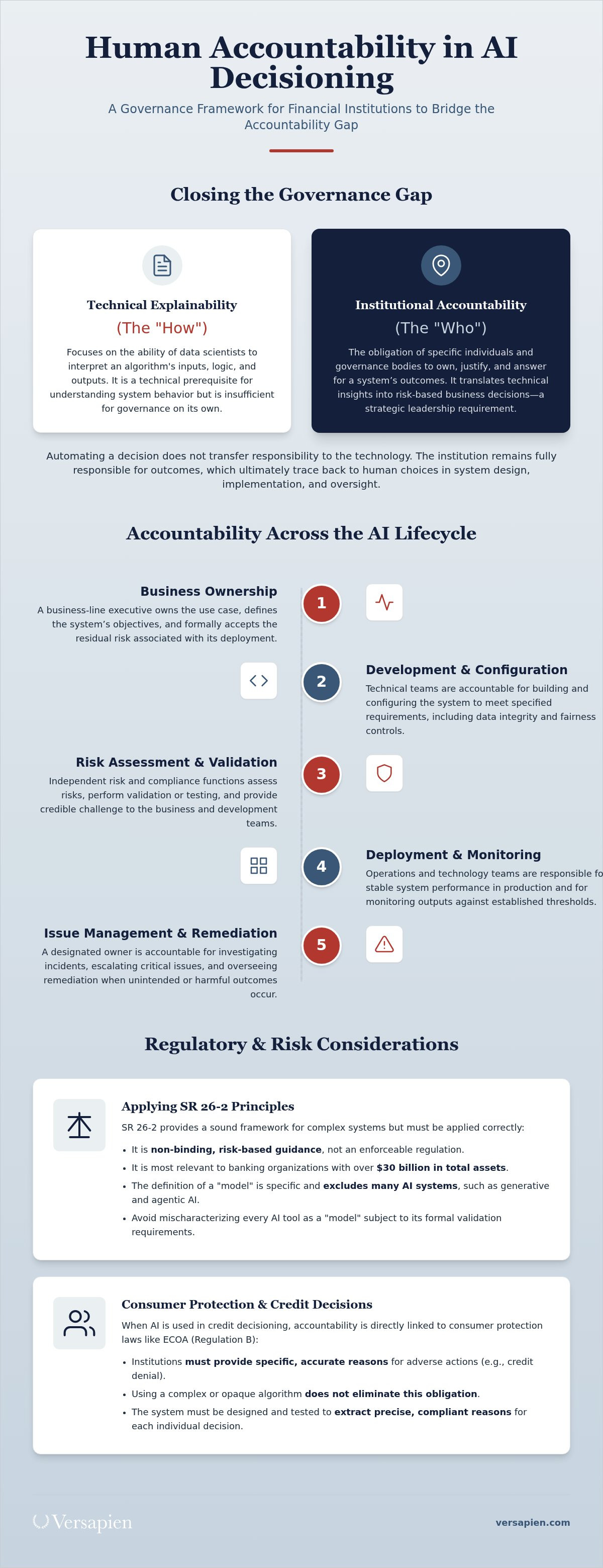
Technical Explainability vs. Institutional Accountability
Technical explainability and institutional accountability are related but distinct concepts. Explainability focuses on the “how”, which is the ability of data scientists and validators to interpret an algorithm’s inputs, logic, and outputs. It is a technical prerequisite for understanding system behavior.
Institutional accountability, however, addresses the “who”, which is the obligation of specific individuals and governance bodies to own, justify, and answer for the system’s outcomes. While an algorithm may be explainable, that explanation is insufficient for governance if no one has the authority and responsibility to act on it. Accountability is a strategic requirement for senior management and the Board, translating technical insights into risk-based business decisions.
Why Automated Decisions Do Not Eliminate Human Responsibility
Automating a decision-making process does not transfer responsibility to the technology itself. The institution remains fully responsible for the outcomes produced by its systems. Human judgment is essential in designing, testing, deploying, and monitoring these systems. An algorithm operates within the parameters, data constraints, and ethical boundaries set by people. Therefore, any harm caused by an automated decision ultimately traces back to human choices regarding the system’s development, implementation, or oversight.
Defining Accountability Across the AI Lifecycle
Effective AI accountability is not a single sign-off at deployment but a continuous chain of ownership across the entire lifecycle. This requires clearly assigned roles at each stage:
Business Ownership: A business-line executive owns the use case, defines the system’s objectives, and accepts the residual risk associated with its use.
Development and Configuration: Technical teams are accountable for building and configuring the system according to specified requirements, including data integrity and fairness considerations.
Risk Assessment and Validation: Independent risk and compliance functions are accountable for assessing risks, performing validation or testing appropriate to the system’s nature, and providing credible challenge.
Deployment and Monitoring: Operations and technology teams are responsible for the system's stable performance in a production environment and for monitoring its outputs against established thresholds.
Issue Management and Remediation: A designated owner is accountable for investigating incidents, escalating issues, and overseeing remediation when a system produces unintended or harmful outcomes.
Regulatory and Risk Considerations for AI Accountability
Establishing an AI accountability framework requires careful consideration of regulatory guidance, consumer protection laws, and third-party risk management principles. While the regulatory environment for AI is still developing, existing frameworks for model risk and consumer compliance provide a durable foundation for governance.
Applying SR 26-2 Where Model Risk Management Is Relevant
On April 17, 2026, the Federal Reserve, FDIC, and OCC issued interagency Supervisory Guidance on Model Risk Management (SR 26-2). It is important to understand its specific scope and nature. This is non-binding, risk-based guidance, not an enforceable regulation. It is most relevant to banking organizations with over $30 billion in total assets, though it may apply to smaller institutions with significant exposure to model risk.
The guidance defines a "model" as a quantitative system applying statistical, economic, or financial theory. This definition excludes simple arithmetic, deterministic rule-based software, and, critically, generative and agentic AI. Therefore, the formal model validation and "effective challenge" requirements detailed in the guidance do not automatically apply to all AI systems. Institutions should use these principles as a sound practice for managing complex systems but must avoid mischaracterizing every AI tool as a "model" subject to SR 26-2.
Consumer Protection and Automated Credit Decisions
When AI is used in credit decisioning, accountability is directly linked to consumer protection laws like the Equal Credit Opportunity Act (ECOA) and its implementing regulation, Regulation B. These rules require creditors to provide applicants with specific, accurate principal reasons for adverse actions, such as a credit denial. Using a complex, opaque algorithm does not absolve a lender of this obligation.
An institution must be able to extract the precise reasons for an individual credit decision from its automated system. Accountability in this context means having a demonstrable process to ensure that adverse action notices are accurate and compliant. This requires robust system design, testing, and ongoing monitoring to confirm that the logic used for generating denial reasons aligns with regulatory requirements. For more information on this topic, see our article on preparing for increased scrutiny in consumer lending compliance.
Third-Party and Vendor Accountability
Financial institutions frequently rely on third parties for AI systems and components. This introduces significant risk if accountability is not clearly established in contracts and managed through a robust oversight program. An institution cannot delegate its accountability to a vendor.
Oversight of third-party AI should be commensurate with the risk, purpose, and materiality of the system. This includes conducting thorough due diligence before engagement, establishing clear contractual obligations for performance and transparency, and performing independent testing or validation of the vendor’s system. Over-reliance on a vendor's own attestations without independent verification creates a significant accountability gap. A structured approach to third-party risk management for AI vendors is essential for maintaining control.
Operationalizing Human Accountability
A theoretical accountability framework is ineffective until it is operationalized through clear roles, decision rights, and intervention mechanisms. This ensures that human judgment guides the use of AI and that individuals have the authority to act when systems deviate from expectations.
Assigning Clear Ownership and Decision Rights
For every high-impact AI system, a specific individual, typically a senior business-line leader, should be designated as the system "owner." This owner is accountable for the system’s performance, its alignment with business strategy, and its adherence to the institution's risk appetite. This ownership must be supported by clearly defined decision rights. For example, the owner should have the authority to approve deployments, require modifications, or halt the use of a system if it presents unacceptable risk.
Human Oversight, Escalation, and Intervention
Effective human oversight requires more than passive monitoring; it demands active engagement and predefined pathways for intervention. This includes:
Ongoing Monitoring: Establishing key performance and risk indicators to track system behavior in real-time, with automated alerts for anomalies.
Escalation Protocols: Creating clear, documented procedures for escalating issues from front-line operators to system owners and, if necessary, to senior management or governance committees.
Intervention Authority: Empowering designated individuals to intervene and override an automated decision or take a system offline in response to a critical incident, such as a cybersecurity threat, evidence of bias, or significant performance degradation.
Effective Challenge, Validation, and Ongoing Monitoring
The principle of "effective challenge," central to model risk management, requires that systems be subject to critical review by qualified, independent parties. While SR 26-2 formalizes this for models, the concept is a sound practice for all high-risk AI. This is distinct from other review functions:
Validation and Testing: The rigor and timing of validation or testing should be commensurate with the system's risk and complexity. For models under SR 26-2, validation is generally performed before first use, but the guidance allows for deployment before validation is complete in urgent situations, provided heightened controls are in place.
Independent Review: For AI systems not classified as models, an independent review by a qualified second-line-of-defense function (e.g., Risk, Compliance) can provide a similar level of scrutiny without being bound by formal model validation procedures.
Internal Audit: Internal Audit’s role is not to perform validation but to assess the effectiveness of the overall AI governance and risk management framework, including the independence and rigor of the validation or review functions.
Building an AI Accountability Framework
A durable AI accountability framework integrates governance, risk management, and compliance into a cohesive architecture. This structure does not stifle progress; rather, it enables innovation by providing clear guardrails for responsible experimentation and deployment.
Governance, Roles, and Board/Senior Management Oversight
Effective governance starts at the top. The Board of Directors and senior management are responsible for setting the institution’s risk appetite for AI and ensuring an adequate governance framework is in place. While a dedicated cross-functional AI governance committee can be an effective structure, it is not universally mandatory. The key is to ensure that oversight responsibilities are clearly assigned, whether to an existing committee (e.g., Enterprise Risk) or a new one. This body should have a charter defining its authority to review and approve high-risk AI initiatives, oversee policy, and review monitoring reports. For guidance, see our article on what a board should know about AI risk.
Integration with Existing Risk and Compliance Frameworks
AI accountability should not exist in a silo. It must be integrated into the institution’s existing enterprise risk management (ERM) and compliance management systems (CMS). AI-specific risks, such as data privacy, algorithmic bias, and operational resilience, should be incorporated into the enterprise risk taxonomy. AI controls should be mapped to existing compliance obligations, including those related to fair lending, UDAAP (Unfair, Deceptive, or Abusive Acts or Practices), and financial crime. This integration ensures that AI is managed with the same discipline as other sources of risk.
Documentation, Issue Management, and Remediation
Comprehensive documentation is the bedrock of accountability. It provides a clear audit trail of how an AI system was designed, tested, and approved. Key documentation includes the system’s business purpose, data lineage, design assumptions, testing outcomes, and known limitations. This record is invaluable for issue management.
When an issue occurs, a formal process should guide the response. This includes root-cause analysis to determine why the system failed, impact assessment to understand the scope of any harm, and timely remediation to correct the problem and compensate affected consumers if necessary. A well-documented issue management process demonstrates to regulators and other stakeholders that the institution has a mature and accountable approach to governing its use of AI.
Executive Takeaways
Accountability is Institutional, Not Just Technical: Shift the focus from pure "explainability" to establishing clear lines of human ownership for AI system outcomes. Assign a specific business-line owner for every high-impact system.
Apply Regulatory Guidance with Precision: Understand that SR 26-2 is non-binding guidance applicable to a specific definition of "model" and does not cover all AI, particularly generative AI. Base governance on its principles but avoid misapplying its specific requirements.
Connect AI Controls to Consumer Protection: Ensure that any AI system used for credit decisions can produce the specific, accurate adverse action reasons required by ECOA/Regulation B. The use of complex algorithms does not remove this core compliance obligation.
Operationalize Human Oversight: Move beyond passive monitoring to create active oversight with clear escalation paths and pre-defined intervention triggers. Empower designated individuals to override or shut down a system that is performing outside of established risk tolerances.
Integrate, Don't Isolate, AI Governance: Embed AI risk management into your existing Enterprise Risk Management (ERM) and Compliance Management System (CMS) frameworks. This helps integrate AI-related risks into the institution's broader risk-management framework.
Vendor Management Requires Clear Accountability**:** An institution cannot outsource its accountability. Apply risk-based third-party oversight that includes appropriate due diligence, testing or independent review, ongoing monitoring, and contractual provisions addressing matters such as performance, transparency, data, access, and audit rights.
How Versapien Can Help
Versapien helps financial institutions design and implement practical AI accountability frameworks that align with business objectives and regulatory expectations. Our senior-led advisory services focus on developing clear governance structures, defining roles and responsibilities, integrating AI risk into existing enterprise frameworks, and preparing for regulatory examinations. We provide implementation-focused recommendations to help you manage AI-related risks effectively while enabling responsible innovation.


Comments