
AI Implementation for Risk Management in Consumer Financial Services
Updated: Jul 21
The imperative for financial institutions to modernize risk management frameworks is no longer a matter of competitive advantage but of regulatory necessity. As the Consumer Financial Protection Bureau (CFPB) and other federal agencies intensify their scrutiny of automated systems and algorithmic decision-making, reliance on traditional, backward-looking risk assessments creates significant exposure. The central challenge for Chief Risk Officers and compliance leaders is not whether to adopt artificial intelligence, but how to execute an AI implementation for risk management that is both effective and defensible under examination.
Successfully navigating this transition requires more than new software; it demands a structural re-engineering of the governance that connects technological innovation with regulatory durability. Without a meticulously designed framework, firms risk deploying "black box" models that can introduce bias, violate fair lending standards, and fail to meet the heightened expectations for transparency and explainability set forth by regulators.
Table of Contents
Defining AI Implementation for Risk Management in 2026
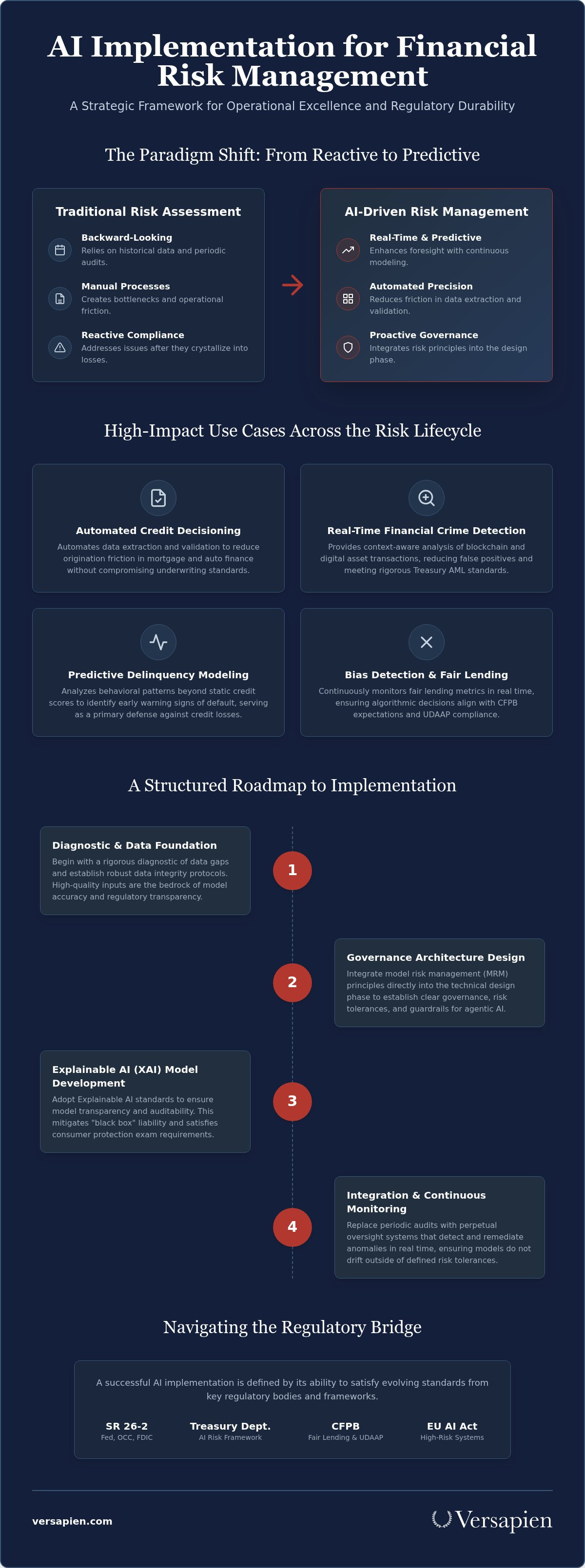
An effective AI implementation for risk management is the systematic integration of machine learning, and increasingly agentic AI, into an institution's core governance, risk, and compliance (GRC) frameworks. This approach fundamentally diverges from traditional, static assessments that analyze historical data in periodic cycles. Instead, AI-driven risk management enables a real-time, predictive posture, allowing organizations to anticipate and mitigate threats before they materialize into material losses or regulatory breaches. The objective is to evolve from a collection of manual, siloed data processes into an integrated and intelligent risk ecosystem.
For institutions engaged in high-velocity consumer lending, auto finance, and digital asset services, this shift is essential for maintaining both competitiveness and compliance. As transaction speeds accelerate and data volumes expand, manual oversight becomes increasingly inefficient and prone to error, making a well-governed AI implementation a cornerstone of modern operational resilience.
The Core Components of an AI-Driven Risk Framework
A durable AI risk framework is built upon three interdependent pillars. Each must be architected with regulatory expectations in mind to ensure the system is not only powerful but also transparent and auditable.
Data Integrity: The accuracy, fairness, and predictive power of any AI model are direct functions of the data on which it is trained. Establishing unimpeachable data integrity is the bedrock of a defensible AI program. This involves rigorous data hygiene, clear data lineage, and governance policies that protect consumer privacy while ensuring the completeness required for unbiased model development.
Algorithmic Governance: Models are not static assets; they require continuous oversight to ensure they operate within defined risk tolerances and do not "drift" into non-compliant behavior. Algorithmic governance involves establishing clear policies for model development, validation, and monitoring, aligning with established principles of Model Risk Management (MRM) as outlined in guidance like SR 11-7.
Continuous Monitoring: The era of periodic, point-in-time audits is giving way to perpetual oversight. An AI-driven framework facilitates continuous monitoring of risk controls, model performance, and potential biases, providing leadership with a real-time view of the institution's risk posture and enabling proactive intervention.
Why 2026 is the Pivotal Year for Risk Modernization
Several converging forces make the coming years a critical window for financial institutions to modernize their risk management capabilities. Delaying action introduces the risk of being outpaced by more agile competitors and unprepared for a more stringent regulatory environment.
Increased Regulatory Scrutiny: Federal agencies, particularly the CFPB, are explicitly focused on algorithmic bias, digital redlining, and the explainability of automated consumer-facing decisions. Institutions must be prepared to demonstrate that their AI systems are fair, transparent, and do not result in disparate outcomes for protected classes.
The Rising Cost of Manual Compliance: In a digital-first economy, the operational and financial burden of manual compliance continues to grow. AI implementation offers a path to automate repetitive tasks, reduce false positives in areas like AML monitoring, and allocate expert human resources to higher-value strategic oversight, making compliance more effective and cost-efficient.
This drive toward intelligent automation is also transforming how consumers navigate complex choices; for instance, Vinoperte leverages personalized AI to simplify the selection process in the hospitality and retail sectors, highlighting the versatility of predictive technology.
Similarly, in the realm of personal finance, Easy Wealth AI serves as a family AI CFO, utilizing intelligent classification and automated bookkeeping to provide families with real-time financial reporting and clarity.
Strategic AI Use Cases Across the Risk Management Lifecycle
The application of AI in risk management extends across the entire financial services ecosystem, from loan origination to ongoing compliance monitoring. By strategically targeting high-impact areas, institutions can achieve measurable improvements in efficiency, accuracy, and regulatory adherence.
Automated Credit Decisioning: AI models can analyze thousands of data points to enhance precision in consumer lending and mortgage underwriting, moving beyond traditional credit scores to create a more holistic and equitable assessment of creditworthiness.
Financial Crime Compliance: In the realm of Bank Secrecy Act (BSA) and Anti-Money Laundering (AML) compliance, AI offers real-time fraud detection and transaction monitoring, particularly for complex and high-volume digital asset transactions.
Regulatory Change Management: Natural Language Processing (NLP) and other AI tools can be used to monitor, interpret, and map evolving regulatory requirements, ensuring that an institution's policies and controls remain current and comprehensive.
Operational Resilience: By analyzing vast datasets from internal systems, AI can predict potential systemic failures, IT disruptions, or third-party vendor risks before they impact consumer services, strengthening the institution's overall operational resilience.
AI in Consumer Lending and Auto Finance
For consumer lenders, the proper AI implementation can provide a significant edge in a competitive market while reinforcing fair lending principles. Predictive delinquency modeling allows institutions to identify at-risk borrowers early and offer proactive assistance, mitigating credit losses. Crucially, sophisticated bias-detection algorithms can be integrated into the model development lifecycle to test for and correct potential discriminatory outcomes, creating a stronger and more defensible fair lending assessment. Furthermore, AI-powered document intelligence can streamline the verification of income, assets, and identity in mortgage and auto loan originations, reducing friction for consumers and operational costs for the lender. For those seeking to better understand this balance, a deeper exploration of modernizing consumer lending compliance is essential.
Financial Crime and Digital Asset Oversight
The fight against financial crime has become increasingly complex with the rise of digital assets and sophisticated money laundering schemes. Traditional rules-based monitoring systems often generate a high volume of false positives, consuming valuable analyst time. AI implementation, through advanced pattern recognition, can dramatically reduce these false positives in Know Your Customer (KYC) and AML workflows. For institutional crypto entities and fintechs, agentic AI presents an opportunity for more sophisticated transaction monitoring, capable of identifying subtle and complex illicit financing typologies that evade legacy systems. Integrating these advanced capabilities into a formal BSA compliance program is a critical step for firms operating in the digital asset space. The governance challenges that accompany this shift are significant, requiring a robust framework as detailed in analyses of how AI is transforming BSA/AML compliance.
Navigating the Regulatory Bridge: Compliance and Governance
The primary objection from boards and senior leadership regarding AI implementation often centers on the "black box" problem—the fear that an indecipherable algorithm will become a significant regulatory liability. This concern is valid and must be addressed directly through a commitment to building Explainable AI (XAI). XAI encompasses a set of techniques and practices designed to make AI decision-making processes transparent and understandable to human stakeholders, including internal auditors, compliance officers, and external examiners. Without explainability, an institution cannot adequately defend its models against accusations of bias or unfair treatment of consumers.
A cornerstone for building this defensible posture is mapping the AI implementation to established standards, most notably the NIST AI Risk Management Framework (RMF). While not a financial regulation itself, the NIST AI RMF provides a structured, voluntary framework for managing the risks associated with AI systems. Adopting its principles of governance, mapping, measurement, and management provides a clear and auditable trail that demonstrates a commitment to responsible AI innovation.
Aligning AI Innovation with Consumer Finance Expectations
For institutions under the purview of the CFPB, OCC, or other federal banking regulators, any AI implementation must be built upon a framework designed to survive intense scrutiny. This begins with proactively addressing the risk of algorithmic bias and UDAAP (Unfair, Deceptive, or Abusive Acts or Practices) violations. Thorough documentation of the model development process is non-negotiable, forming the core of a robust Model Risk Management (MRM) program. This documentation should detail data sources, feature selection, fairness testing, and validation results. In high-stakes decisioning processes, such as adverse action on a credit application, incorporating a human-in-the-loop (HITL) review process remains a critical control for mitigating risk and ensuring that automated decisions can be reviewed and explained.
Governance as a Stability Mechanism
Effective AI governance is not a one-time project but an ongoing discipline that provides a stability mechanism for innovation. This requires establishing clear, board-level oversight for all significant AI implementation projects, ensuring that accountability rests at the highest levels of the organization. To manage performance, the board and senior leadership should define and track measurable Key Performance Indicators (KPIs) for AI-driven risk reduction, such as lower credit loss rates, reduced false positives in AML alerts, or improved compliance audit outcomes. This governance structure must be designed for durability, capable of adapting to an evolving regulatory landscape and ensuring that the institution's use of AI remains both effective and compliant over the long term.
The AI Implementation Roadmap: From Strategy to Execution
A successful AI implementation for risk management follows a structured, phased approach that moves methodically from initial assessment to perpetual optimization. Rushing this process without establishing the proper governance and data foundations is a common cause of failure.
Phase 1: Diagnostic Assessment. The initial phase involves a comprehensive review of the institution's current risk landscape to identify high-impact areas where AI can deliver the most significant value. This includes a thorough assessment of existing data infrastructure to pinpoint gaps in quality, completeness, or accessibility that must be remediated.
Phase 2: Framework Design. With a clear understanding of the objectives and data readiness, the next step is to build the governance and compliance architecture. This includes drafting policies for model risk management, establishing the AI governance committee, and aligning the program with frameworks like the NIST AI RMF.
Phase 3: Controlled Pilot. Before a full-scale rollout, AI models should be tested in a controlled pilot program. This allows the institution to validate model performance, refine processes, and demonstrate value in a low-stakes, high-visibility environment, building internal buy-in and confidence.
Phase 4: Scaled Integration. Following a successful pilot, the AI solution can be methodically integrated across core risk and resilience functions. This phase requires careful project management to ensure a smooth transition from legacy systems and adequate training for all relevant personnel.
Phase 5: Perpetual Optimization. AI implementation is not a static endpoint. The final phase involves continuous, iterative monitoring of model performance and the broader risk environment. Models must be periodically retrained and refined to adapt to new data and evolving threats, ensuring their long-term effectiveness and compliance.
Data Preparation and Integrity
The success of any AI initiative is predicated on the quality of its underlying data. Many financial institutions possess vast reserves of legacy data, which must be cleaned, normalized, and validated to create high-fidelity training sets for AI models. This process requires establishing strong data governance policies to protect consumer privacy and ensure compliance with regulations like the Gramm-Leach-Bliley Act (GLBA). Ultimately, data hygiene—the practice of maintaining clean, accurate, and well-governed data—is the primary predictor of AI success.
Program and Project Management for AI
Treating an AI implementation as a pure technology project is a critical mistake. It is a significant digital transformation initiative that requires structured program and project management. Establishing clear milestones, deliverables, and communication protocols is essential for keeping the project on track and aligned with strategic objectives. The project leadership must balance the desire for rapid innovation with the rigorous demands of regulatory change management. When leveraging external expertise, the goal of any project-based consulting should be to build sustainable internal capabilities, ensuring the institution can manage and evolve its AI systems long after the initial engagement is complete.
Engaging an Advisory Partner for Strategic Oversight
Successfully navigating the complexities of an AI implementation for risk management—from regulatory interpretation to technical execution—often requires specialized expertise that may not exist entirely in-house. While large, mass-market consulting firms offer broad capabilities, the nuanced demands of consumer finance regulation and the specific risk profiles of fintechs, lenders, and digital asset firms often call for a more focused approach. The right advisory partner acts as a strategic architect, bridging the critical gap between executive strategy, technical data science, and regulatory compliance.
Boutique Advisory vs. Mass-Market Consulting
A boutique advisory partner provides direct access to deeply specialized expertise in areas like consumer lending, BSA/AML, and digital asset compliance. This focus allows for the development of tailored solutions that avoid the "one-size-fits-all" templates common among larger firms, which may not be suited to the unique operational realities and risk appetites of a specific institution. This approach is built on a foundation of professional gravity and quiet competence, prioritizing the delivery of durable, measurable results over high-volume sales. The value lies in building a stable, defensible program, not simply implementing software.
Actionable Framework for Executive Leadership
Moving from conceptual understanding to practical execution requires a deliberate and structured plan. For Chief Risk Officers, Chief Compliance Officers, and other senior leaders tasked with overseeing this transition, the following actions provide a clear path forward for initiating a sound AI implementation for risk management.
1. Conduct a Comprehensive Risk and Data Readiness Assessment.
Before any technology is selected, commission a formal assessment to identify the most pressing risk management challenges and evaluate the state of your institution's data assets. This diagnostic should map specific business problems to potential AI use cases and produce a clear-eyed analysis of your data integrity, governance, and accessibility. The outcome should be a prioritized list of opportunities and a roadmap for any necessary data remediation.
2. Establish a Cross-Functional AI Governance Committee.
Assemble a dedicated governance committee with representation from Risk, Compliance, Legal, IT, Data Science, and relevant business lines. This body should be charged with developing and overseeing the institution's AI strategy, setting risk tolerance levels, approving new model deployments, and ensuring all activities align with regulatory requirements and ethical standards. Formalize its charter and grant it the authority to provide effective oversight.
3. Map Existing Governance to the NIST AI RMF.
Direct your compliance and risk teams to perform a gap analysis between your current governance frameworks (e.g., MRM, change management) and the principles of the NIST AI Risk Management Framework. This exercise will reveal areas where existing policies must be enhanced to specifically address the unique risks of AI systems, such as explainability, bias, and data privacy. This provides a defensible structure for demonstrating prudent risk management to examiners.
4. Design and Initiate a Controlled Pilot Program.
Select a single, well-defined use case from your readiness assessment for a controlled pilot program. Choose an area where success can be clearly measured and the potential impact of failure is contained, such as reducing false positives in transaction monitoring rather than automating final credit decisions. A successful pilot will build institutional momentum and provide invaluable lessons for a broader rollout.
5. Prepare for Heightened Regulatory Scrutiny.
Begin building the documentation and evidentiary records needed to withstand a rigorous regulatory examination of your AI systems. This includes detailed records of model development, validation, fairness testing, and ongoing monitoring. Engaging a strategic advisor like Versapien can help ensure your governance framework, policies, and documentation are architected from the outset to meet the exacting standards of the CFPB, OCC, and other financial regulators.
By taking these deliberate steps, leadership can guide the organization toward a future where AI is not a source of regulatory anxiety, but a powerful, well-governed tool for building a more resilient and competitive institution. Partner with Versapien to navigate your AI risk transformation.


Comments