
AI Model Validation: What Financial Institutions Should Expect Before Deployment
Updated: Sep 22
Before an AI model is deployed, a financial institution should understand what the model does, how it performs, where it can fail, and whether the resulting risks are acceptable. Validation provides an independent assessment of those questions before the model begins affecting customers, transactions, or business decisions. This process serves as a critical control, translating complex technical assessments into clear business and risk considerations for the appropriate decision-makers.
While established principles of model risk management, such as those outlined in the Office of the Comptroller of the Currency's (OCC) guidance and the Federal Reserve’s SR 11-7, provide a durable foundation, their application requires careful consideration for modern AI systems. The validation approach for a machine-learning model used in fraud detection will differ from that of a generative AI tool for marketing copy or a predictive model for credit underwriting. The objective is not a one-size-fits-all checklist but a risk-based framework that provides decision-makers with a defensible rationale for moving a model into production.
Table of Contents
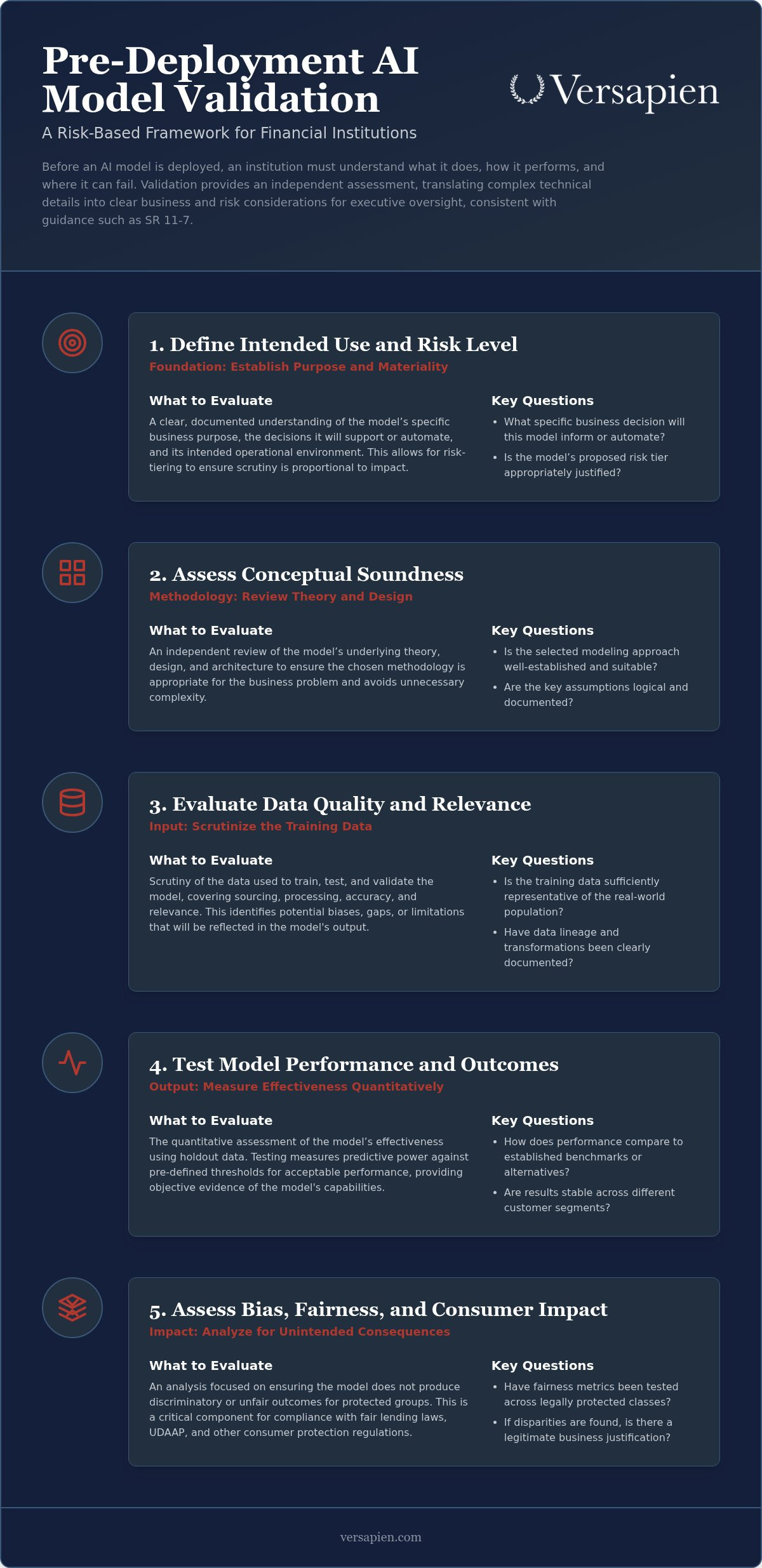
A Framework for Pre-Deployment AI Model Validation
A structured pre-deployment validation framework ensures that key risk domains are consistently evaluated. The depth of each assessment should be proportionate to the model's materiality, complexity, and potential impact on consumers and the institution. The following nine areas provide a comprehensive structure for this critical evaluation.
1. Define the Intended Use and Risk Level
What to evaluate: The validation starts with a clear, documented understanding of the model’s specific business purpose. This includes defining the exact problem the model is designed to solve, the decisions it will support or automate, and its intended operational environment.
Why it matters: Without a precise scope, validation becomes an unfocused technical exercise. Defining the intended use establishes the benchmark against which all subsequent tests are measured. It also allows for risk-tiering, ensuring that high-impact models, such as those used for credit decisions, receive more rigorous scrutiny than low-risk models used for internal process optimization.
Questions to ask:
What specific business decision will this model inform or automate?
Who are the intended users of the model’s outputs?
What is the potential financial, reputational, and consumer-impact risk if the model performs poorly?
Is the model’s proposed risk tier (e.g., high, medium, low) appropriately justified?
Supporting evidence: A formal model proposal document, business requirements documentation, and minutes from a governance committee approving the model’s development and intended risk tier.
2. Assess Conceptual Soundness and Model Design
What to evaluate: This involves an independent review of the model’s underlying theory, design, and architecture. Validators should assess whether the chosen methodology, be it a traditional regression model, a gradient-boosted machine, or a large language model, is appropriate for the defined business problem.
Why it matters: A model may produce statistically strong results in testing but be built on a flawed or unnecessarily complex premise. Assessing conceptual soundness helps prevent the deployment of models that are difficult to maintain, explain, or adapt over time. For more complex systems, this review confirms that the design choices are deliberate and justified rather than arbitrary. For more on this, see our guide to model risk management in the age of artificial intelligence.
Questions to ask:
Is the selected modeling approach well-established and suitable for this use case?
Are the key assumptions underlying the model logical and documented?
Does the model design introduce unnecessary complexity?
For vendor-provided models, is the documentation sufficient to understand the conceptual design?
Supporting evidence: Model development documents, academic research or industry white papers supporting the chosen methodology, and architectural diagrams.
3. Evaluate Data Quality, Relevance, and Limitations
What to evaluate: This component scrutinizes the data used to train, test, and validate the model. The assessment covers data sourcing, processing, completeness, accuracy, and relevance to the business problem. It also involves identifying any potential biases, gaps, or limitations in the datasets.
Why it matters: An AI model is a reflection of the data it was trained on. Flawed, biased, or irrelevant data will produce a flawed, biased, or irrelevant model, regardless of the sophistication of the algorithm. Understanding data limitations is crucial for defining the model's appropriate operating boundaries.
Questions to ask:
Is the training data sufficiently representative of the real-world population the model will encounter?
What steps were taken to identify and handle missing values, outliers, or erroneous data?
Are there known biases in the data source (e.g., historical human biases) that could be learned by the model?
Have data lineage and transformations been clearly documented?
Supporting evidence: Data dictionaries, data profiling reports, exploratory data analysis documentation, and records of data pre-processing steps.
4. Test Model Performance and Outcomes
What to evaluate: This is the quantitative assessment of the model’s effectiveness. It involves testing the model against a holdout dataset to measure its predictive power, accuracy, or other relevant performance metrics. For generative AI systems, evaluation may include task-specific measures of output quality, accuracy, consistency, relevance, and safety, potentially supplemented by automated metrics or comparison against defined reference outputs.
Why it matters: Performance testing provides objective evidence of whether the model can achieve its intended goal. It moves beyond theory to demonstrate the model’s capabilities in a controlled environment. This step also requires establishing clear, pre-defined thresholds for acceptable performance.
Questions to ask:
What are the key performance metrics for this model, and why were they chosen?
How does the model’s performance compare to established benchmarks or alternative models?
Has the model been tested on out-of-time or out-of-sample data to assess its generalizability?
Are the performance results stable across different customer segments or demographic groups?
Supporting evidence: Model validation reports detailing test methodologies and results, challenger model comparisons, and back-testing or simulation results.
5. Assess Bias, Fairness, and Consumer Impact
What to evaluate: For models that affect consumers, particularly in areas like lending or marketing, this is a critical validation step. It involves specific statistical tests to detect potential bias or disparate impacts on protected classes. This assessment examines whether the model’s outcomes are equitable across different demographic groups, even if the model does not explicitly use protected characteristics as inputs.
Why it matters: For models that affect consumers, institutions should evaluate whether model outcomes create fair lending, consumer protection, or other compliance risks. The nature and depth of that analysis should reflect the model's intended use, applicable legal requirements, and potential impact on consumers. Identifying and mitigating potential fairness issues before deployment is essential for managing compliance with regulations like the Equal Credit Opportunity Act (ECOA) and preventing reputational damage. This is a core component of sound consumer lending compliance.
Questions to ask:
What fairness metrics (e.g., adverse impact ratio, statistical parity) were used, and are they appropriate for this use case?
Were proxy variables for protected characteristics identified and their impact analyzed?
If disparities were found, what steps were taken to mitigate them, and what is the residual risk?
How will the institution explain the model’s decision-making process for adverse action notices?
Supporting evidence: Fairness testing reports, disparate impact analysis, documentation of any risk mitigation steps taken, and adverse action notice logic.
6. Evaluate Explainability and Transparency
What to evaluate: This area assesses the degree to which a model’s decisions can be understood. The level of required explainability varies. A credit underwriting model requires a high degree of transparency to generate adverse action reasons, while an internal operational model may require less. Techniques like SHAP (SHapley Additive exPlanations) or LIME (Local Interpretable Model-agnostic Explanations) can be used to interpret complex models.
Why it matters: "Black box" models create significant business and regulatory risk. The level of explainability needed should be appropriate to the model's use, complexity, potential impact, and applicable legal or regulatory requirements. For certain consumer-facing decisions, the institution may need to understand and communicate the reasons underlying model outputs with a greater degree of specificity. For consumer-facing models, explainability is often a direct regulatory requirement for providing clear and accurate reasons for decisions.
Questions to ask:
Is the level of explainability appropriate for the model’s risk and intended use?
Can the model produce clear, compliant reason codes for its decisions where required?
How will the model’s logic be explained to internal stakeholders, auditors, and examiners?
What is the trade-off between the model's performance and its interpretability?
Supporting evidence: Explainability analysis reports (e.g., SHAP plots), documentation of reason code logic, and sample explanations for model outputs.
7. Test for Failure Modes and Limitations
What to evaluate: This involves stress testing the model to understand its breaking points. Validators should assess the model’s robustness by exposing it to extreme or unexpected inputs, adversarial data, and simulated scenarios of significant market or environmental shifts. This also includes identifying the model’s core limitations and defining the conditions under which it should not be used.
Why it matters: A model that performs well under normal conditions may fail catastrophically in a crisis. Identifying these vulnerabilities before deployment allows the institution to build appropriate controls, such as circuit breakers or manual review triggers, to prevent significant losses or customer harm.
Questions to ask:
How does the model perform under simulated recessionary or high-volatility scenarios?
What happens when the model receives unexpected or nonsensical data inputs?
Is the model susceptible to adversarial attacks designed to manipulate its outcomes?
Are the model’s operational limitations clearly documented and understood by its users?
Supporting evidence: Stress testing and sensitivity analysis reports, scenario analysis documentation, and a formally documented list of model limitations.
8. Review Controls, Human Oversight, and Escalation Procedures
What to evaluate: A model does not operate in a vacuum. This step reviews the end-to-end process in which the model will be embedded. It includes assessing the planned monitoring procedures, the role of human oversight, the qualifications of the personnel who will use the model, and the defined protocols for escalating issues or overriding model decisions.
Why it matters: Even a perfectly validated model can create risk if its operational controls are weak. Strong human oversight and clear escalation paths ensure that model errors or performance degradation are detected and addressed quickly. This governance layer is a key expectation of effective AI governance committees.
Questions to ask:
What key metrics will be monitored after deployment to detect model performance decay?
Under what specific conditions can a human user override the model’s output?
What is the process for investigating and responding to a customer complaint related to a model decision?
Is there a defined plan for retiring or replacing the model?
Supporting evidence: A comprehensive model monitoring plan, user training materials, process flow diagrams showing human intervention points, and incident response procedures.
9. Document Findings and Establish Approval Conditions
What to evaluate: The final step of pre-deployment validation is to synthesize all findings into a formal report. This report should provide a clear, independent opinion on the model’s fitness for purpose, identify all material findings and limitations, and recommend specific conditions for its approval and deployment.
Why it matters: This documentation creates an official record of the validation process and its conclusions. It provides executive decision-makers with a consolidated view of the model’s risks and mitigating factors. Conditional approval, such as requiring a six-month post-deployment review or limiting the model’s use to a pilot group, is a sound practice for managing residual risks.
Questions to ask:
Does the final validation report provide a clear recommendation on whether to approve the model for production?
Are all identified weaknesses or limitations documented with corresponding management action plans?
Have the model owner and business unit formally acknowledged and accepted the model’s residual risks?
Is there a clear audit trail of the validation process and the final approval decision?
Supporting evidence: The final, signed-off model validation report, management’s formal response to validation findings, and minutes from the governance body that approved the model for deployment.
Executive Checklist: Questions to Answer Before an AI Model Goes Live
Before giving the final approval for deployment, executive management and risk committees should confirm that the validation process has provided satisfactory answers to a core set of questions. This checklist serves as a final governance gate.
Purpose and Scope: Is the intended use clearly defined, and has it been formally approved?
Independent Review: Has the model been independently tested and validated by a qualified party separate from the model developers?
Data Integrity: Are the data sources, quality, and important limitations well understood and documented?
Performance: Are the model’s performance results acceptable for the intended use and stable across key segments?
Consumer Impact: Have material bias and consumer-impact risks been evaluated and mitigated to an acceptable level where relevant?
Failure Modes: Are the model's significant limitations and potential failure modes documented and understood by the business?
Human Oversight: Are human oversight, intervention, and escalation procedures clearly defined and implemented?
Issue Resolution: Have all high-risk validation findings been resolved, or have the residual risks been formally accepted?
Accountability: Is there clear accountability for the final deployment decision and ongoing performance of the model?
Executive Takeaways
AI model validation is not intended to eliminate all model risk. Its purpose is to provide assurance that the institution understands the model's capabilities, limitations, and potential risks before it affects customers, financial outcomes, or critical business processes. A rigorous, independent validation process transforms a model from a technical construct into a well-governed business tool.
By adopting a structured framework, financial institutions can establish a repeatable and defensible process that supports both innovation and safety. This approach ensures that decision-makers are equipped with the necessary information to make a sound risk-based judgment on whether, and under what conditions, a new AI model should be deployed.


Comments