
AI ROI in Banking: How Executives Can Measure Productivity, Risk Reduction and Business Value
AI productivity is not the same as AI value. Measuring AI return on investment means linking outcomes attributable to an AI use case to its full costs, then comparing that value with a credible pre-AI baseline. Without separating the tool’s contribution from other process or market changes, it can be difficult to interpret improved results.
Banking executives are right to look beyond adoption and time saved: neither demonstrates financial impact on its own. A sound assessment connects productivity, risk reduction, service quality, or revenue to defined business outcomes while accounting for implementation, oversight, and ongoing operating costs. This article explains how to define value, establish meaningful measures, and translate operational gains into financial terms. It also shows how controlled comparisons and explicit assumptions help leaders distinguish AI’s contribution from changes elsewhere in the business.
Table of Contents
Measuring AI's Contribution to Banking Performance
For banking executives, the challenge is determining whether AI investments are improving business performance in ways that justify their cost and associated risks. That requires looking beyond adoption and productivity metrics to understand how AI affects operating expenses, business capacity, customer outcomes, revenue, and risk exposure. The measures used should reflect the specific business objective and provide credible evidence of the initiative's contribution.
Executives should distinguish between financial returns, operational capacity, and risk reduction when evaluating AI investments. Reduced labor hours do not necessarily translate into lower expenses, particularly when employees are reassigned rather than eliminated. Likewise, improved fraud detection, fewer processing errors, or stronger compliance outcomes may reduce potential losses and improve control effectiveness without generating immediate financial savings. Reporting these benefits separately gives leadership a more realistic view of the investment's contribution and avoids overstating ROI.
Revenue, Efficiency, and Customer Value
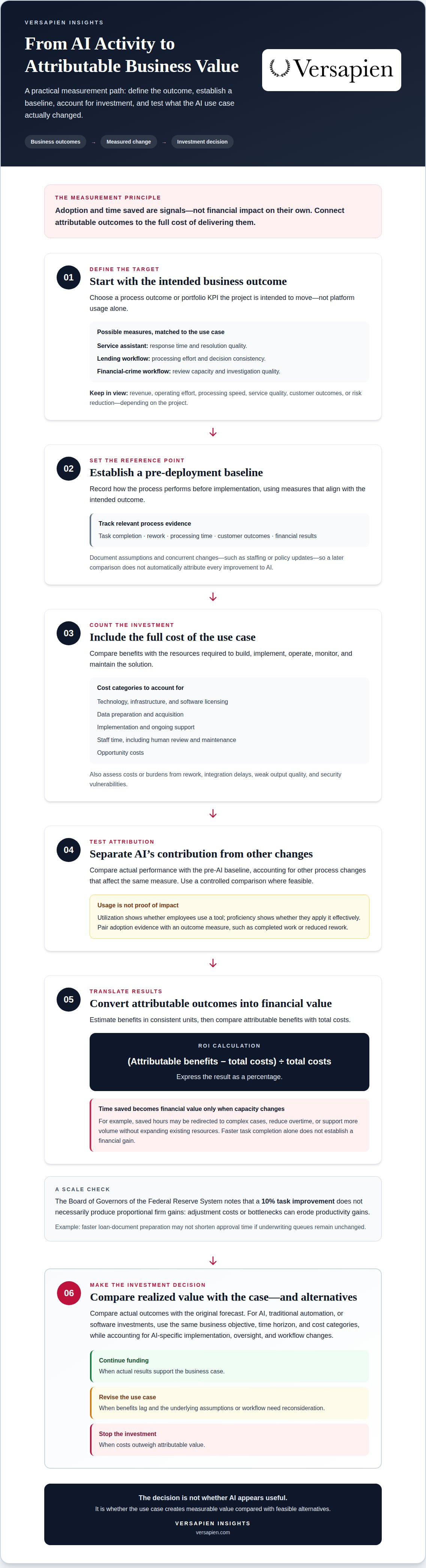
These metrics show whether AI affects revenue, operating effort, processing speed, or customer outcomes. Choose measures that fit the use case: assess a service assistant through response time and resolution quality, for example, or track processing effort and decision consistency in a lending workflow.
Utilization shows whether employees use a tool; proficiency shows whether they apply it effectively. Neither proves impact. Pair adoption evidence with an outcome metric, such as completed work or reduced rework, to distinguish routine use from improved performance.
Financial Value, Costs, and Attribution
Financial value translates attributable outcomes into business terms and compares them with the investment. Include infrastructure, labor, data acquisition, and software licensing, as well as implementation and ongoing support. Measuring AI return on investment also means accounting for the resources needed to build, operate, monitor, and maintain the solution, including staff time.
Estimate benefits using consistent units, then divide net value, benefits minus costs, by total costs. To attribute gains, compare results with the pre-AI baseline and account for other process changes that affect the same metric.
Speed to Value and Measurable Projects
Speed to value is the time between deployment and observable business impact. Adoption, learning, and workflow changes can delay benefits. Track task completion, rework, processing time, customer outcomes, and financial results relevant to the use case.
Examples include an AI assistant that helps service staff draft responses and a financial-crime workflow that prioritizes alerts. For customer service, compare handling time, resolution quality, customer outcomes, and downstream rework with established baselines. For financial crime, assess whether prioritization increases investigation capacity while preserving detection quality, controlling false positives, maintaining coverage of suspicious activity, and supporting sound investigation decisions. Evaluate the end-to-end process rather than treating an isolated efficiency metric as proof of value.
Translating Productivity Gains and Risk Reduction into Financial Value
Time saved has financial value only when an organization can put that capacity to work. A bank might redirect hours saved on document review to complex cases, reduce overtime, or handle more volume without expanding existing resources. These are operational capacity gains, not direct cost savings unless they change the bank's financial records, such as reducing external spend or overtime. In lending, faster document processing should also be evaluated against underwriting quality, decision consistency, approval outcomes, and customer outcomes. The financial result depends on which constraint changes, not simply on faster output.
According to the Board of Governors of the Federal Reserve System, a 10% task improvement may not produce proportional firm gains because adjustment costs or bottlenecks can erode productivity gains. For example, faster loan-document preparation may not shorten approval time if underwriting queues remain unchanged. The U.S. Bureau of Labor Statistics identifies productivity as one metric for investigating AI’s economic impact.
The costs of AI extend beyond initial implementation and licensing. Implementation may add expenses for infrastructure, data preparation, software, monitoring, and staff review. Rework, integration delays, weak output quality, or security vulnerabilities can also offset savings and add process burdens. Assess these effects alongside labor reduction, revenue changes, and customer outcomes. Rework, integration delays, weak output quality, or security vulnerabilities can also offset savings and add process burdens. Assess these effects alongside labor reduction, revenue changes, and customer outcomes.
Risk reduction is a distinct source of value. AI can improve identification and prioritization of suspicious transactions, strengthen fraud detection and reduce exposure to preventable losses, identify operational errors more consistently, improve the quality and timeliness of compliance reviews, and decrease manual-processing risk and downstream remediation. These benefits may not create immediate financial savings, so they should be reported separately from realized returns. Balanced metrics are essential: evaluate fraud detection alongside false-positive rates, missed activity, investigation quality, analyst workload, and the coverage and timeliness of suspicious-activity reviews. A more efficient process can still destroy value if poor output increases remediation or weakens controls.
To strengthen attribution, compare results with the same process before implementation and document concurrent changes, such as staffing or policy updates. This helps distinguish AI’s contribution from broader operational improvements. Organizations evaluating these trade-offs should discuss AI implementation and business-value questions with an advisor.
Making AI ROI Part of Investment and Portfolio Governance
Two projects with similar budgets can create different value because they serve different business objectives. Executives should define success against the portfolio KPI each project is intended to move, not AI adoption alone. For document review, that might mean improving case throughput without weakening review quality.
A practical framework connects five elements: intended outcome, pre-deployment baseline, total investment, attributable change, and realized result. Establish the baseline before deployment, then compare actual outcomes with the original forecast. This distinguishes measurable business value from activity such as prompts submitted or employees given platform access.
Calculate ROI by subtracting total costs from attributable benefits, dividing the net value by total costs, and expressing the result as a percentage. Include technology, data, human capital, and opportunity costs in the investment view. Record assumptions where measurement is incomplete, and update estimates as operating evidence becomes available.
For a meaningful comparison, benefits and costs should be measured over the same evaluation period. The calculation should distinguish forecast benefits from realized results and account for ongoing technology, staffing, oversight, and maintenance expenses. Where benefits are difficult to monetize, such as additional employee capacity or reduced risk exposure, report them separately and document the assumptions used rather than presenting estimates as realized financial returns.
AI investments should be evaluated against traditional automation and software alternatives using the same business objectives, evaluation periods, and cost categories. Executives should also account for AI-specific implementation, oversight, and workflow requirements. This creates a more meaningful comparison of the available investment options and helps determine whether AI offers sufficient incremental value to justify its additional complexity and cost.
This discipline connects AI measurement to investment and portfolio governance. For each initiative, leadership should ask three questions: Is the initiative delivering the business outcome originally approved? Are realized benefits sufficient to justify the full investment, including ongoing operating and oversight costs? Does the initiative remain a better use of capital and resources than available alternatives?
The answers should guide whether to continue, scale, adjust, or terminate the initiative. Business owners can explain operational effects, finance can assess the value calculation, and risk and compliance teams can evaluate control outcomes and relevant exposure. Assign clear ownership for the business case, validate reported outcomes, compare actual results with the approved forecast, and use portfolio reviews to make funding decisions as evidence and priorities change.
Executive Takeaways
AI investment decisions require more than adoption figures or reported time savings. Executives can improve capital allocation by measuring outcomes against a baseline, separating types of value, and linking evidence to portfolio decisions.
Establish measurable business outcomes and pre-implementation baselines before deployment.
Distinguish realized financial returns from operational capacity gains and risk benefits.
Capture full lifecycle costs, including implementation, technology, data, staffing, oversight, and maintenance.
Assess AI attribution by accounting for concurrent process, staffing, policy, and market changes.
Monitor performance against the approved business case and use the results to continue, scale, adjust, or terminate funding.
Establish clear accountability for benefit measurement, validation, and reporting.
How Versapien Can Help
Financial institutions need a disciplined approach to evaluating AI investments, particularly when expected productivity gains, risk benefits, and implementation costs are difficult to quantify. Versapien advises financial services leaders on assessing AI governance and risk considerations, evaluating business cases, and developing practical approaches to measuring investment performance. Our focus is helping leadership gain a clearer understanding of where AI initiatives are creating value, where material gaps exist, and what actions should inform future investment decisions. Contact Versapien to discuss your organization's AI governance and business-value priorities.



Comments