
BSA/AML Governance: Building Effective Board and Management Oversight
Updated: Sep 22
Effective BSA/AML governance requires more than approving policies and receiving periodic reports. Boards and senior management need enough information, authority, and organizational visibility to understand the institution's financial crime risk profile, assess whether the program is operating as intended, and determine whether significant risks and weaknesses are being addressed. The appropriate governance structure will vary with an institution's size, complexity, products, services, and risk profile. This article examines the respective roles of the Board, senior management, and the BSA Officer and identifies the information, questions, and governance practices that can support effective oversight of a BSA/AML program.
Table of Contents
Defining Board and Management Responsibilities in BSA AML Governance
A durable Bank Secrecy Act/Anti-Money Laundering (BSA/AML) governance framework is built on a clear delineation of duties between the Board of Directors and senior management. While their functions are complementary, they are distinct. The Board provides strategic oversight and direction, while management is responsible for the program’s day-to-day execution. Misalignment between these roles can lead to gaps in accountability, inadequate resource allocation, and a diminished capacity to manage financial crime risk.
Based on guidance from the FFIEC BSA/AML Examination Manual, the responsibilities can be understood as follows:
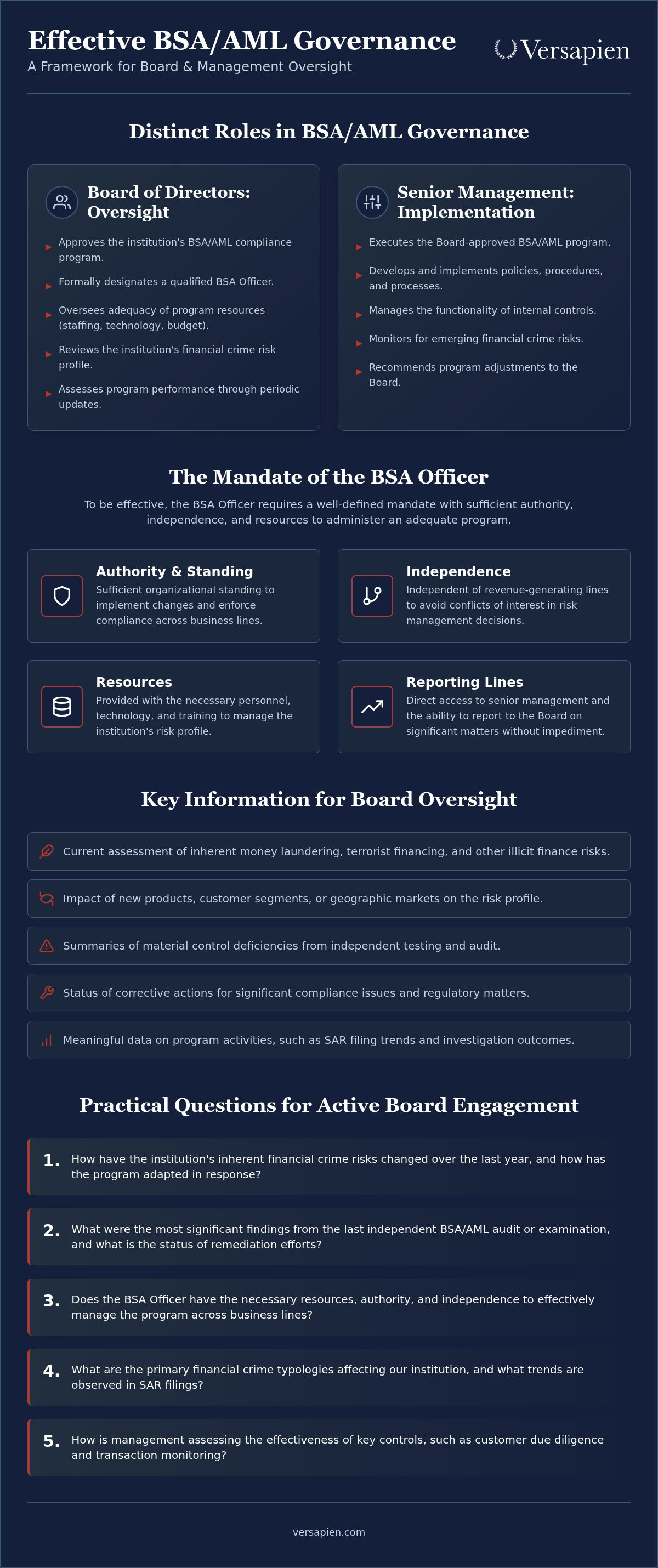
Board of Directors Oversight: The Board is responsible for approving the institution’s BSA/AML compliance program and designating a qualified BSA Officer. Its oversight responsibilities include ensuring that the BSA/AML compliance function has appropriate authority, independence, access to information, and resources, consistent with the institution’s risk profile. The Board should review and understand the institution's overall financial crime risk profile and periodically receive updates from management and the BSA Officer to assess program performance and address significant issues.
Senior Management Implementation: Senior management is tasked with carrying out the Board-approved program. This involves developing and implementing policies, procedures, and processes that translate the Board's strategic direction into operational reality. Management ensures that lines of business understand their BSA/AML responsibilities, internal controls are functioning as designed, and staff receive appropriate training. They are also responsible for monitoring emerging risks and recommending necessary program adjustments to the Board.
The Role and Authority of the BSA Officer
The BSA Officer is central to the governance structure, acting as the designated leader of the BSA/AML program. To be effective, this individual or office needs a well-defined mandate. According to regulatory guidance, the BSA Officer should have sufficient authority, independence, and resources to administer an adequate program. This includes:
Authority and Standing: The BSA Officer should have a level of authority and organizational standing that allows them to implement necessary changes and enforce compliance across business lines without undue obstruction.
Independence: The BSA Officer should have sufficient authority, independence, organizational standing, and access to information and resources to administer the BSA/AML program effectively. The governance structure should provide appropriate separation from business-line pressures that could impair the officer’s ability to carry out those responsibilities.
Resources: The BSA Officer and their team must be provided with the necessary personnel, technology, and training to manage the institution's specific risk profile.
Reporting Lines: The BSA Officer should have regular access and a direct reporting line to senior management and be able to report directly to the Board or a committee of the Board on significant matters. The FFIEC manual does not prescribe a specific reporting structure but emphasizes that the officer must have the ability to communicate critical issues to the highest levels of the organization without impediment.
What the Board Should Know and Ask
Effective Board oversight depends on receiving clear, concise, and risk-focused information. Passive reception of reports is insufficient; directors should actively probe the information presented to understand its implications. Management reporting should provide the Board with a comprehensive view of the BSA/AML risk environment and program performance.
Key areas for Board-level reporting and inquiry include:
The Institution's Risk Profile: A current assessment of the institution’s inherent money laundering, terrorist financing, and other illicit finance risks. This should include analysis from the institution's financial crime risk assessment.
Significant Business Changes: Updates on how new or changing products, customer segments, geographic markets, or delivery channels affect the risk profile and control environment.
Control Weaknesses and Testing Results: Summaries of material control deficiencies identified through independent testing, internal audit, or other appropriate assurance activities, along with management’s remediation plans.
Significant Issues and Remediation Status: A clear picture of significant compliance issues, ongoing regulatory matters, and the status of corrective actions, particularly any that are overdue.
Program Metrics and Indicators: Meaningful data on program activities, such as Suspicious Activity Report (SAR) filing trends, investigation outcomes, and other indicators that provide insight into program performance.
Resource Adequacy: An assessment of whether staffing, technology, and budget remain appropriate for the institution's size, complexity, and risk profile.
Practical Questions for the Board
To move from passive oversight to active engagement, Board members can use targeted questions to evaluate the health of the BSA/AML program. These questions should encourage substantive discussion rather than simple attestations.
How have our institution's inherent financial crime risks changed over the last year, and how has our program adapted in response?
What were the most significant findings from our last independent BSA/AML audit or examination, and what is the status of our remediation efforts?
Does our BSA Officer have the necessary resources, authority, and independence to effectively manage the program across all business lines?
What are the primary financial crime typologies affecting our institution, and what trends are we observing in our SAR filings?
How is management assessing the effectiveness of our key controls, such as customer due diligence and transaction monitoring?
Are there any new technologies, products, or strategic initiatives that could materially alter our risk profile, and what is our plan to manage those risks?
Based on current reporting, what are the top 1-2 financial crime risks that management is most concerned about for the upcoming year?
Management Reporting and Program Effectiveness
For management, the challenge is to translate vast amounts of operational data into a coherent narrative of risk and performance. Reporting that focuses solely on activity metrics—such as the number of alerts generated or cases closed—provides an incomplete picture. While these volumes can provide useful context, they should generally be considered alongside risk indicators, control-performance information, qualitative analysis, and other evidence when assessing program effectiveness.
Effective management reporting should synthesize quantitative and qualitative information to support strategic decision-making. This includes:
Risk Indicators and Trends: Analysis of data that signals shifts in risk, such as changes in high-risk customer activity, emerging fraud schemes, or new illicit finance typologies identified by law enforcement.
Control Performance: Metrics that assess how well key controls are working. This could include quality assurance results for investigations, lookback outcomes, or the accuracy of sanctions screening systems.
Significant Findings and Investigations: Details on high-profile investigations, significant control failures, and any internal or external events that have a material impact on the BSA/AML program.
Testing and Validation Results: A summary of findings from independent testing, model validation where applicable, internal audit, and other assurance activities that evaluate the soundness of the program's components. For a deeper look at this topic, see our guide on how financial institutions should test their BSA/AML programs.
Remediation Progress: Clear tracking of progress against corrective action plans for issues identified by auditors, examiners, or internal reviews.
It is critical to avoid relying on a single key performance indicator (KPI) as a universal measure of success. For example, a high alert-to-SAR conversion rate may indicate efficient transaction monitoring in one institution but could signal overly broad rules in another. Effectiveness is context-dependent and best assessed through a combination of data points, qualitative analysis, and independent testing.
Governing Change and Emerging Risk
A static BSA/AML program quickly becomes an ineffective one. A strong governance framework provides a structured process for identifying, assessing, and integrating change into the compliance program. This applies to both internal business changes and external shifts in the risk environment.
Governance should address how the institution manages risk associated with:
New Products and Services: A formal process to assess financial crime risks before launching new offerings.
New Technologies: For institutions adopting automation or artificial intelligence in their compliance processes, governance should oversee system selection, implementation, and ongoing performance monitoring.
Digital Assets: For firms engaging in digital asset activities, the governance framework should address the risks relevant to the institution’s digital-asset activities, including considerations associated with pseudonymity, transaction transparency, cross-border activity, and other applicable risks.
Emerging Typologies: A process for incorporating new information on money laundering and terrorist financing methods from law enforcement advisories and other sources into risk assessments and controls.
When institutions use quantitative models for functions such as transaction monitoring or risk scoring, model risk management may become a relevant governance consideration. The April 2026 interagency model risk management guidance, transmitted by the Federal Reserve through SR 26-2, is risk-based and nonbinding and is expected to be most relevant to banking organizations with more than $30 billion in total assets, while potentially being relevant in certain circumstances to smaller organizations with significant model risk exposure. Its relevance depends on the institution’s model use, risk profile, and other applicable circumstances; it should not be treated as a prescriptive BSA/AML requirement.
Similarly, when considering future regulatory changes, such as the April 2026 FinCEN proposed rule on AML/CFT Program requirements, it is essential to treat them as proposals. They do not represent current requirements or supervisory expectations until they are finalized.
From Oversight to Action
The final element of effective BSA AML governance is a clear path from oversight to action. Identifying risks and deficiencies is only the first step; the framework must also ensure they are addressed in a timely and sustainable manner. This requires a structured approach to remediation and continuous improvement.
Key components of an action-oriented governance process include:
Clear Ownership: Assigning specific accountability to individuals or departments for remediating identified weaknesses.
Defined Escalation Paths: Establishing formal channels for elevating significant risks, overdue action items, or resource constraints to senior management and the Board.
Remediation Tracking: Implementing a system to monitor the progress of corrective actions from identification through to completion.
Validation of Closure: For significant issues, determining whether independent validation or other appropriate assurance is warranted to confirm that corrective actions have been implemented and the underlying issue has been adequately addressed.
Periodic Assessment: Regularly evaluating the governance framework itself to confirm that reporting structures, committee charters, and oversight processes remain appropriate for the institution’s evolving risk profile.
This disciplined approach also supports examination readiness. A well-documented and repeatable governance process can help demonstrate how the institution identifies, escalates, and remediates significant BSA/AML risks and deficiencies. Evidence of effective self-identification and remediation can provide useful context during regulatory examinations.
Executive Takeaways
Clarify Roles and Responsibilities. The Board’s role is strategic oversight and resourcing, while senior management is responsible for program implementation and execution. This distinction, aligned with FFIEC guidance, is foundational to effective governance.
Equip the Board with Risk-Focused Information. Move beyond operational metrics to provide the Board with reporting on the institution's risk profile, material control weaknesses, significant issues, and resource adequacy.
Promote Active Inquiry, Not Passive Review. The Board should use targeted, open-ended questions to probe management’s understanding of financial crime risks and the program’s ability to mitigate them.
Build a Governance Process for Managing Change. Establish formal procedures to assess and integrate risks from new products, technologies, and emerging illicit finance typologies.
Ensure a Closed-Loop Remediation Process. Effective governance includes clear ownership for corrective actions, defined escalation paths, and an appropriate process for determining whether significant deficiencies have been adequately remediated.
How Versapien Can Help
Versapien provides strategic advisory services to help financial institutions strengthen their BSA/AML governance frameworks. Our senior-led teams, with experience from major consulting firms, assist clients in assessing and enhancing Board and management reporting, defining roles and responsibilities, and developing sustainable processes for risk identification and remediation. We offer practical, implementation-focused guidance to help organizations align their governance practices with their risk profile and applicable regulatory requirements.



Comments