
Building a Defensible Financial Crime Risk Assessment Framework
Updated: Sep 22
A financial institution’s financial crime risk assessment is the foundation of its Bank Secrecy Act/Anti-Money Laundering (BSA/AML) compliance program. When executed properly, it is a critical management tool that informs strategic decisions, directs resource allocation, and provides a defensible rationale for the institution’s control environment. When designed poorly, it becomes a liability—a document that fails to withstand scrutiny from regulators, auditors, and the board of directors.
The central challenge is to move the risk assessment from a periodic, check-the-box exercise to a dynamic analysis of the institution’s specific risk profile. This requires a structured methodology grounded in reliable data, transparent assumptions, and effective governance. While a separate analysis covers common mistakes that weaken these frameworks, this guide provides a practical, step-by-step methodology for building a financial crime risk assessment that is credible, useful, and defensible.
Table of Contents
What Makes a Financial Crime Risk Assessment Defensible?
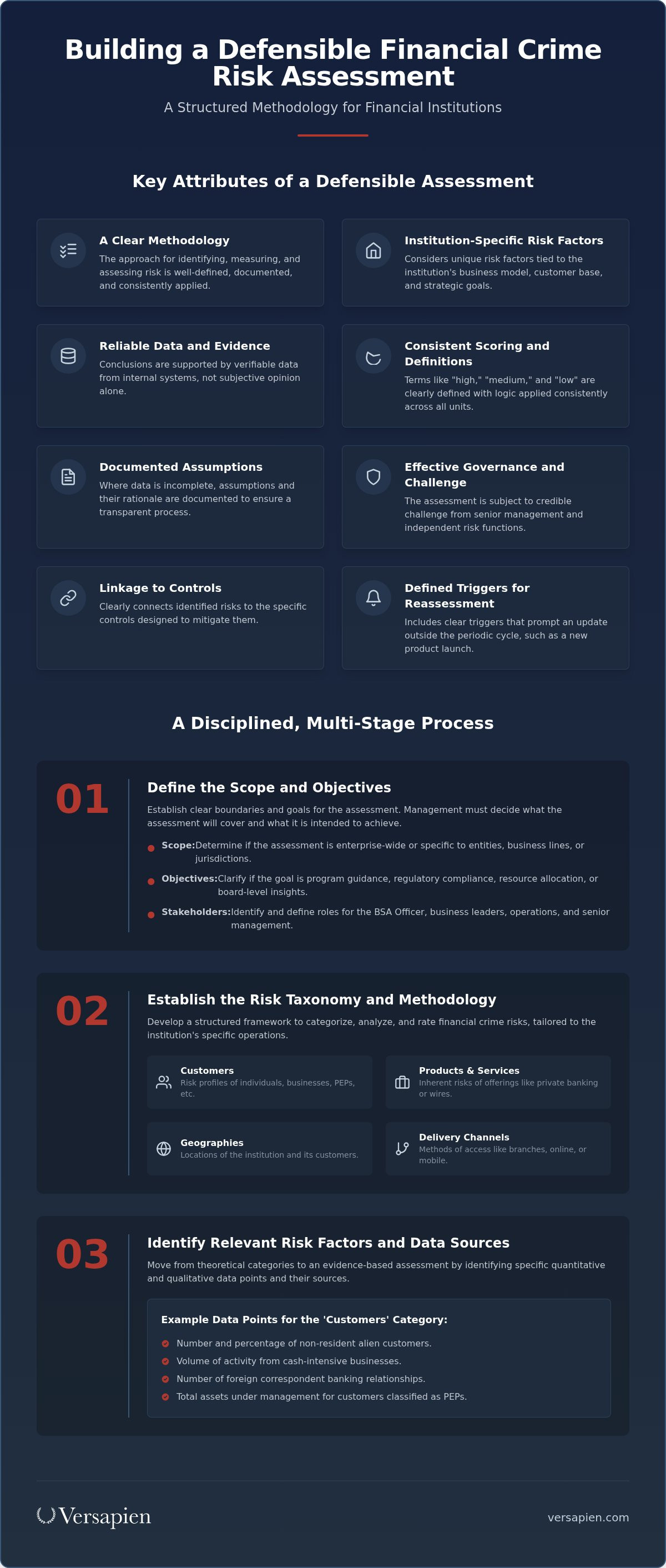
Before building the framework, it is important to understand the characteristics that regulators, auditors, and other stakeholders may consider when evaluating the quality and credibility of the assessment. A defensible risk assessment is not defined by a specific format or scoring model but by the quality and rigor of its underlying process. Key attributes include:
A Clear Methodology: The approach for identifying, measuring, and assessing risk is well-defined, consistently applied, and documented for all stakeholders to understand.
Institution-Specific Risk Factors: The assessment moves beyond generic categories to consider risk factors unique to the institution’s business model, customer base, and strategic objectives.
Reliable Data and Evidence: Conclusions are supported by verifiable data from internal systems, business unit reporting, and other credible sources rather than subjective opinion alone.
Consistent Scoring and Definitions: Terms like “high,” “medium,” and “low” risk are clearly defined, and the scoring logic is applied consistently across all assessed business lines and products.
Documented Assumptions: Where complete data is unavailable, the institution documents the assumptions made and the rationale behind them, demonstrating a thoughtful and transparent process.
Effective Governance and Challenge: The draft assessment is subject to credible challenge from senior management, independent risk functions, and, where appropriate, internal audit to ensure its objectivity and accuracy.
Linkage to Controls: The assessment clearly connects identified risks to the specific controls designed to mitigate them, providing a clear line of sight between risk and response.
Defined Triggers for Reassessment: The framework includes clear triggers that prompt an update outside the periodic cycle, such as the launch of a new product or entry into a higher-risk market.
A Methodology for Building the Framework
Building a defensible financial crime risk assessment requires a disciplined, multi-stage process. The following steps provide a structured approach that institutions can adapt to their specific size, complexity, and risk profile.
Step 1: Define the Scope and Objectives
The first step is to establish clear boundaries and goals. Management must decide what the assessment will cover and what it is intended to achieve. Key questions to address include:
Scope: Will the assessment cover the entire enterprise, or will it be performed for individual legal entities, business lines, or jurisdictions? Many institutions use an enterprise-wide assessment supported, where appropriate, by more detailed assessments of individual business lines, legal entities, products, or jurisdictions.
Objectives: Is the primary goal to inform the BSA/AML program, satisfy a regulatory requirement, guide the allocation of compliance resources, or provide strategic insights to the board? A clear statement of objectives ensures the final product is fit for purpose.
Stakeholders: Who needs to be involved in the process? This typically includes the BSA Officer, business line leaders, operations, technology, and senior management. Defining roles and responsibilities early prevents confusion and ensures necessary buy-in.
Step 2: Establish the Risk Taxonomy and Assessment Methodology
A risk taxonomy provides a structured way to categorize and analyze financial crime risks. The FFIEC BSA/AML Examination Manual outlines common risk categories that serve as a useful starting point. An institution should tailor these to its own operations.
Typical risk categories include:
Customers: The types of customers served, including individuals, businesses, and other entities, and their associated risk profiles (e.g., politically exposed persons, cash-intensive businesses).
Products and Services: The inherent money laundering or terrorist financing risk associated with each offering, such as private banking, international wire transfers, or digital asset services.
Geographies: The locations where the institution and its customers conduct business, with a focus on jurisdictions known for higher levels of corruption, terrorism, or drug trafficking.
Delivery Channels: The methods through which customers access products and services, such as branches, online banking, mobile applications, or third-party intermediaries.
Once the taxonomy is set, the institution must define its assessment methodology. This includes the rating scale (e.g., a three- or five-point scale for inherent risk and control effectiveness) and the logic for calculating residual risk. The methodology should be documented and approved through the appropriate governance channels.
Step 3: Identify Relevant Risk Factors and Data Sources
With the taxonomy in place, the next step is to identify specific risk factors and the data needed to measure them. This is where the assessment moves from theoretical to evidence-based. For each category in the taxonomy, the institution should list quantitative and qualitative data points.
For example, under the “Customers” category, relevant data points might include:
The number and percentage of non-resident alien customers.
The volume of activity from customers identified as cash-intensive businesses.
The number of foreign correspondent banking relationships.
The total assets under management for customers classified as politically exposed persons (PEPs).
Identifying the source for each data point is equally important. Data may come from core processing systems, customer relationship management (CRM) platforms, transaction monitoring systems, or manual reports from business units. Verifying the reliability of these sources is essential for the assessment’s credibility.
Step 4: Assess Inherent Financial Crime Risk
Inherent risk is the exposure to financial crime before the application of any mitigating controls. It is a measure of the risk that exists naturally within a product, customer relationship, or geographic location. For example, offering international wire transfers to high-risk jurisdictions carries a high inherent risk, regardless of the strength of the institution’s transaction monitoring system.
Using the defined methodology and collected data, the institution assesses the inherent risk for each identified factor. This process requires both quantitative analysis and qualitative judgment from subject matter experts. Each rating should be accompanied by a rationale explaining why a particular score was assigned.
Step 5: Evaluate the Design and Effectiveness of Controls
After assessing inherent risk, the focus shifts to the controls designed to mitigate it. This evaluation has two components:
Design Effectiveness: Does the control, as designed, appropriately address the identified inherent risk? For example, is the customer due diligence (CDD) process designed to collect sufficient information to understand the nature and purpose of higher-risk customer relationships?
Operating Effectiveness: Is the control functioning as intended in practice? This can be verified through sources such as quality assurance testing results, internal audit reports, recent regulatory examination findings, and performance metrics from compliance systems.
A control may be well-designed but operate ineffectively due to insufficient staff, inadequate training, or technology failures. A thorough evaluation considers both aspects to arrive at a holistic rating for the control environment.
Step 6: Determine and Document Residual Risk
Residual risk is the level of risk that remains after controls are considered. It is the central output of the risk assessment and directly informs the institution’s risk appetite and compliance strategy. The determination of residual risk is a function of inherent risk and control effectiveness.
High Inherent Risk + Weak Controls = High Residual Risk
High Inherent Risk + Strong Controls = Moderate or Low Residual Risk
Low Inherent Risk + Strong Controls = Low Residual Risk
It is critical to avoid a purely mechanical calculation. The final residual risk rating should be a reasoned conclusion based on the evidence, documented with a clear narrative explaining how the rating was determined.
Step 7: Apply Governance, Management Challenge, and Independent Review
A draft of the risk assessment should never be considered final until it has undergone a rigorous review and challenge process. This governance step ensures the assessment is not developed in a silo and reflects a comprehensive view of the institution’s risks. The BSA Officer should present the draft findings to a management-level committee, which should be empowered to challenge assumptions, question conclusions, and request additional analysis. This process adds significant credibility and demonstrates to regulators that the risk assessment is taken seriously by senior leadership.
Step 8: Finalize Documentation and Reporting
The final risk assessment report should be a clear, concise, and self-contained document. It should summarize the methodology, key findings, and overall residual risk profile of the institution. Importantly, it must serve as an auditable record of the process. All data sources, assumptions, scoring decisions, and governance approvals should be documented and retained. The report should be presented to senior management and the board of directors for their review and approval.
Step 9: Connect Assessment Results to Program Enhancements
A defensible risk assessment is a tool for action. The residual risk ratings should directly influence the priorities of the BSA/AML program. Areas identified with moderate or high residual risk may require specific enhancements, such as:
Revising policies and procedures.
Adjusting transaction monitoring scenarios and thresholds.
Providing targeted training to front-line staff and management.
Investing in new compliance technology.
Increasing staffing in key compliance functions.
Documenting these action plans and tracking them to completion demonstrates that the institution uses the risk assessment to actively manage its risk. This is a key component of effective BSA/AML program modernization.
Step 10: Establish Triggers for Ongoing Updates
The financial crime risk landscape is not static. A risk assessment can become outdated quickly if it is not refreshed in response to material changes. While most institutions conduct a full reassessment annually or every 18 months, certain events should trigger an interim review. These triggers should be formally documented and can include:
The launch of a new product or service.
Expansion into a new geographic market.
A merger or acquisition.
Significant changes in the customer base.
Emergence of new financial crime typologies.
New or amended regulatory requirements.
Executive Takeaways
For senior management and the board, the financial crime risk assessment is more than a compliance document; it is a foundational element of the institution’s risk management infrastructure. Building a defensible framework requires a commitment to a structured, evidence-based, and transparent process.
Treat the risk assessment as a management tool. Its primary purpose is to help the institution understand its risk profile and make informed decisions about where to allocate resources and management attention.
Defensibility comes from process, not presentation. Regulators are less concerned with the format of the report and more focused on the rigor of the methodology, the quality of the data, and the evidence of effective governance and challenge.
Ensure clear ownership and accountability. The BSA Officer typically leads the process, but business line leaders must be accountable for providing accurate data and participating in the assessment of their respective areas.
The results must drive action. A risk assessment that identifies significant risks but leads to no corresponding changes in controls or strategy is a failed exercise. The board should expect to see clear action plans linked directly to the assessment’s findings.
By following a disciplined methodology, institutions can develop a financial crime risk assessment that not only satisfies regulatory expectations but also provides genuine strategic value, helping to protect the organization from financial, reputational, and legal harm. Developing these frameworks often benefits from the independent perspective offered by firms like Versapien, which specialize in financial crime compliance and risk management.


Comments