
Financial Crime Risk Assessments: Five Mistakes That Weaken the Framework
A well-designed financial crime risk assessment is a critical foundation of an effective Bank Secrecy Act/Anti-Money Laundering (BSA/AML) compliance program. When executed correctly, it provides a comprehensive map of an institution’s risk landscape, enabling leadership to allocate resources, calibrate controls, and make strategic decisions with confidence. Yet, many organizations undermine the value of their assessments by repeating a handful of critical, unforced errors. These mistakes transform the assessment from a dynamic strategic tool into a static compliance document that is ill-suited to modern financial risks.
A deficient risk assessment not only invites regulatory scrutiny but also creates blind spots that criminals can exploit. It obscures the true level of residual risk, leaving the board and senior management with a dangerously inaccurate understanding of the institution’s vulnerabilities. The most effective frameworks are not merely compliance exercises; they are essential instruments for sound governance and sustainable growth. This analysis moves beyond generic definitions to examine five specific methodological mistakes that weaken a financial crime risk assessment and provides actionable guidance for strengthening the framework.
Table of Contents
Mistake 1: Treating the Assessment as a Periodic Compliance Exercise
Mistake 2: Using a Generic Methodology Unfit for the Business Model
Mistake 3: Failing to Distinguish Between Inherent Risk, Control Effectiveness, and Residual Risk
Mistake 4: Relying on Subjective Scoring Without Sufficient Data and Challenge
Mistake 5: Failing to Update the Assessment After Significant Business Changes
Mistake 1: Treating the Assessment as a Periodic Compliance Exercise
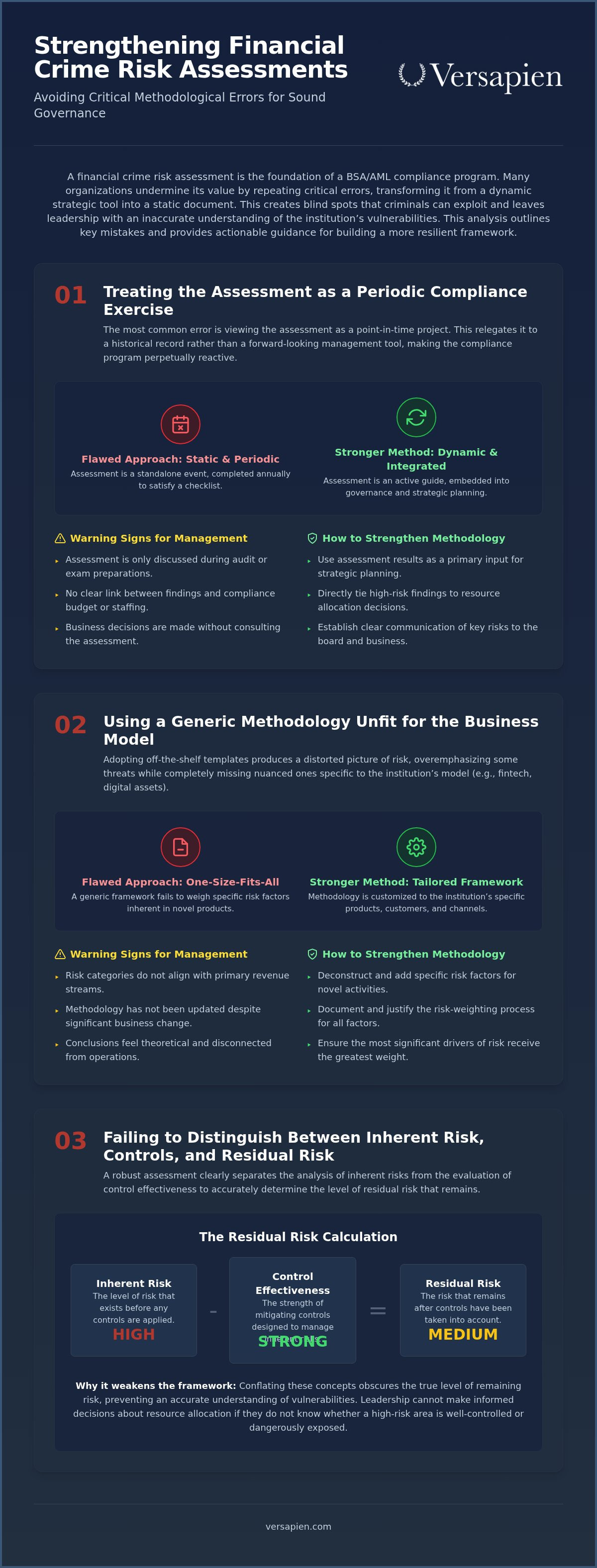
The most common error is viewing the financial crime risk assessment as a point-in-time project, completed annually or biennially to satisfy an examination checklist. This approach relegates the assessment to a historical record rather than a forward-looking management tool. When its findings are not integrated into daily operations and strategic planning, the institution misses its primary value: guiding risk-based decision-making.
Why It Weakens the Framework
A static assessment quickly becomes obsolete. The financial crime threat landscape, along with an institution’s products, customers, and geographic reach, can change significantly in a matter of months. An assessment that sits on a shelf for a year fails to inform the very decisions that introduce new risks, such as new product development, market expansion, or technology adoption. This disconnect leads to a compliance program that is perpetually reacting to yesterday’s threats, leaving the institution exposed to emerging vulnerabilities like sophisticated fraud schemes or illicit use of new payment channels.
Warning Signs for Management
The risk assessment is only discussed during audit or regulatory exam preparations.
Business and product teams are unaware of the assessment’s findings or their role in it.
There is no clear link between the risk assessment’s conclusions and the compliance department’s budget, staffing models, or technology roadmap.
Decisions to launch new products or enter new markets are made without formally consulting or updating the risk assessment.
How to Strengthen the Methodology
Embed the financial crime risk assessment into the institution’s governance and operational rhythm. The results should be a primary input for the strategic planning process. Establish clear communication channels to ensure that the board, senior management, and business line leaders understand the key risks and the rationale behind the control environment. Crucially, the assessment’s output—particularly the analysis of high-residual risks—should directly influence resource allocation for monitoring systems, investigative staff, and training programs. This transforms the assessment from a compliance artifact into an active guide for risk management.
Mistake 2: Using a Generic Methodology Unfit for the Business Model
Many institutions, particularly those in high-growth phases, adopt off-the-shelf risk assessment templates or methodologies that do not reflect their unique risk profile. A framework designed for a traditional commercial bank, for example, is often inadequate for a fintech lender, a digital asset exchange, or a specialized payments company. These generic models fail to properly weigh the specific risk factors inherent in novel products, non-traditional delivery channels, or unique customer bases.
Why It Weakens the Framework
A one-size-fits-all methodology produces a distorted picture of risk. It may overemphasize risks that are minimal to the business (e.g., cash handling for a digital-only bank) while completely missing or undervaluing more significant, nuanced threats (e.g., smart contract vulnerabilities in a DeFi platform). This leads to a misallocation of compliance resources, with controls that are either excessive for low-risk activities or insufficient for high-risk ones. Regulators expect a risk assessment to demonstrate a deep understanding of the institution’s specific activities, and a generic framework signals a superficial, “check-the-box” approach to compliance.
Warning Signs for Management
The risk categories in the assessment do not align with the institution’s primary products, customer types, or revenue streams.
The methodology and weighting of risk factors have not been reviewed or updated since they were first adopted, despite significant business changes.
Staff responsible for the assessment struggle to explain how the methodology applies to the institution’s newest or most complex offerings.
The assessment’s conclusions feel theoretical and disconnected from the practical challenges faced by compliance and operations teams.
How to Strengthen the Methodology
The methodology must be tailored to the institution’s business model. Begin by deconstructing the specific risk indicators across all relevant dimensions: customers, products and services, geographies, and delivery channels. For a fintech firm, this might mean adding specific risk factors for third-party platform integrations or the use of alternative data in underwriting. For a firm handling digital assets, it requires incorporating factors related to blockchain analytics and privacy coin exposure. The risk-weighting process should be documented and justified, ensuring that the most significant drivers of the institution’s inherent risk receive the greatest weight. For further reading on this topic, a well-structured approach is essential for building a defensible financial crime risk assessment framework.
Mistake 3: Failing to Distinguish Between Inherent Risk, Control Effectiveness, and Residual Risk
A robust risk assessment depends on a clear and logical separation of three distinct concepts: inherent risk, control effectiveness, and residual risk. Inherent risk represents the exposure before any controls are applied. Control effectiveness measures the strength of the mitigating controls designed to manage that risk. Residual risk is the exposure that remains after controls are considered. Weaker frameworks often conflate these elements, for instance, by lowering an inherent risk rating because a strong control exists, leading to a flawed and indefensible conclusion.
Why It Weakens the Framework
Blurring these components makes it impossible to accurately assess the true state of risk. If inherent risk is not identified in its pure state, the institution cannot determine whether its control environment is appropriately designed or sufficiently resourced. It also masks the potential impact of a control failure. If a high inherent risk is improperly categorized as "medium" from the start, the failure of a key control may appear to have a moderate impact when, in reality, it could be catastrophic. This methodological flaw prevents management from understanding where the biggest vulnerabilities lie and which controls are most critical to the safety and soundness of the institution.
Warning Signs for Management
The assessment produces a single “risk score” without a clear, documented calculation showing how inherent risk was adjusted by control ratings.
Narratives in the assessment describe risks and controls together without first establishing a baseline inherent risk rating.
Auditors or examiners have questioned the logic used to arrive at residual risk ratings.
There is no distinct process for testing or rating the effectiveness of controls; their existence is simply noted.
How to Strengthen the Methodology
Adopt a structured, sequential process. First, assess inherent risk based on the nature of the business, considering factors outlined in the FFIEC BSA/AML Examination Manual such as products, services, customers, and geographies. Second, independently evaluate the design and operational effectiveness of the mitigating controls (e.g., KYC procedures, transaction monitoring rules, investigation protocols). This evaluation should be evidence-based, using data from quality assurance reviews, internal audits, or system validations. Finally, determine the residual risk by analyzing the impact of the control environment on the inherent risk. This clear, three-stage approach provides a transparent and defensible rationale for the final risk ratings.
Mistake 4: Relying on Subjective Scoring Without Sufficient Data and Challenge
Many risk assessments rely heavily on qualitative judgments and subjective scoring, where risk levels are determined by consensus or historical convention rather than empirical evidence. While expert judgment is a necessary component, it becomes a weakness when it is not grounded in verifiable data and subjected to rigorous, independent challenge. An assessment based on opinion rather than facts is easily discredited during regulatory review and provides a poor foundation for strategic decisions.
Why It Weakens the Framework
Subjectivity introduces bias and inconsistency. It can lead to the underestimation of risks in familiar business lines or the overestimation of risks in new, less understood areas. Without supporting data, risk ratings become difficult to defend or replicate, creating a perception that the assessment is arbitrary. This erodes the credibility of the compliance function and makes it difficult to secure business-wide buy-in for necessary risk mitigation efforts. It also hampers the ability to track risk trends over time, as changes in scores may reflect shifting opinions rather than actual changes in the risk environment.
Warning Signs for Management
Risk ratings are assigned in workshops without reference to supporting data dashboards, reports, or metrics.
The assessment lacks a clear appendix or documentation trail that links risk scores to specific data sources.
Compliance staff cannot articulate the specific quantitative or qualitative inputs used to justify a "high" or "medium" rating.
The second line of defense (e.g., a risk management function) or internal audit accepts the assessment’s conclusions without material challenge or validation of the inputs.
How to Strengthen the Methodology
Incorporate both quantitative and qualitative data into the assessment process. Quantitative inputs can include transaction volumes by channel, the number of high-risk customers, geographic revenue concentration, and SAR filing metrics. Qualitative inputs, such as subject-matter expert interviews, are still valuable but should be structured and documented. Crucially, the process must include a credible challenge component. An independent risk management function, internal audit, or a qualified third party should review and challenge the assumptions, data inputs, and conclusions of the assessment. This critical review ensures objectivity and forces the assessment team to build a well-defended, evidence-based analysis.
Mistake 5: Failing to Update the Assessment After Significant Business Changes
Even an institution with a strong annual assessment process can fail by not treating the framework as a living document. A significant business or risk change can quickly make an existing assessment incomplete or outdated if the change is not evaluated and incorporated appropriately. Waiting for the next annual cycle to incorporate these changes means the institution is operating with an inaccurate risk map for a prolonged period.
Why It Weakens the Framework
Operating with an outdated risk assessment means the control environment is not aligned with the current risk profile. The existing transaction monitoring rules, customer risk rating models, and due diligence procedures may not be designed to capture the risks associated with the new business activity. This creates a window of vulnerability that can persist for months, exposing the institution to financial crime and regulatory action. For example, launching a new cryptocurrency service without immediately updating the risk assessment and corresponding controls is a significant failure of risk management. Timely updates are critical for a proactive compliance posture, particularly in areas like digital asset compliance and governance.
Warning Signs for Management
The institution has launched new products, expanded into new countries, or onboarded a new, high-risk customer segment since the last assessment was finalized.
The formal product or initiative approval process does not include a mandatory step to assess financial crime risk and update the enterprise-wide assessment.
There is no defined policy specifying what types of events trigger an ad-hoc or interim risk assessment update.
Regulators, in a recent exam, identified risks that were not contemplated in the most recent assessment.
How to Strengthen the Methodology
Establish a formal policy that defines the triggers for an off-cycle risk assessment update. These triggers should include, at a minimum: the introduction of new products or services, expansion into new geographic markets, acquisitions of other companies, implementation of new technologies that affect BSA/AML processes, and significant changes in the institution’s customer base. The new product approval (NPA) process should be closely integrated with the risk assessment framework. Any new initiative should require a preliminary financial crime risk analysis, and if the residual risk is determined to be significant, it should trigger a formal update to the enterprise-wide assessment before launch.
Questions Management Should Ask About Its Financial Crime Risk Assessment
To ensure the framework is sound, senior management, the board, and risk leaders should proactively challenge the process and its outputs. An effective assessment should be able to withstand rigorous questioning. Consider asking the following:
Methodology: Does our assessment methodology accurately reflect our current business model, including our newest products, customer segments, and delivery channels? How was it tailored to our specific risks?
Data Integrity: What specific data sources support our inherent risk ratings? How do we ensure this data is accurate, complete, and timely?
Control Effectiveness: How do we measure the effectiveness of our controls? Are these ratings based on independent testing and validation, or are they self-attested? How are control weaknesses and remediation plans tracked?
Triggers for Change: What specific events automatically trigger an update to the risk assessment outside of the normal review cycle? Is this process formally documented and consistently followed?
Resource Allocation: How do the results of the risk assessment directly influence our compliance budget, staffing levels, technology investments, and training priorities? Can we draw a clear line from a high-risk rating to a corresponding resource decision?
Governance and Oversight: Who provides credible, independent challenge to the risk assessment’s inputs and conclusions? How are the final results and key findings communicated to and approved by the board or a designated committee?
Conclusion: From Compliance Document to Strategic Asset
A financial crime risk assessment that avoids these five common mistakes is transformed from a regulatory burden into a valuable strategic asset. It provides the clarity needed to innovate safely, allocate resources intelligently, and build a compliance program that is both effective and efficient. By ensuring the assessment is dynamic, tailored, data-driven, and properly governed, institutions can build a defensible framework that satisfies regulatory expectations and provides a true picture of the risk landscape. This analytical rigor is the cornerstone of a resilient financial crime compliance program capable of adapting to an evolving threat environment.


Comments