
Digital Asset Compliance: Governance Considerations for Financial Institutions
As financial institutions move from exploratory analysis to active integration of digital assets, they face a complex and fragmented regulatory environment. The challenge is no longer whether to engage with this asset class, but how to do so within a governance framework that satisfies board directives, risk appetite statements, and stringent supervisory expectations. A durable approach requires moving beyond technical assessments of blockchain technology and embedding digital asset compliance into the core of existing enterprise risk management structures.
For Chief Risk Officers, Chief Compliance Officers, and executive leadership, the central task is to build a program that is both defensible to examiners and adaptable to rapid market and regulatory evolution. This requires a deliberate, structured approach to defining risks, assigning ownership, and establishing oversight. The following framework outlines the key governance decisions institutions must address to build a resilient and regulator-ready digital asset compliance program.
Table of Contents
1. Defining the Digital Asset Activity and Regulatory Perimeter
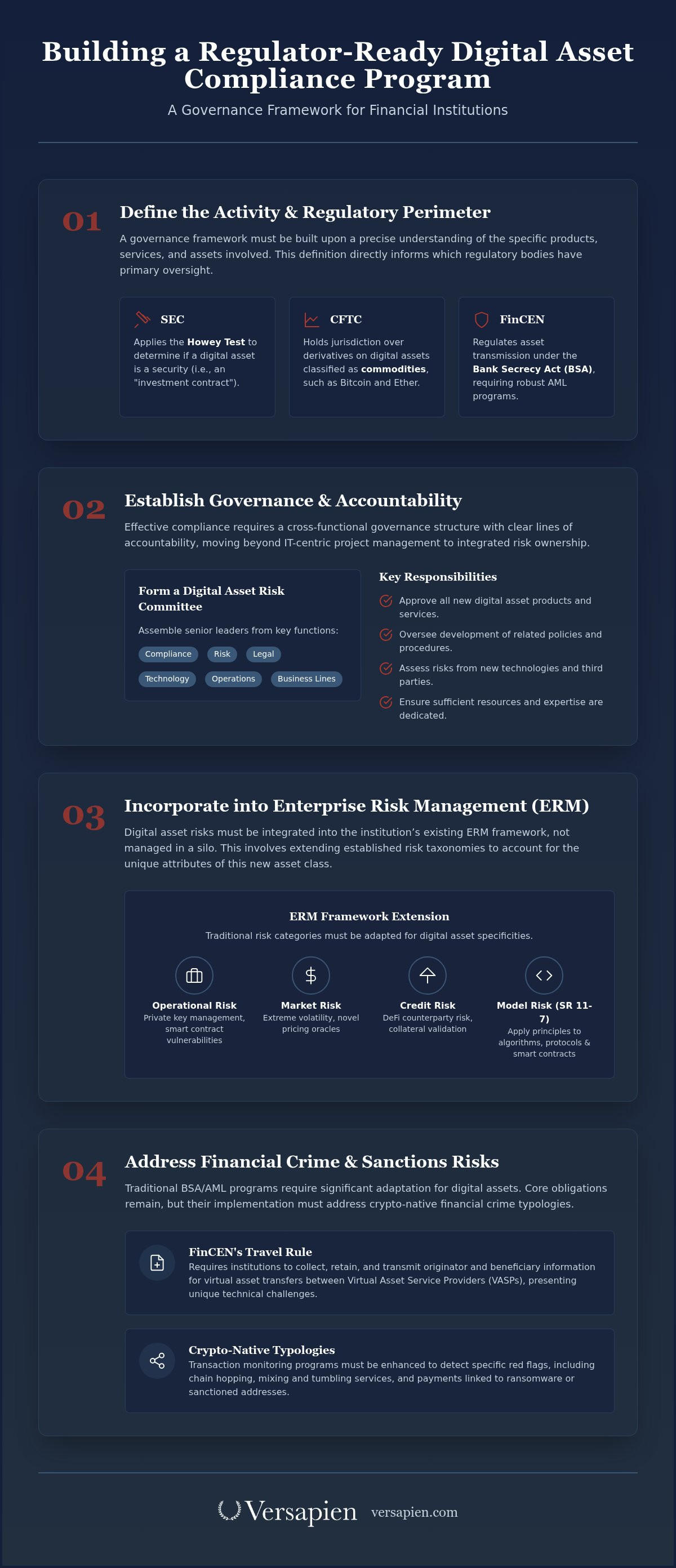
Before any policy is drafted, an institution must precisely define the scope of its intended digital asset activities. A vague mandate to “explore crypto” is insufficient; a governance framework must be built upon a clear understanding of the specific products, services, and assets involved. This initial definition directly informs the regulatory perimeter.
The primary jurisdictional challenge in the U.S. remains the distinction between a security, a commodity, and other forms of digital property. This classification dictates primary oversight:
Securities and Exchange Commission (SEC): The SEC applies the Howey Test to determine if a digital asset constitutes an "investment contract" and is therefore a security. This analysis is fact-specific and remains a focal point of significant regulatory enforcement and litigation. Institutions must conduct a rigorous, documented analysis for any asset they intend to trade or hold.
Commodity Futures Trading Commission (CFTC): The CFTC generally has jurisdiction over derivatives contracts on digital assets it classifies as commodities, such as Bitcoin and Ether. Its oversight focuses on fraud and manipulation in the spot markets for these commodities.
Financial Crimes Enforcement Network (FinCEN): Regardless of an asset’s classification as a security or commodity, institutions engaging in its transmission are typically considered money services businesses (MSBs) and must comply with the Bank Secrecy Act (BSA), including robust Anti-Money Laundering (AML) programs and transaction reporting requirements.
Federal banking agencies, including the Office of the Comptroller of the Currency (OCC), the Federal Reserve, and the FDIC, expect institutions under their supervision to engage in "novel activities" with extreme caution. This requires robust risk management and, in many cases, a supervisory non-objection before launching new digital asset products.
2. Establishing Governance and Accountability
Effective digital asset compliance cannot reside solely within a single department. It requires a cross-functional governance structure with clear lines of accountability. A common failure point is treating digital assets as a technology project owned by IT or innovation teams, disconnected from core risk and compliance functions. Instead, leadership should establish a dedicated digital asset risk committee or working group comprising senior leaders from compliance, risk, legal, technology, operations, and the relevant business lines.
This body’s charter should clearly define its responsibilities, including:
Reviewing and approving all new digital asset products or services.
Overseeing the development and maintenance of all digital asset-related policies and procedures.
Assessing the risks associated with new technologies, protocols, and third-party providers.
Ensuring sufficient resources and expertise are dedicated to digital asset compliance.
Receiving and reviewing regular reporting on risk metrics, control effectiveness, and compliance issues.
3. Incorporating Digital Assets into Enterprise Risk Management
Digital asset risks must be integrated into the institution’s existing Enterprise Risk Management (ERM) framework, not managed in a silo. This involves extending established risk taxonomies—covering operational, market, credit, liquidity, and compliance risk—to account for the unique attributes of distributed ledger technology. For example, operational risk assessments must now include factors like smart contract vulnerabilities and private key management protocols.
A significant area of focus is adapting model risk management principles to the automated, algorithmic nature of many digital asset protocols. While regulatory guidance like SR 11-7 was not written for smart contracts, its principles of conceptual soundness, ongoing monitoring, and outcomes analysis provide a sound framework for managing these risks. Institutions should consider applying a similar level of rigor to decentralized finance (DeFi) protocols, pricing oracles, and automated execution algorithms. This includes demanding independent code audits as a critical component of due diligence, analogous to the independent validation required for traditional financial models. For more on this topic, see our related article on Model Risk Management in the Age of Artificial Intelligence.
4. Addressing Financial Crime and Sanctions Risks
Traditional BSA/AML programs require significant adaptation for digital assets. The core obligations of customer due diligence, transaction monitoring, and suspicious activity reporting remain, but their implementation is different. Institutions must develop specific policies and controls to address crypto-native financial crime typologies, such as chain hopping, mixing and tumbling services, and ransomware payments.
Key considerations include:
The Travel Rule: FinCEN requires financial institutions to collect, retain, and transmit certain information on fund transfers, a requirement that now extends to virtual assets. Complying with this rule presents technical challenges in the digital asset ecosystem, requiring specialized solutions to transmit originator and beneficiary information between Virtual Asset Service Providers (VASPs).
Sanctions Screening: The Office of Foreign Assets Control (OFAC) has made it clear that sanctions obligations apply to all U.S. persons, including those transacting with digital assets. This requires institutions to have a capability to screen blockchain addresses listed on the Specially Designated Nationals (SDN) list and block prohibited transactions.
Transaction Monitoring: Existing AML monitoring systems are often ill-equipped to analyze blockchain data. Institutions need to supplement their capabilities with specialized blockchain analytics tools that can trace the source and destination of funds, identify high-risk counterparties, and flag suspicious on-chain behavior. A well-structured approach is critical for building a defensible financial crime risk assessment that examiners will expect to see.
5. Evaluating Custody, Technology, and Third-Party Dependencies
For most financial institutions, engaging with digital assets involves reliance on third-party custodians, exchanges, and technology providers. This elevates the importance of a rigorous third-party risk management (TPRM) program tailored to the specific risks of the digital asset ecosystem.
Due diligence on a potential digital asset custodian must go beyond standard TPRM questionnaires. It should include a deep technical assessment of their security protocols, particularly concerning private key generation, storage, and usage. Key questions include their use of multi-signature wallets, hardware security modules (HSMs), and the operational controls separating asset management duties. The institution’s policy must clearly define its own responsibilities versus those of the custodian, especially regarding transaction authorization and asset segregation.
6. Establishing Monitoring, Reporting, and Escalation
A static compliance framework is insufficient. The digital asset environment requires continuous monitoring and a dynamic reporting structure that provides timely, relevant information to decision-makers. Management should establish key performance indicators (KPIs) and key risk indicators (KRIs) to monitor the health of the digital asset program. These might include metrics on transaction monitoring alert volumes, the success rate of Travel Rule data transmission, and the security performance of third-party custodians.
Clear escalation paths are essential. The governance committee must define triggers that would prompt an emergency review, such as a major security breach at a custodian, a significant smart contract exploit in a utilized protocol, or new guidance from a primary regulator. This ensures that emerging risks are addressed swiftly by the appropriate level of management. This level of preparation is a core component of preparing for an OCC or FDIC examination on any novel or high-risk activity.
7. Defining Board and Executive Oversight
Ultimately, the board of directors is responsible for overseeing the institution's risk-taking activities, including those related to digital assets. The board must be provided with sufficient education to understand the fundamental risks and strategic opportunities. Management’s reporting to the board should be transparent and framed within the context of the institution's overall risk appetite statement.
Board reporting should not be overly technical. It should focus on the material risks to the institution, the effectiveness of the control environment, and the alignment of the digital asset strategy with the institution's long-term objectives. The board's role is not to manage the program day-to-day but to challenge management's assumptions, confirm that risks are being managed within established tolerance levels, and ensure that the compliance and risk functions are adequately resourced and independent.
Digital Asset Governance Readiness Checklist
Executive teams and boards can use the following questions to assess the maturity of their institution's digital asset governance framework:
Scope and Classification: Have we clearly defined the specific digital asset activities we will engage in and documented our process for classifying each asset (e.g., as a security or commodity)?
Accountability: Is there a formally chartered, cross-functional committee or working group with senior leadership participation responsible for overseeing all digital asset activities?
Policy Integration: Have our existing policies (e.g., ERM, TPRM, BSA/AML, Model Risk) been updated to explicitly address the unique risks of digital assets, or have we created standalone policies that are fully integrated with our enterprise frameworks?
Financial Crime Controls: Do we have a demonstrable capability to comply with FinCEN's Travel Rule and conduct OFAC sanctions screening on blockchain addresses?
Third-Party Diligence: Does our due diligence process for digital asset custodians and vendors include a deep technical review of their security, operational controls, and private key management protocols?
Technology and Resilience: Have we assessed the operational resilience of our digital asset infrastructure, including dependencies on third-party nodes, oracles, and protocols?
Monitoring and Metrics: Have we established and approved specific KRIs and KPIs to monitor digital asset risks, and are these metrics reported to senior management and the board regularly?
Board Reporting: Does the board receive reporting that clearly articulates the institution's digital asset risk exposure in the context of our approved risk appetite statement?
Incident Response: Have we updated our incident response and business continuity plans to include scenarios specific to digital assets, such as a major custodian breach, a 51% attack, or a smart contract failure?
Expertise: Have we assessed the internal expertise of our risk, compliance, and audit teams and identified a plan to address any gaps through training or strategic hiring?
Building a durable digital asset compliance program is a strategic imperative for any financial institution entering this space. By focusing on these core governance decisions, leadership can create a framework that supports responsible innovation while satisfying the expectations of regulators and stakeholders. The expertise developed through this process, which Versapien helps clients build, provides the foundation for navigating an evolving financial landscape with confidence.


Comments