
BSA/AML Program Modernization: Beyond Traditional Transaction Monitoring
Updated: Sep 22
Many financial institutions continue to invest heavily in transaction monitoring technology while overlooking a more fundamental issue: an effective Bank Secrecy Act/Anti-Money Laundering (BSA/AML) program depends on more than the ability to generate and investigate alerts. Effective modernization requires a comprehensive examination of how financial crime risks are identified, how data is used, how investigations are conducted, how controls are governed, and how program effectiveness is measured. A narrow focus on technology often produces marginal gains while leaving foundational weaknesses unaddressed.
The result is a cycle of reactive investment. Firms purchase new monitoring systems or add machine learning overlays, hoping to reduce false positives or improve efficiency. Yet, persistent issues like high alert volumes, long investigation times, and recurring audit findings suggest the problem lies deeper than the detection engine. A BSA/AML program cannot be modernized simply by implementing a new platform. Program effectiveness depends on the integrity of the underlying risk assessment, the quality of available data, the discipline of the investigative process, and the rigor of program governance.
This analysis moves beyond a technology-centric view to present a structured framework for genuine BSA/AML program modernization. It outlines the interconnected components of an effective program and provides practical considerations for senior management to assess whether their investments are addressing symptoms or solving core challenges in their BSA/AML compliance framework.
Table of Contents
Indicators of a Fragmented Modernization Effort
Before committing to significant technology or process changes, leadership should look for common indicators that a BSA/AML program is operating inefficiently. These symptoms often point to deeper, systemic issues that a new monitoring tool alone cannot resolve. Acknowledging these operational realities is the first step toward building a case for a more holistic modernization strategy.
Consider whether your institution exhibits any of the following characteristics:
Excessive alert volumes and high false-positive rates: Detection scenarios that are poorly calibrated to the institution’s specific risk profile generate significant operational noise, consuming investigative resources with little return.
Manual data aggregation and enrichment: Investigators spend a disproportionate amount of time gathering and reconciling customer and transactional data from disparate systems rather than performing value-added analysis.
Poor linkage between risk assessments and controls: The enterprise-wide financial crime risk assessment is a static, check-the-box exercise with little demonstrable impact on monitoring scenarios, customer segmentation, or risk-based alerting thresholds.
Long investigation turnaround times: Inefficient workflows, lack of access to complete information, and inconsistent documentation standards extend case closure times, creating backlogs and increasing operational risk.
Limited management information and metrics: Reporting focuses on operational volume (e.g., alerts cleared, cases closed) rather than on effectiveness, such as the quality of Suspicious Activity Reports (SARs) or the identification of new money laundering typologies.
Repeated audit or examination findings: External and internal reviews consistently identify the same control weaknesses, suggesting that root causes are not being adequately addressed.
Technology changes without corresponding process redesign: A new system is implemented, but the surrounding human processes, roles, and responsibilities remain unchanged, limiting the technology's potential benefits.
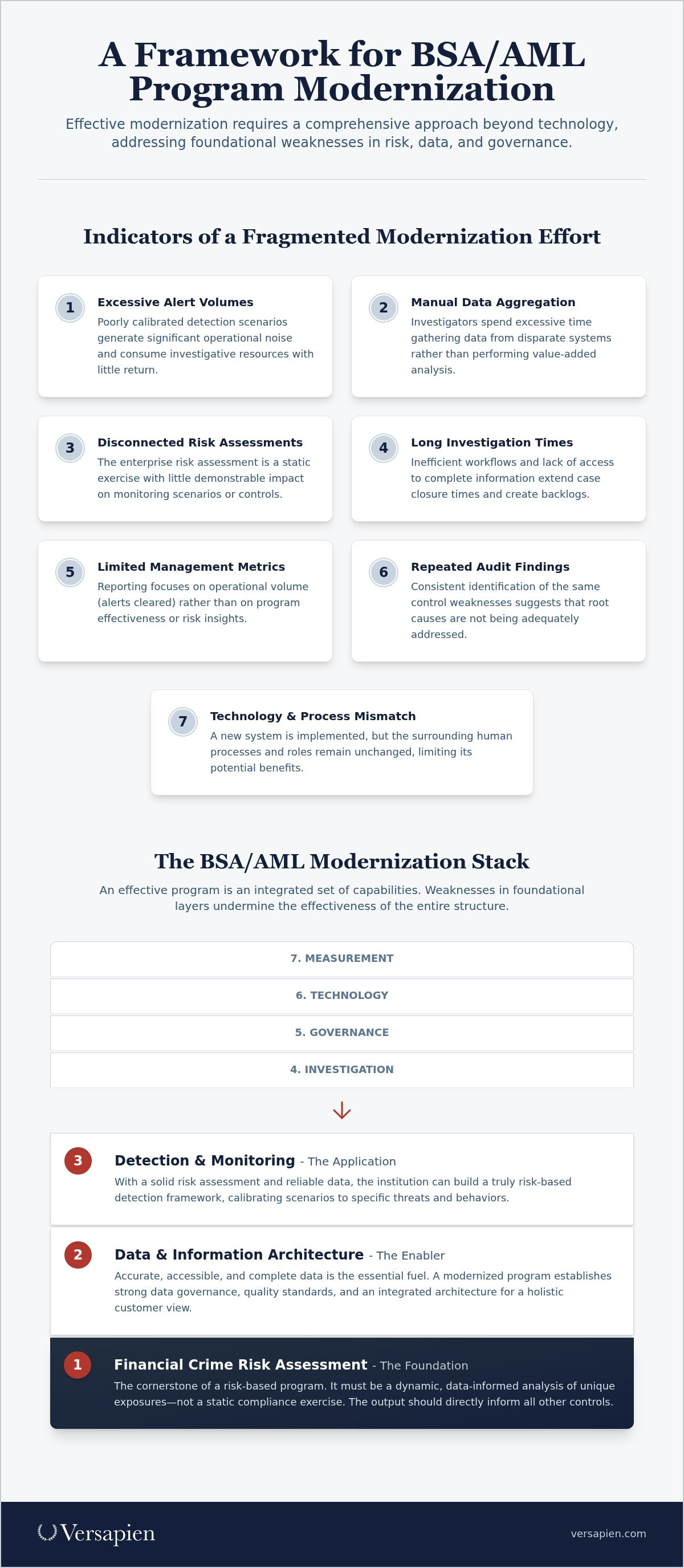
The BSA/AML Modernization Stack: A Framework for Effectiveness
Effective BSA/AML compliance is not the product of a single system but the output of an integrated set of capabilities. Viewing modernization through a layered framework, the BSA/AML Modernization Stack, helps clarify the dependencies between each component. Weaknesses at a foundational layer will invariably undermine the effectiveness of the layers above it. For example, advanced analytics cannot compensate for poor-quality data, and an efficient investigative process cannot fix a flawed risk assessment.
The stack provides a logical sequence for assessing and strengthening a program: Risk → Data → Detection → Investigation → Governance → Technology → Measurement.
1. Financial Crime Risk Assessment: The Foundation
The risk assessment is the cornerstone of a risk-based BSA/AML program. It should be a dynamic and data-informed analysis of the institution’s unique exposure to money laundering, terrorist financing, and other illicit financial activities. Many institutions, however, treat the risk assessment as a periodic compliance requirement rather than a strategic tool. An outdated or generic assessment leads to misaligned controls, where resources are either over-allocated to low-risk areas or insufficient to cover emerging threats.
Modernization begins here. The assessment must be refreshed to accurately reflect the institution's current products, customers, geographies, and delivery channels. This includes evaluating emerging risk areas, such as the introduction of digital assets or expansion into new markets. The output should directly inform the design of the entire compliance program, from customer due diligence (CDD) standards to the logic underpinning transaction monitoring scenarios. For more on this, see our guide to building a defensible financial crime risk assessment framework.
2. Data and Information Architecture: The Enabler
Accurate, accessible, and complete data is the essential fuel for every subsequent BSA/AML function. Without a sound data architecture, even the most sophisticated detection systems will fail. Many programs are hindered by data that is siloed across legacy systems, inconsistent in its formatting, or of questionable quality. This forces compliance teams to rely on manual workarounds, introduces the risk of error, and prevents a holistic view of customer relationships and activity.
A modernized program establishes strong data governance. This involves defining clear ownership, establishing data quality standards, and creating an integrated architecture that provides investigators with a comprehensive and reliable view of customer information. The goal is to ensure that when an alert is generated, the supporting data is readily available, trustworthy, and sufficient to conduct an effective investigation without extensive manual remediation.
3. Detection and Monitoring: The Application
With a solid risk assessment and reliable data, the institution can build a truly risk-based detection program. Transaction monitoring modernization is not about maximizing the number of scenarios but about optimizing their precision. Each scenario should be explicitly mapped to a specific risk identified in the assessment. Customer segmentation and alerting thresholds should be analytically derived and periodically tested for effectiveness.
The common problem of high false positives is often a direct result of generic, out-of-the-box scenarios that do not reflect the institution’s specific customer base or product mix. By tailoring detection logic to known risks and behaviors, an institution can focus its resources on activity that genuinely warrants scrutiny, improving both efficiency and the likelihood of identifying suspicious behavior.
4. Investigations and Case Management: The Response
Generating a quality alert is only the first step. The effectiveness of a BSA/AML program is ultimately determined by the quality of its investigations. Modernization in this area focuses on streamlining the end-to-end investigative workflow. This includes improving alert triage processes, providing investigators with integrated case management tools, and enforcing consistent documentation and quality assurance standards.
An inefficient investigative function creates bottlenecks and increases the risk that critical information will be missed. By equipping analysts with all necessary information in a single environment and defining clear procedures for analysis, documentation, and escalation, institutions can improve both the speed and quality of their SAR filings.
5. Governance and Program Oversight: The Structure
Strong governance provides the framework that holds the entire program together. It ensures accountability, manages change, and provides a mechanism for continuous improvement. A modernized governance structure includes clear roles and responsibilities, a formal process for managing issues to resolution, and robust oversight of any changes to systems, models, or processes.
When new technologies are introduced or monitoring rules are changed, a formal governance process ensures that the decisions are justified, tested, documented, and approved. This discipline prevents ad-hoc changes that can introduce unintended risks or break downstream processes. As Versapien often advises, effective governance ensures that technology investments and process enhancements align with strategic compliance objectives and are implemented in a controlled and sustainable manner.
6. Technology and Advanced Analytics: The Accelerator
Technology, including artificial intelligence and machine learning, should be viewed as an accelerator, not a panacea. When applied to a strong foundation of risk understanding and high-quality data, advanced analytics can significantly enhance detection capabilities and operational efficiency. For example, network analytics can uncover previously hidden relationships between seemingly disparate actors, while machine learning can help prioritize alerts for investigation.
However, deploying these tools without addressing foundational weaknesses in the stack will yield disappointing results. The effectiveness of any analytical model is entirely dependent on the quality of the data it consumes. Furthermore, the use of AI and machine learning introduces new model risk management considerations that require robust validation, ongoing performance monitoring, and clear governance. For a deeper discussion, explore the governance challenges that follow AI transformation in BSA/AML compliance.
7. Measuring Effectiveness: The Feedback Loop
Finally, a modern BSA/AML program must be able to demonstrate its effectiveness. This requires moving beyond simple activity metrics. Instead of reporting only on alert volumes and case closure rates, management and boards should demand metrics that speak to the quality and impact of the program.
Meaningful metrics might include SAR quality scores, the percentage of SARs that result in law enforcement inquiries, the time to identify new typologies, and risk-coverage analysis showing how well monitoring scenarios align with the highest-risk areas of the business. This creates a continuous feedback loop, allowing the institution to refine its risk assessment, data strategies, and detection logic based on real-world outcomes.
Executive Takeaways: Questions for Senior Management
As leaders evaluate proposals for BSA/AML program investments, they must look beyond the promises of technology vendors and ask probing questions about the health of the entire compliance framework. A commitment to genuine modernization requires a holistic view that prioritizes foundational integrity over superficial fixes.
Management and the board should consider the following:
Are we modernizing technology, or are we modernizing the overall program? Does the initiative address underlying weaknesses in our risk assessment, data quality, and governance, or does it simply replace one system with another?
Do our monitoring scenarios reflect our current risk profile? Is there a clear, documented link between the risks identified in our enterprise-wide assessment and the logic used to generate alerts?
Can investigators access reliable and complete information efficiently? How much time do our analysts spend gathering data versus analyzing it?
Are program changes governed and tested? Do we have a formal, documented process for approving, implementing, and validating changes to our monitoring rules and systems?
Do our metrics demonstrate effectiveness or simply activity? Can we articulate to regulators and the board how our program is successfully mitigating financial crime risk, beyond simply counting alerts and cases?
Are technology investments addressing an identified risk or operational problem? Is there a clear business case for adopting advanced analytics, and have we established the necessary data and governance prerequisites for its success?


Comments