
Building a Compliance Program for High-Growth Fintech Companies
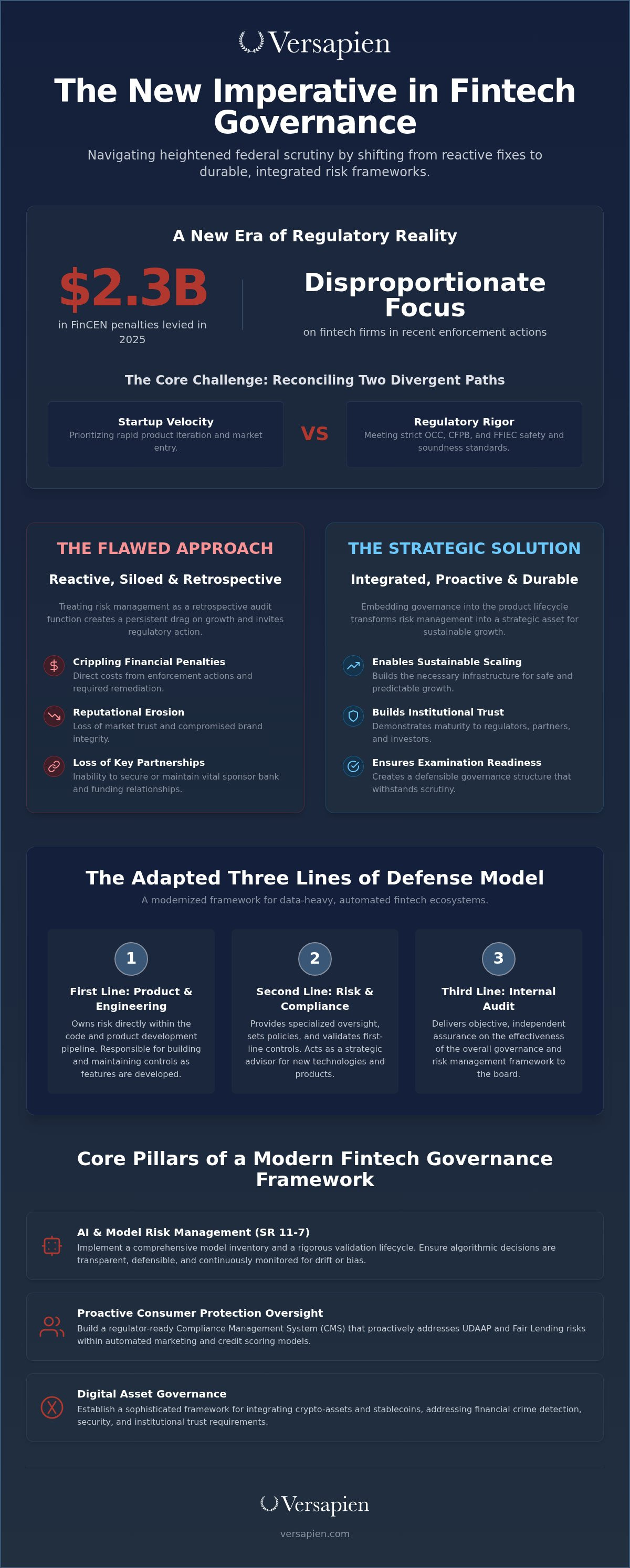
Precision, durability, and foresight are the new prerequisites for fintech survival in an era of heightened federal scrutiny. In 2025, FinCEN levied 2.3 billion dollars in penalties against financial services companies, with a disproportionate volume of enforcement actions targeting fintech firms. This data confirms that the regulatory honeymoon is over. While the agility of a startup remains a competitive asset, it often creates a structural deficit when confronted by the rigorous expectations of the OCC and CFPB. Senior leaders now face the challenge of embedding fintech risk management into the core product lifecycle rather than treating it as a retrospective audit function.
There is mounting friction between product teams racing to deploy AI-driven models and compliance officers tasked with ensuring adherence to SR 11-7 and the 2026 California Transparency in Frontier AI Act. While traditional risk programs often stifle innovation through rigid gatekeeping, a modern approach integrates compliance directly into the engineering stack. This article provides a strategic examination of how to architect a governance framework that satisfies federal examiners while maintaining your development velocity. We'll explore the transition from reactive fixes to durable, enterprise-wide risk structures that align your growth objectives with current regulatory mandates.
Table of Contents
The Divergent Paths of Rapid Fintech Scaling and Regulatory Expectations
The "move fast and break things" ethos has reached a point of diminishing returns. In the current environment, the friction between rapid product iteration and federal safety requirements is no longer a theoretical debate. It's a financial reality. When high-growth firms prioritize speed over structural integrity, they invite remediation costs, reputational erosion, and significant delays in market entry. Effective fintech risk management serves as a multi-dimensional discipline that integrates operational resilience, credit modeling, and compliance into a single, cohesive framework.
A foundational step in this process involves understanding financial technology not just as a product category, but as a complex ecosystem governed by specific regulatory expectations. Relying on a check-the-box mentality is a strategic error. In digital-first environments, data velocity far outpaces traditional audit cycles, making static controls obsolete before they're even documented. Governance must be as dynamic as the code it oversees.
Supervisory Pressure and the Shift Toward Institutional Maturity
The OCC and CFPB have intensified their oversight of non-bank financial entities, signaling an end to the era of regulatory leniency. The FFIEC continues to refine baseline standards for digital assets and fintech security, forcing firms to adopt institutional-grade maturity long before they reach the scale of traditional banks. This shift requires senior leaders to move beyond temporary fixes and toward durable, defensible governance that can withstand the rigors of a formal examination.
The Strategic Cost of Governance Deficits
Poor risk architecture creates a persistent regulatory drag that can paralyze a firm's growth trajectory. Beyond the immediate threat of enforcement actions, governance deficits compromise the ability to secure institutional funding or maintain vital sponsor bank partnerships. A robust fintech risk management strategy isn't an obstacle to innovation. It's the necessary infrastructure that allows a company to scale safely and predictably in a volatile market. By prioritizing governance early, leadership teams ensure that their product roadmap remains viable under increasing scrutiny.
Constructing an Integrated Governance Framework for Emerging Technologies
Effective governance in high-growth environments requires a departure from siloed operations. Modern fintech risk management thrives on an Integrated Risk Management (IRM) approach that harmonizes artificial intelligence, financial crime detection, and enterprise-level oversight. By dismantling the barriers between technical product teams and compliance officers, firms create a unified defense layer capable of identifying systemic vulnerabilities before they manifest as regulatory breaches. This structural alignment is particularly critical when aligning with FDIC guidance on fintech due diligence, which emphasizes the necessity of rigorous risk assessment throughout the partnership lifecycle.
The traditional Three Lines of Defense model remains relevant but requires significant adaptation for data-heavy, automated ecosystems. In these environments, the first line must own the risk within the code itself; the second line provides specialized oversight; and the third line delivers independent assurance. This ensures that governance isn't a static manual but an active component of the deployment pipeline. While siloed models often identify risks in isolation, an integrated framework provides the holistic view necessary to protect institutional health.
Model Risk Management in the Age of AI
Responsible AI oversight involves balancing predictive power with the explainability requirements mandated by SR 11-7. Senior leaders should implement a comprehensive model inventory and a rigorous validation lifecycle. This process ensures that algorithmic decisions remain transparent and defensible. Ongoing monitoring is essential to prevent drift or bias in automated credit and marketing workflows, ensuring that innovation doesn't outpace ethical and regulatory boundaries.
Digital Asset Governance and Institutional Trust
As firms integrate crypto-assets and stablecoins, they require a sophisticated digital asset compliance advisory to navigate a fragmented regulatory landscape. Effective governance here includes establishing robust policies for digital asset custody, transaction monitoring, and liquidity management. Integrating these crypto-specific controls into the broader enterprise risk framework builds the institutional trust necessary for long-term stability. For those seeking to refine these frameworks, a consultation with a strategic advisor can clarify the path forward.
Strengthening Examination Readiness and Consumer Protection Oversight
Fragmented data, legacy processes, and reactive controls often undermine a firm's standing during a regulatory review. A mature approach to fintech risk management requires a Compliance Management System (CMS) that functions as a living architecture rather than a static repository. As product features evolve, the CMS must adapt to capture new risks associated with user interface changes, fee structures, and data handling practices. This agility ensures that when the CFPB or OCC initiates an examination, the firm presents a defensible record of proactive oversight rather than a collection of retrospective fixes.
Consumer Compliance and Algorithmic Bias
Algorithmic credit scoring and automated marketing systems introduce specific UDAAP and Fair Lending risks that traditional audits might overlook. Senior leaders shouldn't assume that automated decisions are inherently neutral. It's essential to implement rigorous testing for disparate impact to ensure lending models don't inadvertently penalize protected classes. Integrating algorithmic risk management guidelines into the development lifecycle allows firms to balance predictive efficiency with regulatory explainability. Proactive monitoring for unfair, deceptive, or abusive acts or practices (UDAAP) protects the institution from the compounding costs of consumer remediation and reputational damage.
Examination Mastery: From Preparation to Remediation
Mitigating BSA/AML and OFAC exposure requires a defensible financial crime risk assessment framework that accounts for the high velocity of digital transactions. Regulators expect fintech-bank partnerships to meet FFIEC and OCC safety standards, placing a heavy burden on third-party risk management. Preparing the Board Room for an exam involves senior leader coaching and the synthesis of complex risk data into clear, evidence-based narratives. When examiners issue Matters Requiring Attention (MRAs), the response must be methodical, addressing the root cause with measurable results to demonstrate institutional maturity.
Strategic Takeaways: Transitioning Toward Governance-Led Innovation
A mature governance framework moves beyond the role of a defensive barrier. It becomes a catalyst for institutional growth. For high-growth firms, fintech risk management serves as the bridge between technical innovation and regulatory durability. When compliance is integrated into the strategic roadmap, it ceases to be a cost center and transforms into a source of competitive differentiation. This transition requires a shift in how risk data is communicated, moving from technical jargon to actionable business insights that inform board-level decision-making.
Board-Level Reporting and Oversight
Effective oversight depends on the quality of information provided to the Board of Directors and executive sponsors. Key Risk Indicators (KRIs) focus on high-impact areas such as model validation status, algorithmic fairness results, and digital asset exposure. It's essential that the Board Risk Committee possesses the technical literacy required to oversee AI-driven models and digital asset risks. Without this specialized knowledge, governance remains superficial, leaving the institution vulnerable to systemic failures and regulatory criticism.
Executive Action Plan: A Framework for Defensible Growth
The following checklist provides a structured path for senior leaders to assess their current risk maturity and establish a roadmap for sustainable scaling. This framework ensures that the organization remains resilient as it expands into new markets or product lines.
Executive Readiness Checklist
1. Model Governance Audit: Conduct a comprehensive gap analysis of current machine learning applications against SR 11-7 standards to identify vulnerabilities in predictive accuracy or explainability.
2. Ecosystem Integrity: Formalize the third-party risk management lifecycle for all critical vendors, ensuring adherence to FFIEC and OCC safety and soundness expectations for fintech-bank partnerships.
3. Agile Compliance Integration: Embed consumer compliance testing, including UDAAP and Fair Lending reviews, directly into the development sprint cycle to mitigate risks before code enters production.
4. Regulatory Reporting Synthesis: Develop a unified reporting dashboard that translates technical risk metrics into strategic insights for executive and board-level review.
Navigating these regulatory complexities requires a partner with deep-seated expertise in both technical architecture and federal oversight. Versapien provides senior-led advisory services that help institutions architect these defensible frameworks. By aligning risk management with product growth, firms achieve the institutional maturity necessary to satisfy regulators while maintaining their competitive edge. Establishing these structures today ensures the organization is prepared for the examinations of tomorrow.
Establishing Durable Governance for Sustainable Growth
The transition from a reactive compliance posture to a governance-led strategy represents a critical milestone in the life of a high-growth firm. By integrating AI model oversight with traditional enterprise frameworks, leadership teams ensure that innovation remains both defensible and durable. Success in fintech risk management isn't found in temporary fixes but in the implementation of regulator-ready roadmaps that withstand the scrutiny of the OCC and CFPB. This structural integrity allows senior leaders to focus on product expansion without the persistent drag of regulatory remediation.
Versapien brings senior-led advisory and Big-Four regulatory experience to help institutions navigate these complexities through a holistic approach to AI and enterprise risk. Our focus on technical oversight and strategic foresight provides a steadying force within a complex environment. A well-structured program provides the stability necessary to capture market opportunities with confidence and institutional maturity.
Establishing these frameworks today ensures your firm is prepared for the examinations of tomorrow.
Common Challenges in Fintech Compliance and Governance
Strategic leadership in high-growth environments requires a shift from reactive problem-solving to a structured, framework-led approach. While early-stage firms often prioritize speed, institutional maturity demands a clear definition of risk appetite that balances growth with capital safety. This involves more than setting static limits; it's about creating a dynamic boundary that evolves alongside the product roadmap. Effective fintech risk management integrates these boundaries into a decision matrix, ensuring that every innovation is evaluated against its potential regulatory and operational impact.
The following matrix provides a governance framework for assessing maturity across critical risk domains, helping boards and executive teams transition from basic compliance to strategic oversight.
Applying this framework ensures that the significance of SR 11-7 and FFIEC standards is understood at the board level, rather than remaining confined to the compliance department. When boards possess the technical literacy to oversee AI and digital asset risks, they can provide the "effective challenge" that regulators expect. This methodical approach doesn't just satisfy examiners; it builds the institutional durability necessary to withstand market volatility and navigate complex sponsor bank relationships. By formalizing these domains, leadership teams convert compliance from a functional necessity into a strategic advantage.


Comments