
Deepfake-Enabled Fraud: Governance and Control Testing for Customer Verification
Deepfake-enabled fraud is an increasingly important concern for financial services organizations as synthetic voices, videos, and images create new ways to impersonate customers, bypass identity checks, and manipulate employees into authorizing sensitive transactions. For institutions that rely on digital onboarding, remote customer service, and electronic payment channels, the challenge extends beyond detecting synthetic media: it is ensuring that verification controls, decision-making processes, and escalation procedures work together to prevent fraud when an individual check fails.
Effective governance and control testing for customer verification should therefore be a strategic priority for financial services leaders. Institutions need to understand where biometric authentication, identity proofing, and caller verification can be exploited; determine whether independent safeguards limit the consequences of a successful impersonation; and test how suspicious activity is detected, investigated, and resolved. This article presents a practical approach to evaluating those controls across customer onboarding, account access, and high-risk transactions.
Table of Contents
1. Deepfake Risks in KYC, Identity Verification, and Biometric Authentication
For senior leaders, the issue is not whether a particular deepfake detector performs well in a controlled test. It is whether the institution can trust the customer-verification process when an attacker can imitate a real person or manipulate the evidence used to establish identity. A failure at onboarding can create a fraudulent account; a failure in servicing can expose an existing account; and a failure before a high-value transaction can turn an impersonation attempt into a direct loss.
Reported cybercrime losses show the scale of the broader problem, although available figures should not be misrepresented as deepfake-specific losses. The FBI’s 2025 Internet Crime Report (IC3) recorded 22,364 complaints involving AI-related information and adjusted losses exceeding $893 million. The report also recorded more than $20 billion in losses across internet crime overall. These figures are context for the risk environment, not a measure of deepfake losses or the effectiveness of any particular control.
Biometrics and automated detection can strengthen verification, but they should not be treated as conclusive proof of identity or intent. A convincing image, voice, or video may pass one check while other signals suggest that the request is unusual. Controls can also fail because of weaknesses in the technology, gaps in the process, poorly designed exceptions, or pressure on staff to complete a customer request.
Senior management should focus on four risk questions:
Coverage: Do verification controls address both spoofed inputs presented to a device and manipulated media introduced through a digital process?
Reliability: Do vendors and internal teams provide credible evidence about false approvals, false rejections, performance across relevant customer groups, and known limitations?
Containment: If a check is bypassed, can independent controls prevent an attacker from opening an account, changing credentials, or completing a high-impact transaction?
Accountability: Are decision rights, escalation paths, exception approvals, and remediation responsibilities clear across business, technology, fraud, risk, and compliance teams?
The practical implication is to evaluate the full customer journey rather than purchase or test a detection tool in isolation. Institutions should understand what evidence a tool produces, how that evidence influences decisions, what happens when signals conflict, and whether staff can override an automated result without adequate challenge. Independent verification and transaction safeguards provide important layers of protection when a biometric or identity check is inconclusive.
Biometric information also creates privacy and conduct considerations. Requirements depend on the jurisdiction, data, purpose, and entity involved. Texas and Washington, for example, have biometric statutes with different definitions and exceptions, while the FTC may address unfair or deceptive practices involving biometric information under its existing authority. Leaders should ensure legal and privacy specialists assess the rules applicable to the institution rather than assume one standard applies everywhere.
A key question is whether the institution can demonstrate that verification controls work together, that weaknesses are visible, and that the organization can contain risk when an attacker gets past an initial check. That is the purpose of governance and control testing.
2. Caller ID, IVR, and knowledge-based authentication weaknesses
Deepfake risk is not limited to digital onboarding. Contact centers and servicing teams may receive requests from someone who sounds like a customer, uses a familiar phone number, or knows personal information. Caller ID, interactive voice response (IVR), and knowledge-based questions can support a verification process, but none should be relied on as decisive proof of identity.
Common control weaknesses include:
Treating a familiar caller ID or convincing voice as sufficient evidence that the caller is legitimate.
Allowing password resets, contact-detail changes, device enrollment, or account recovery to weaken existing verification.
Using personal information that may be available to an attacker as a primary authentication factor.
Relying on several signals that are actually correlated, such as a phone number and a one-time code delivered to that same number.
Allowing employees to override a failed or conflicting check without clear authority, independent review, or a documented rationale.
A stronger approach combines independent evidence with risk-based safeguards. High-impact actions should receive stronger verification than routine inquiries. The verification method should be established before the suspicious interaction and should not depend on contact details or devices changed during that interaction. Depending on the institution’s channels and customer base, stronger options may include a previously registered application, a phishing-resistant passkey or security key, or a separately authorized transaction.
Executives should also consider the operational trade-off. Additional checks can reduce fraud exposure, but poorly designed controls may increase customer friction, delay legitimate activity, or create inconsistent outcomes. The objective is not to add friction to every interaction. It is to apply proportionate safeguards to actions where impersonation could cause material loss or customer harm.
Testing should examine whether:
A spoofed caller ID or synthetic voice can progress through the same recovery path as a legitimate customer.
A change to a phone number, email address, or device weakens a later verification step.
Conflicting identity, device, behavioral, or transaction signals trigger an appropriate review rather than being outweighed by one favorable score.
Employees understand when to stop, escalate, or seek independent authorization, and whether overrides are visible to management.
The institution can reconstruct the decision and determine why a request was approved, denied, delayed, or escalated.
The focus should be on the integrity of the end-to-end decision, not on whether any one authentication method is described as strong. A control environment is only as dependable as its weakest recovery path, exception process, or decision handoff.
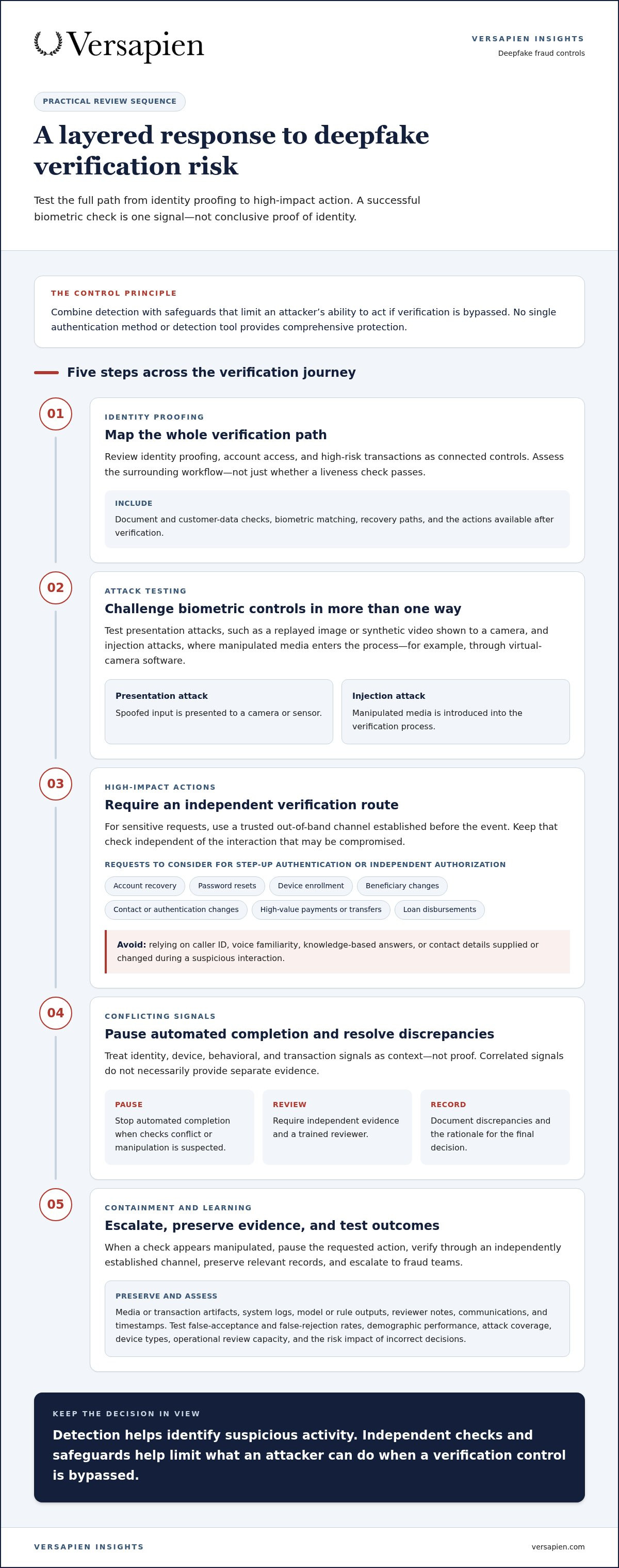
3. Deepfake fraud protection for banks and financial institutions
A practical testing program should determine whether the institution can detect a suspicious interaction, make a sound decision, contain the potential loss, and learn from identified weaknesses. The five-step methodology below is a management tool for structuring that assessment. It is not a regulatory standard or a validated proprietary framework.
Define the scenario and objective: Select a high-impact customer journey and define the failure being tested. Examples include synthetic media passing identity verification during onboarding, an impersonated caller requesting account recovery, or a suspicious request preceding a high-value transfer.
Trace the end-to-end decision: Follow the scenario through automated checks, staff review, exception handling, approval authority, and the final customer or transaction outcome. Identify where the process relies on a single signal or where an attacker could exploit a handoff.
Evaluate the evidence: Determine whether the available records explain why the request was approved, denied, delayed, or escalated. Review relevant system outputs, reviewer decisions, exceptions, and fallback paths, including whether testing reflects production configurations rather than demonstrations alone.
Assess the governance response: Confirm that decision rights are clear. Management should know who can approve exceptions, who provides independent challenge, which issues require escalation, and which function is accountable for remediation.
Report actionable findings: Group findings by control coverage, process design, technology, decision rights, evidence, or operational capacity. Prioritize them by potential customer harm and loss exposure, and specify an accountable remediation owner and target date for material gaps.
A balanced test should look beyond whether a deepfake is detected. It should consider:
Effectiveness: How often does the process accept a suspicious attempt, incorrectly reject a legitimate customer, or fail to escalate conflicting signals?
Coverage: Are relevant presentation and digital-injection scenarios included, along with alternate channels and recovery paths?
Consistency: Are outcomes and customer impacts understood across relevant demographic groups, devices, channels, and operating conditions?
Operational Capacity: Can reviewers handle alerts and exceptions at realistic volumes without encouraging unsafe workarounds?
Governance and Evidence: Can management see who made the decision, what evidence supported it, whether an override occurred, and whether the issue was remediated?
Testing results should inform decisions about control investment, acceptable risk, vendor oversight, staffing, and remediation priorities. Findings should not stop at a technical defect or a list of failed scenarios. Leaders need to understand the business consequence, the conditions that allowed the weakness to occur, and whether compensating controls meaningfully limit exposure.
Responsibilities should remain clear. Business owners operate customer controls, technology teams maintain supporting systems, and risk and compliance functions provide appropriate challenge. Internal Audit may independently assess design and evidence without taking ownership of management decisions. This separation supports accountability while allowing leaders to see whether the overall process is working as intended.
Executive Takeaways
Deepfake-enabled fraud requires executives to evaluate verification as an interconnected control environment rather than rely on a single biometric or authentication result. Decision-makers should prioritize testing that connects technical signals, human decisions, governance authority, and potential loss exposure.
Approve risk-based requirements for step-up authentication, independent secondary authorization, transaction holds, and management overrides on high-impact customer actions.
Prioritize tests that cover presentation attacks, injection attacks, fallback paths, demographic performance, false rejections, review capacity, and the consequences of incorrect decisions.
Establish an escalation hierarchy that defines who may pause a transaction, who provides independent challenge, and who authorizes exceptions or release.
Require a complete exception record linking the trigger, decision, evidence preserved, authority exercised, customer impact, remediation owner, and closure validation.
Set evidence standards for logs, reviewer notes, model or rule outputs, communications, approvals, and timestamps so control decisions can be reconstructed.
Assign remediation ownership to the accountable business, technology, risk, or fraud function and require management reporting until material gaps are sustainably closed.
How Versapien Can Help
Deepfake-enabled fraud is a test of an institution’s broader risk governance, not just its technology. Versapien advises financial services leaders on how to evaluate whether customer-verification controls, decision rights, and oversight practices are aligned with the institution’s risk exposure. Through its work in enterprise risk, regulatory strategy and compliance, and AI and digital transformation, Versapien helps leadership teams develop a clearer view of material weaknesses and practical priorities for improvement.



Comments