
Operational Risk Management in an AI-Enabled Financial Institution
As financial institutions embed artificial intelligence into customer service, fraud detection, lending, and internal operations, operational risk teams face a new challenge. AI can change how failures occur, how quickly they spread, and how easily they can be detected. Existing operational risk management frameworks, built for human-led and rules-based processes, may need to evolve to address the speed, scale, and complexity of AI-enabled activities.
The core issue is not that AI creates an entirely new discipline of risk. Instead, it changes the nature, velocity, and potential impact of traditional operational risks. An AI-enabled process can introduce or amplify failures related to data integrity, unexpected system outputs, automation controls, vendor dependencies, and human oversight. Integrating these considerations requires a deliberate evolution of the operational risk management function, moving from periodic assessments to a more dynamic approach to oversight, with monitoring frequency and intensity aligned to the significance and risk of the AI-enabled process.
This analysis outlines a practical lifecycle for managing the operational risks of AI. It provides a framework for risk, business, and technology functions to identify, assess, monitor, and manage these evolving challenges by adapting existing ORM tools and practices.
Table of Contents
The AI-Enabled Operational Risk Lifecycle
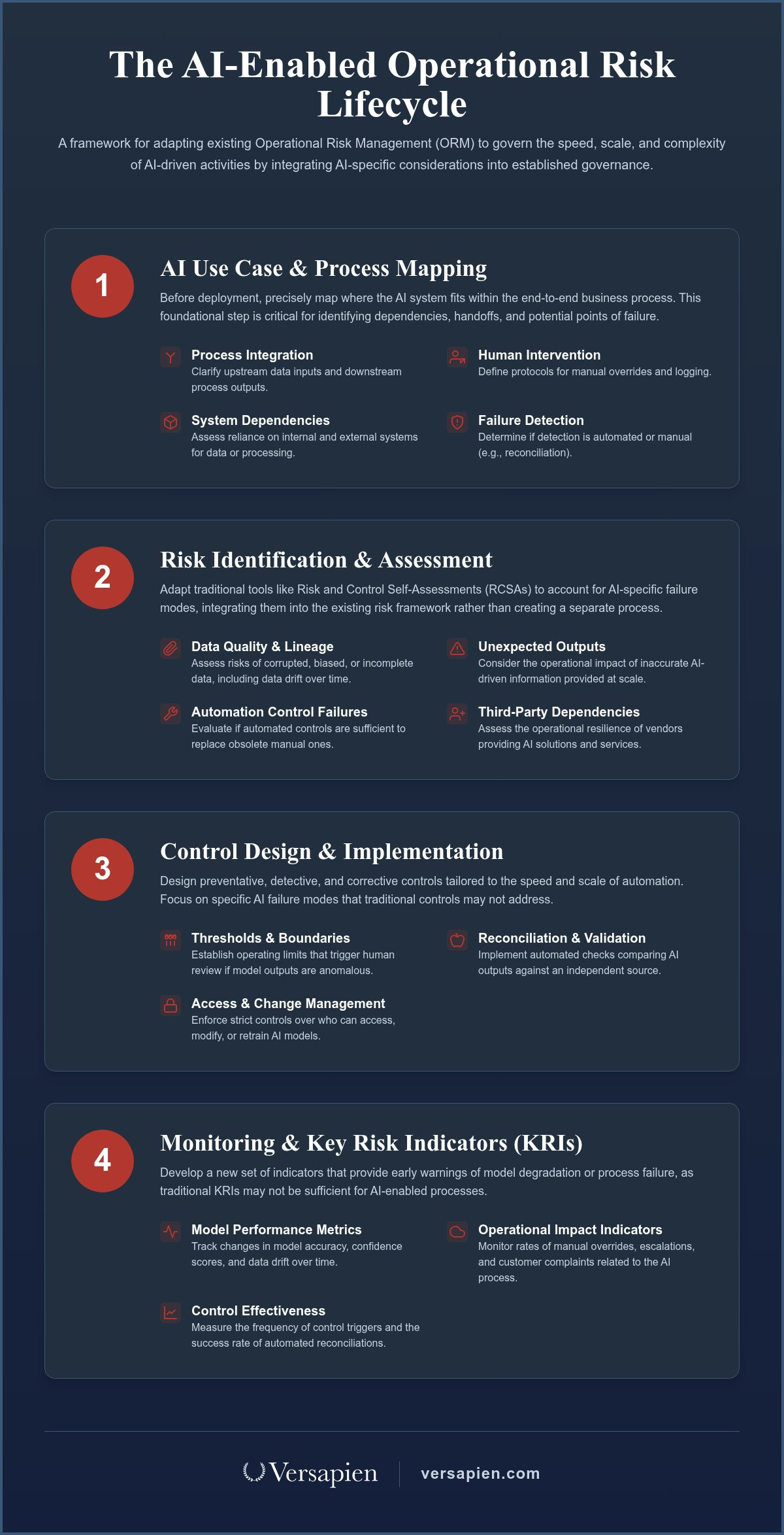
Managing operational risk in an AI-driven environment requires a structured approach that begins before a model is deployed and continues throughout its use. By adapting the traditional risk management lifecycle, institutions can integrate AI-specific considerations into established governance processes. This ensures that AI-related risks are not managed in a silo but are part of the broader operational risk taxonomy.
Step 1: AI Use Case and Process Mapping
Before deploying an AI system, management must understand precisely where it fits within an end-to-end business process. This foundational step is often overlooked in the rush to implement new technology, yet it is critical for effective risk identification. The objective is to create a detailed process map that clarifies dependencies, handoffs, and potential points of failure.
Operational risk teams, in partnership with business and technology units, should document answers to several key questions:
Process Integration: Where does the AI system begin and end? What are the immediate upstream data inputs and downstream process outputs?
Human Intervention: Who is authorized to intervene if the AI system fails or produces anomalous results? What are the protocols for manual overrides, and how are they logged and reviewed?
System Dependencies: What other systems, internal or external, does the AI model rely on for data, processing, or execution? What is the operational impact if one of these dependencies fails?
Failure Detection: How would a partial or complete failure of the AI system be detected? Are detection mechanisms automated, or do they rely on manual reconciliation or customer complaints?
For example, a process automation tool designed to handle loan processing might produce incorrect calculations. If the process map fails to account for this possibility, the firm may lack a control to detect the errors before they affect funding and booking, creating financial, reputational, and compliance risks.
Step 2: Risk Identification and Assessment
With a clear process map, the next step is to identify how AI changes the risk profile of the process. This involves adapting traditional tools like the Risk and Control Self-Assessment (RCSA) to account for AI-specific failure modes. The goal is not to create a separate "AI RCSA" but to enhance the existing framework to capture new risk drivers.
Key areas to assess include:
Data Quality and Lineage: An AI system's output is highly dependent on its training and input data. The RCSA should assess the risk of corrupted, biased, or incomplete data leading to flawed outcomes. This extends beyond traditional data validation to include risks associated with data drift over time.
Incorrect or Unexpected Outputs: Unlike rules-based systems, some AI models can produce unexpected or difficult-to-interpret results. The assessment must consider the operational impact of the AI providing inaccurate information at scale, such as an AI-powered customer service tool misstating account terms to thousands of customers simultaneously.
Automation and Control Failures: When a manual process is automated with AI, the controls designed for human operators may become obsolete. The RCSA must evaluate whether automated controls are sufficient to prevent or detect failures that previously would have been caught by a person.
Third-Party and Vendor Dependencies: Many AI solutions are provided by third-party vendors. A critical part of risk identification is assessing the operational resilience of these partners. For more on this, see Versapien’s guide to third-party risk management for AI and fintech vendors.
Step 3: Control Design and Implementation
Effective controls for AI-enabled processes must be designed to address the speed and scale of automation. While preventative controls are important, detective and corrective controls are critical for managing risks that cannot be entirely eliminated.
Consider a third-party AI service used for fraud detection. A preventative control might be the contractual requirement for the vendor to maintain a certain level of system uptime. However, a detective control is also necessary, such as an internal alert that triggers if the firm stops receiving a signal from the vendor for a specified period. The corresponding corrective control would be the pre-defined incident response plan to switch to an alternative fraud screening process.
Controls should be designed around specific AI failure modes:
Thresholds and Boundaries: For AI systems involved in decision-making (e.g., credit underwriting), establish operating thresholds that trigger a human review if the model's outputs exceed certain limits or confidence scores fall too low.
Reconciliation and Validation: Implement automated reconciliation checks that compare the AI system's outputs against an independent source or baseline. This is especially important for financial calculations or data processing tasks.
Access and Change Management: Enforce strict controls over who can access, modify, or retrain AI models. Changes to a model's code, parameters, or underlying data should follow a formal change management process with documented testing and approval.
Step 4: Monitoring and Key Risk Indicators (KRIs)
Traditional KRIs, such as error rates from manual processing or system downtime, may not be sufficient for monitoring AI-enabled processes. Effective monitoring requires developing a new set of indicators that provide early warnings of model degradation or process failure.
Relevant KRIs for AI operational risk include:
Model Output Drift: Unexpected changes in AI outputs that may indicate deterioration in process performance or emerging operational issues.
Data Input Validation Rates: Monitoring the frequency of data quality issues at the point of input, which can indicate problems with upstream data sources.
Manual Intervention Frequency: An increase in the rate of human overrides or adjustments to the AI's output can signal that the model is no longer performing as intended.
System Latency: Measuring the processing time of the AI system, as significant increases can be a leading indicator of technical or capacity issues.
These KRIs should be integrated into existing operational risk dashboards and reported to relevant risk committees, providing a more dynamic view of the firm's risk profile.
Step 5: Incident Management and Response
When an AI-enabled process fails, the speed and scale of the impact can be significantly greater than in a manual environment. An AI-powered tool providing inaccurate information can affect thousands of customers in minutes, making a rapid and well-rehearsed incident response plan essential.
The operational risk incident management framework should be updated to address AI-specific scenarios. This includes defining clear escalation paths that specify who needs to be informed, including business line leaders, technology teams, model risk management, compliance, and legal. The root cause analysis process must also adapt. It may require specialized expertise to determine whether a failure was caused by a data anomaly, a model flaw, a technical issue, or an unforeseen interaction with another system.
Step 6: Lessons Learned and Continuous Improvement
The final stage of the lifecycle is to ensure that insights from incidents, near misses, and monitoring are used to improve the control environment. The issue management process should track remediation efforts for any identified weaknesses. Furthermore, the results of root cause analyses should be fed back into the RCSA process, allowing the institution to update its understanding of the risks and the effectiveness of its controls.
This feedback loop is what transforms operational risk management from a reactive function into a proactive one. By systematically learning from operational events, the firm can strengthen its AI governance and build a more resilient operating model.
Integrating AI Risks into the Existing ORM Framework
A common mistake is to treat "AI risk" as a separate category, creating a new silo that is disconnected from the enterprise-wide view of operational risk. A more effective approach is to map AI-related risk drivers to the institution's existing operational risk taxonomy, which is typically structured around categories like People, Process, Systems, and External Events.
This integration ensures that AI-related risks are assessed and managed with the same rigor as other operational risks. It also allows the Board and senior management to understand these new challenges within a familiar context.
The following table provides a simplified example of how this mapping works:
By using this approach, firms can leverage their existing model risk management and ORM infrastructure, including governance committees, reporting lines, and policy frameworks, to oversee AI without having to build a redundant new bureaucracy.
Executive Takeaways
As financial institutions increase their reliance on AI, Boards and senior management should consider whether the operational risk management framework is evolving in parallel. The focus should be on practical integration and adaptation, not the creation of an entirely new and separate governance structure. Leaders should be asking their teams the following questions:
Process Dependency: Which of our critical business processes are becoming significantly dependent on AI systems, and have we mapped how a failure in those systems could affect downstream operations and customers?
Risk Assessment: Can our existing Risk and Control Self-Assessment (RCSA) processes effectively identify and assess the operational risks introduced by AI, such as data integrity failures, unexpected outputs, or automation blind spots?
Monitoring and Escalation: Are our monitoring capabilities and Key Risk Indicators (KRIs) keeping pace with the speed of automation? Do we have clear, tested escalation protocols for AI-related incidents?
Third-Party Oversight: Do our third-party risk management processes adequately address critical dependencies on AI vendors, including their operational resilience, data security, and model governance standards?
Incident Analysis: Are significant AI-related incidents, including near misses, captured, analyzed for root causes, and used to improve the design and implementation of our controls?
Answering these questions is fundamental to managing the operational realities of an AI-enabled institution. It moves the conversation beyond the theory of AI governance and toward the practical discipline of sound operational risk management.


Comments