
UDAAP Change Management: Reassessing Risk When Products, Fees or Decisioning Change
Updated: Sep 22
Financial institutions frequently alter products, fee structures, customer communication channels, and underwriting algorithms to adjust to commercial requirements and market developments. However, operational change management protocols in financial services are traditionally calibrated to evaluate technical stability, infrastructure resilience, and delivery schedules. When changes to consumer-facing features, fee calculations, or automated decisioning are treated primarily as technical updates, consumer protection considerations are easily overlooked.
The operational risk is tangible. When product modifications alter how fees are assessed, how terms are presented, or how credit decisions are processed, an institution can unintentionally introduce consumer harm. Evaluating Unfair, Deceptive, or Abusive Acts or Practices (UDAAP) risks cannot be an ad hoc exercise conducted only after an influx of customer disputes or regulatory inquiries. A structured, risk-based approach can help institutions reassess consumer risk at appropriate points in the product and operational lifecycle.
Table of Contents
Integrating UDAAP Principles into the Enterprise Change Management Lifecycle
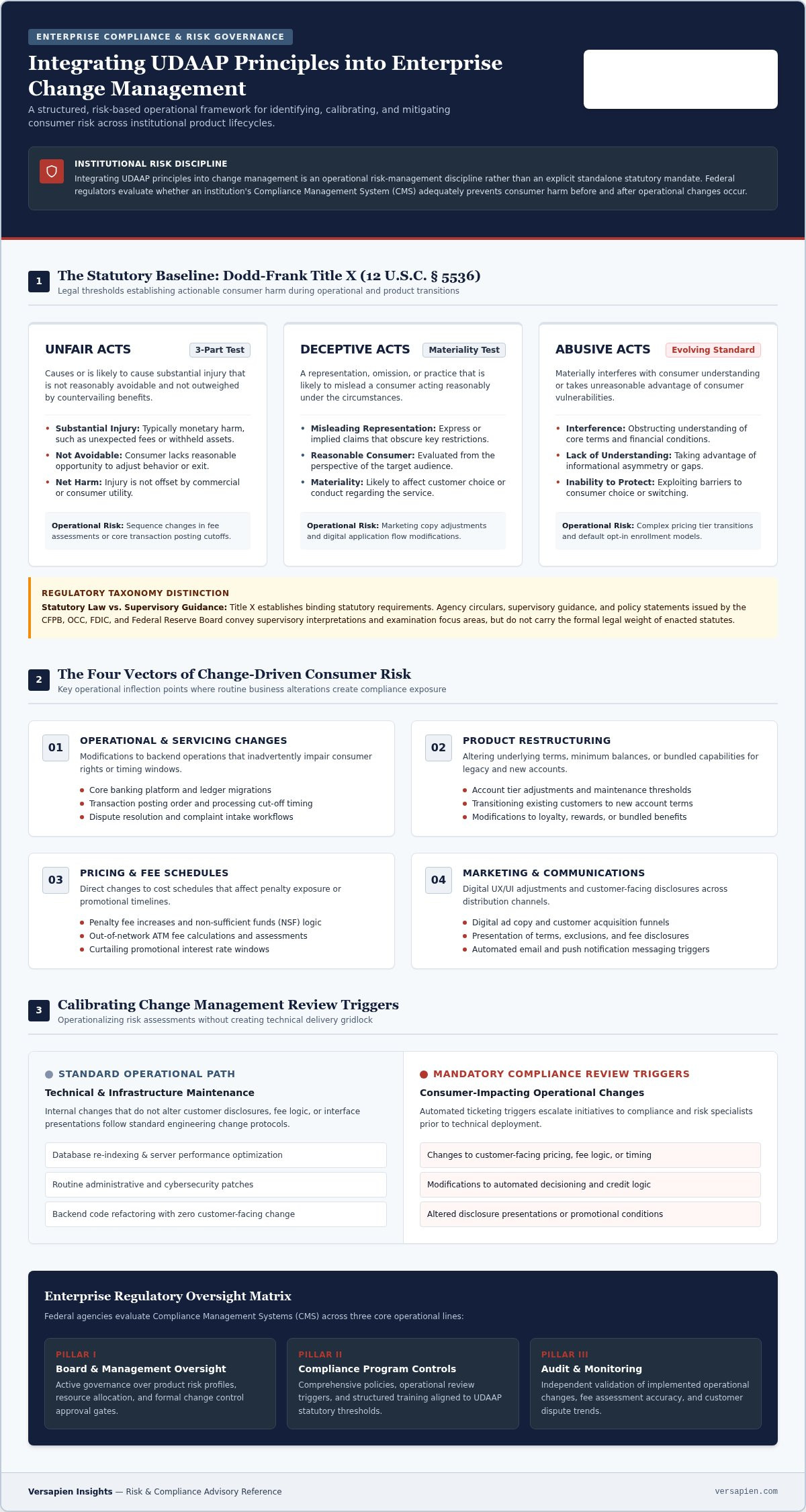
Integrating UDAAP principles into enterprise change management is an institutional risk-management discipline rather than an explicit, standalone statutory mandate. While Title X of the Dodd-Frank Wall Street Reform and Consumer Protection Act (CFPA) explicitly prohibits unfair, deceptive, or abusive acts or practices, the statute does not prescribe a specific operational change management workflow. Rather, regulatory agencies may evaluate an institution's Compliance Management System (CMS), including processes for identifying and managing consumer compliance risks associated with products, services, and operational changes.
When changes occur across business lines, consumer risk profiles shift across distinct operational vectors:
Operational and Servicing Changes: Adjustments to payment processing order, core banking system migrations, payment posting cut-off times, or dispute resolution workflows can lead to unanticipated fees or delayed access to funds, creating substantial injury that consumers cannot reasonably avoid.
Product Restructuring: Modifying account tiers, introducing maintenance thresholds, altering feature bundles, or modifying rewards programs can fundamentally alter the consumer value proposition, creating potential exposure if existing customers are transitioned into less advantageous structures without transparent notification.
Pricing and Fee Schedules: Increasing penalty fees, altering fee assessment timing (such as charging out-of-network ATM fees or non-sufficient funds fees in altered processing sequences), or reducing promotional rate windows can create unfair outcomes if consumers are deprived of reasonable opportunities to adjust their behavior.
Marketing and Consumer Communications: Modifying digital ad copy, email notifications, application workflows, or terms-and-conditions presentations can create deceptive representations if the material conditions, exclusions, or mandatory payment terms are obscured.
A functional regulatory compliance consulting approach embeds review triggers into existing operational ticketing and change control systems. Rather than subjecting every minor technical change, such as an internal security patch or administrative database indexing, to extensive legal analysis, organizations establish calibrated, risk-based triggers that automatically escalate initiatives affecting customer interaction, pricing, decision logic, or disclosures to compliance and risk specialists.
The Statutory Baseline and Evolving Interpretations of Abusive Acts
Effective change governance requires risk professionals to distinguish between binding statutory standards, formal administrative regulations, and nonbinding agency guidance. Title X of the Dodd-Frank Act (codified at 12 U.S.C. § 5536) established the statutory framework for UDAAP. Under the law, an act or practice is:
Unfair: When it causes or is likely to cause substantial injury to consumers which is not reasonably avoidable by consumers and not outweighed by countervailing benefits to consumers or to competition. Substantial injury typically involves monetary harm, such as unexpected fees or withheld assets.
Deceptive: When there is a representation, omission, or practice that is likely to mislead a consumer acting reasonably under the circumstances, and the representation, omission, or practice is material (meaning it affects the consumer's conduct or decision regarding a product or service).
Abusive: When it materially interferes with the ability of a consumer to understand a term or condition of a consumer financial product or service, or takes unreasonable advantage of a lack of understanding on the part of the consumer, the inability of the consumer to protect their interests in selecting or using a consumer financial product or service, or the reasonable reliance by the consumer on a covered entity to act in their interests.
The unfairness and deception concepts draw on established legal and regulatory standards, while the abusiveness standard was established by the Dodd-Frank Act and has been addressed through enforcement actions, advisory materials, and supervisory guidance. Agency circulars and policy statements reflect supervisory interpretations rather than newly enacted legislation. While these publications inform how regulatory examination teams assess institutional conduct, they do not carry the formal weight of statutory amendments. Compliance leaders must structure their change management assessments around the specific statutory definitions while evaluating whether complex pricing schedules or default enrollment features could be interpreted as taking unreasonable advantage of consumer vulnerabilities.
The Four Pillars of a Proactive UDAAP Change Management Framework
To prevent consumer harm while maintaining product velocity, financial institutions can implement a four-stage UDAAP change management framework. This framework functions as an operational best practice for enterprise risk management, rather than a regulatory-prescribed mandate. It organizes oversight into defined checkpoints that align cross-functional stakeholders including product managers, technology leads, operations teams, and compliance officers.
The four stages establish clear accountability before, during, and after any consumer-impacting deployment.
Pre-Implementation Impact Analysis: Conducted during the design and technical specification phase. This stage evaluates the consumer journey, disclosure adequacy, marketing claims, and potential disparate treatment or outcome disparities. Business lines complete a structured questionnaire that identifies changes in pricing, consumer interaction, operational friction, or automated eligibility criteria.
Control Design and Verification: Conducted prior to production deployment. Compliance and operational risk personnel review control effectiveness, verifying that disclosures are prominent, automated calculation engines adhere to disclosed fee schedules, customer service scripts match technical parameters, and digital interfaces provide accurate, balanced information. User acceptance testing (UAT) includes explicit compliance test cases.
Post-Implementation Monitoring: Conducted after launch at intervals and for a duration appropriate to the nature, complexity, and risk of the change. Monitoring may include complaint categories, dispute rates, fee assessment volumes, and opt-out requests. This review evaluates actual consumer outcomes against original design projections by tracking complaint categories, dispute rates, fee assessment volumes, and opt-out requests.
Feedback Integration and Reassessment: Incorporates empirical operational data back into the broader risk management framework. If post-launch monitoring reveals consumer confusion or unexpected financial detriment, the institution initiates operational adjustments, corrective disclosures, or remediation, while refining the risk-scoping criteria for future change initiatives.
Risk-Based Scoping for Change Initiatives
Not all institutional changes warrant identical levels of compliance review. Requiring comprehensive risk evaluations for every routine software update creates operational bottlenecks that undermine adherence to change controls. Conversely, treating complex pricing modifications as standard IT tickets exposes the organization to consumer protection vulnerabilities. A disciplined change management process applies a risk-based tiering model to classify modifications based on their potential consumer impact.
The following matrix illustrates how institutions can calibrate review depth and control evidence across common operational changes.
Applying a risk-based scoping model can help focus analytical resources on initiatives where the potential for consumer injury or misunderstanding is greater, maintaining operational efficiency while preserving rigorous consumer protection oversight.
Operationalizing UDAAP Controls for Digital and AI-Enabled Products
As consumer financial services transition toward digital self-service workflows and automated systems, UDAAP risk patterns evolve. In digital delivery channels, consumer risk is frequently generated by interface presentation, disclosure timing, and algorithmic decisioning rather than direct personnel interactions. Conducting a rigorous consumer lending compliance risk assessment requires risk teams to evaluate the technical components that drive digital product delivery.
Digital design practices commonly referred to as "dark patterns", such as interface designs that obscure cancelation buttons, pre-selected checkboxes for add-on products, or visual hierarchies that downplay critical fee schedules, are not distinct statutory violations under the Dodd-Frank Act. Instead, they represent potential risk indicators that regulatory agencies and courts may evaluate to determine whether an interface design constitutes an unfair, deceptive, or abusive practice. When evaluating user interfaces, risk managers must assess whether the digital journey obscures material terms, leads a reasonable consumer into an unintended financial commitment, or creates unreasonable barriers to exercising contractual rights.
Additionally, institutions must clearly delineate UDAAP considerations from related fair lending obligations. While the Equal Credit Opportunity Act (ECOA) and Regulation B prohibit discrimination against protected classes on a prohibited basis in any aspect of a credit transaction, UDAAP focuses on whether practices cause substantial, unavoidable harm, mislead reasonable consumers, or take unreasonable advantage of consumers. An automated credit model or marketing algorithm can be fully compliant with ECOA yet still trigger UDAAP concerns if it generates systemic errors in fee billing, relies on deceptive promotional descriptions, or operates in a manner that prevents consumers from understanding critical obligations.
Governance around automated models requires careful contextual application of supervisory expectations. The Federal Reserve's April 2026 SR 26-2, Revised Guidance on Model Risk Management, supersedes SR 11-7 and provides risk-based, nonbinding guidance on model risk management. It is important to emphasize that SR 26-2 is risk-based and nonbinding supervisory guidance, primarily relevant to larger banking organizations with more than $30 billion in total assets; asset size alone does not establish a universal applicability threshold for all financial institutions. Furthermore, generative AI and agentic AI models are outside the scope of SR 26-2. Not every automated system constitutes a formal "model" under regulatory definitions, and third-party software tools do not uniformly require the identical mathematical validation protocols demanded of complex internal statistical credit scoring engines.
Similarly, human-in-the-loop controls should not be viewed as a universal regulatory mandate for every automated process. While human intervention is an appropriate control for complex, high-discretion decisions, mandating manual touchpoints across every high-volume digital process can degrade efficiency without necessarily reducing consumer risk. The decision to implement manual intervention must be calibrated to the specific operational context, complexity, and severity of potential consumer impact.
Monitoring Automated Decisioning Systems
When automated decisioning engines are modified, institutions should assess whether the update could produce disparate outcomes, misleading representations, or other consumer risks relevant to the institution's products and applicable requirements. Understanding AI accountability and consumer harm requires risk professionals to verify that decisioning logic aligns with customer-facing disclosures.
Risk and compliance leaders can apply the following operational decision framework when evaluating proposed changes to automated decisioning systems:
Feature and Input Scrutiny: Does the system incorporate alternative data sources (e.g., behavioral tracking, geolocation, telecommunications data) that consumers would not reasonably anticipate being used for eligibility or pricing determinations?
Transparency and Expectation Alignment: Does the automated outcome align with the representations made to the consumer at the point of application or enrollment? If a marketing campaign promises "instant pre-qualification with no impact on credit score," does the technical logic execute a hard credit inquiry under specific workflow conditions?
Interference Analysis: Does the automated workflow introduce artificial delays or friction when a consumer attempts to dispute a transaction, cancel a subscription, or exercise an opt-out choice?
Disparate Detriment Testing: Does post-implementation outcome testing indicate that certain consumer segments experience disproportionate fee assessments or adverse outcomes that cannot be explained by standard risk underwriting metrics?
Conducting pre-deployment testing against these decision criteria can help identify whether automated operational changes could contribute to practices that may implicate the prohibition on abusive acts or practices.
Strengthening Governance through Board Oversight and Executive Accountability
A functional UDAAP change management program requires defined governance structures that delineate operational execution from compliance oversight. While many institutions organize their risk management using the traditional Three Lines model (First Line: Business Units; Second Line: Compliance and Risk; Third Line: Internal Audit), regulatory frameworks do not prescribe this specific operational architecture as a universal requirement. Financial institutions have the flexibility to design organizational structures that suit their scale, operational complexity, and regulatory profile, provided the structure establishes clear accountability and independence.
Regardless of the specific organizational model employed, effective risk governance establishes distinct functional responsibilities during change initiatives:
Business Lines (Operations, Product, Technology): Maintain primary responsibility for identifying proposed changes, initiating risk reviews via established triggers, designing operational controls, and executing pre-launch testing.
Compliance and Risk Management: Provide independent challenge, evaluate proposed initiatives against statutory UDAAP definitions and supervisory guidance, define testing standards, and establish post-implementation monitoring parameters.
Legal Counsel: Interprets evolving judicial precedents, examines novel product structures against federal and state consumer protection statutes, and advises on ambiguous statutory definitions.
Internal Audit: Periodically assesses the overall effectiveness of the change management framework, testing whether operational units adhere to review triggers and whether post-implementation monitoring is systematically executed.
Risk escalation pathways must be grounded in institutional risk-management logic rather than rigid, impractical operational mandates. The Board of Directors maintains broad responsibility for overseeing the institution's overall risk appetite, capital adequacy, and Compliance Management System. However, board members should not be expected to review or approve individual operational, technical, or marketing changes. Expecting board approval for discrete product modifications blurs the line between board oversight and executive management, creating administrative friction without improving consumer protection.
Instead, governance frameworks should define clear escalation thresholds. Operational changes that introduce novel fee mechanisms, enter unchartered regulatory areas, or reveal significant post-implementation compliance defects should escalate to executive risk committees, with aggregate risk profiles and material compliance exceptions summarized for the Board's Risk Committee.
Reporting and Transparency Requirements
Demonstrating a functional Compliance Management System to executive leadership, boards, and regulatory examination teams requires evidence-based reporting. Rather than relying on subjective narratives regarding program health, management reporting should center on empirical metrics that track consumer outcomes throughout the change management lifecycle.
Effective management and board reporting packages should include the following key performance and risk indicators:
Volume and Classification of Change Initiatives: Aggregate counts of operational modifications processed through the change management system, segmented by risk tier (Tier 1, Tier 2, Tier 3) and business unit.
Post-Implementation Complaint Metrics: Complaint volumes and root-cause analyses specifically tagged to products or features modified within the preceding 90 to 180 days, highlighting any spikes in consumer allegations of surprise fees, misrepresentation, or service friction.
Exception and Deferral Tracking: The number of product or technical releases deployed with conditional compliance approvals, outstanding control deficiencies, or deferred testing requirements, including remediation progress against agreed-upon deadlines.
Operational and Financial Corrections: Metrics tracking post-launch refunds, fee waivers, or account adjustments driven by operational calculation errors or disclosure misalignments, identifying specific root causes in the initial change management process.
By monitoring these operational indicators, senior management can identify systemic control weaknesses in the product design lifecycle before they manifest as broad institutional vulnerabilities.
Executive Takeaways
UDAAP Change Management Is an Operational Risk Discipline: While the Dodd-Frank Act strictly prohibits unfair, deceptive, and abusive practices, the law does not dictate a prescriptive change control workflow. Incorporating UDAAP into change management represents an institutional risk-management best practice embedded within the broader Compliance Management System.
Implement Calibrated, Risk-Based Review Triggers: Avoid operational bottlenecks by differentiating routine IT infrastructure maintenance from high-risk product, pricing, and communication updates. Utilize structured risk tiering to concentrate analytical scrutiny where consumer impact is highest.
Evaluate Digital Features Beyond Traditional Boundaries: Digital design choices and interface layouts can serve as potential indicators of unfairness or deception if they obscure material terms or create asymmetric cancellation barriers. Distinguish UDAAP compliance from fair lending mandates (such as ECOA and Regulation B), as algorithmic workflows can be non-discriminatory yet still produce unfair or misleading consumer outcomes.
Contextualize Model Risk and AI Guidance Accurately: Supervisory guidance like SR 26-2 is nonbinding and risk-based, primarily relevant to banking organizations with more than $30 billion in assets; asset size alone does not establish universal applicability. Furthermore, generative and agentic AI architectures fall outside the scope of SR 26-2, and human-in-the-loop oversight is a contextual control rather than a universal regulatory mandate.
Delineate Governance Roles Without Overburdening the Board: Maintain clear operational boundaries between business lines, compliance challenge functions, and internal audit. The Board of Directors maintains oversight over the enterprise risk appetite and compliance framework, but should receive synthesized, metrics-driven reporting rather than requests to approve individual operational product updates.
How Versapien Can Help
Versapien provides boutique advisory services specializing in regulatory compliance, enterprise risk management, and digital transformation for consumer financial services institutions. Our senior-led advisory team brings extensive Big Four consulting leadership and technical expertise to regional banks, fintech companies, mortgage lenders, auto finance organizations, and digital asset firms.
Our advisory capabilities include:
Compliance Management System (CMS) Enhancements: Designing and implementing robust UDAAP change management workflows, risk-scoping matrices, and cross-functional review processes tailored to modern operational environments.
AI and Digital Governance Frameworks: Structuring risk-based oversight for automated decisioning systems, credit scoring models, and digital self-service interfaces to identify potential consumer protection blind spots.
Regulatory Examination Readiness and Remediation: Assisting institutions in evaluating existing change management controls, analyzing customer dispute trends, and structuring sustainable remediation programs for identified compliance gaps.
Board and Executive Advisory: Developing clear, defensible reporting packages and risk escalation frameworks that provide executive leadership and boards with objective visibility into consumer protection risks.
To discuss how Versapien can support your organization's risk management and compliance programs, contact our regulatory compliance advisory team.


Comments