
What Boards and Executive Management Should Know About AI Governance
Updated: Sep 22
Table of Contents
The Evolving Regulatory Landscape for AI in Financial Services
The adoption of artificial intelligence in financial services has transitioned from an aspirational goal to a reality subject to intensifying regulatory scrutiny. By 2026, financial institutions are expected to demonstrate mature governance frameworks that address the inherent risks of automated systems. Major U.S. regulators, including the Securities and Exchange Commission (SEC) and the Financial Industry Regulatory Authority (FINRA), maintain a “technology-agnostic” stance, applying existing rules for investor protection and market integrity to AI-driven activities. Concurrently, the Consumer Financial Protection Bureau (CFPB) has sharpened its focus on algorithmic decision-making, demanding greater transparency and holding institutions accountable for outcomes produced by so-called “black box” models. This environment requires a proactive governance posture, where compliance is an architectural foundation for innovation, not a reactive measure.
Federal Oversight and the Impact on Consumer Lenders
For institutions in the consumer lending space, such as mortgage and auto finance companies, the regulatory implications are particularly acute. Long-standing consumer protection laws, including the Equal Credit Opportunity Act (ECOA) and prohibitions against Unfair, Deceptive, or Abusive Acts or Practices (UDAAP), apply directly to automated underwriting and pricing systems. Regulators are less concerned with the technology itself than with its results. The use of AI does not eliminate an institution’s responsibility for complying with applicable consumer protection and fair lending requirements. If an automated system produces discriminatory or harmful outcomes, the institution may face regulatory, legal, operational, and reputational consequences. The consequences of non-compliance extend beyond financial penalties and enforcement actions, posing significant reputational risk that can erode customer trust and brand value.
Global Standards and Evolving Model Risk
While the U.S. develops its regulatory approach, international frameworks like the EU AI Act are establishing global baselines for risk-based AI governance that influence expectations for U.S. firms with international operations. A critical challenge for leadership is managing the risk of AI systems after deployment. This risk profile is not static; it changes due to factors like data drift, where the production data begins to differ from the data used to train the model, leading to performance degradation. Risk also evolves as internal use cases expand or as regulatory expectations shift. Sustaining a defensible compliance posture requires robust, cross-functional alignment between technology, legal, risk, and business-line leadership to monitor and adapt to these changes continuously.
Core Pillars of a Robust AI Governance Framework
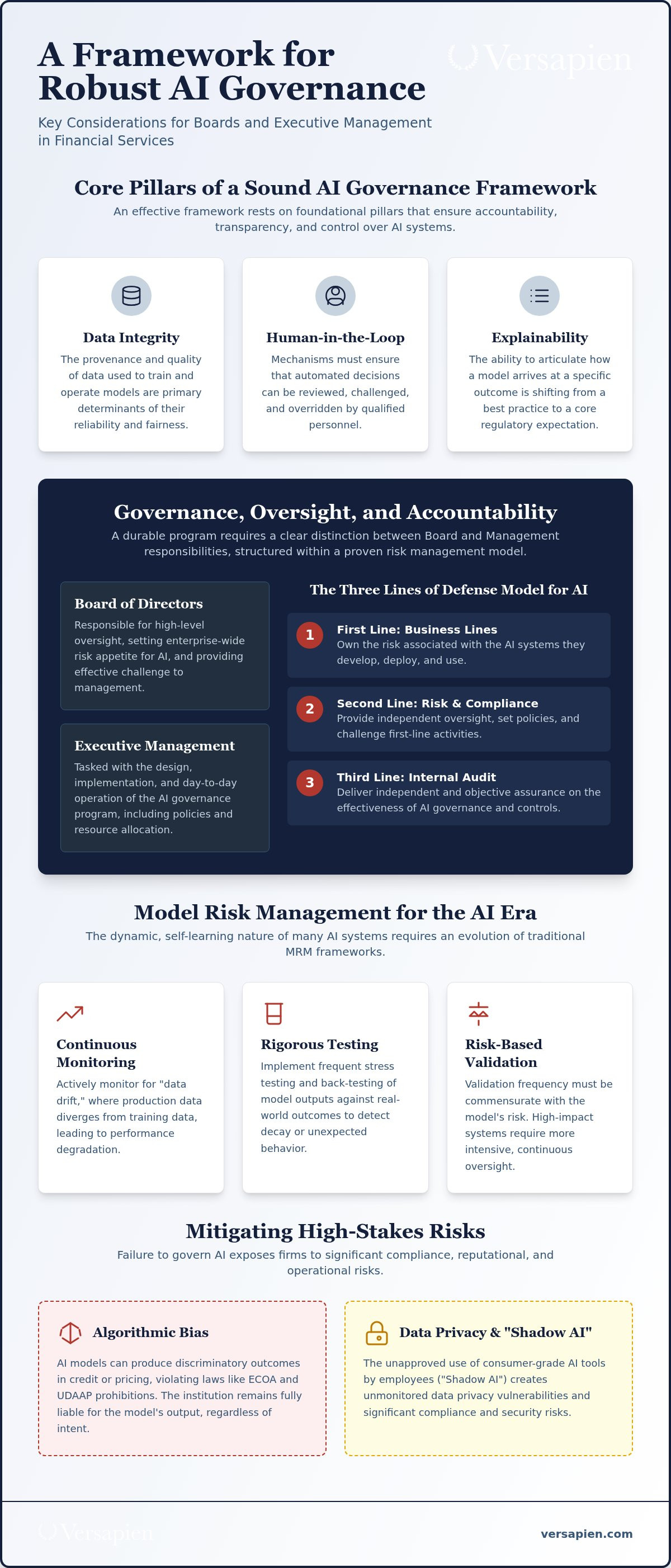
An effective AI governance framework provides the structural stability necessary for an institution to leverage AI safely and soundly. The framework rests on foundational pillars that ensure accountability, transparency, and control. Central to this is data integrity; the provenance and quality of data used to train and operate models are primary determinants of their reliability and fairness. Equally important are mechanisms for human-in-the-loop (HITL) oversight, which ensure that automated decisions can be reviewed, challenged, and overridden by qualified personnel. Equally important is explainability: the ability to understand and communicate how an AI system contributes to a particular outcome. The level of explainability required should be appropriate to the system’s purpose and risk, particularly for high-stakes or consumer-facing decisions where institutions may be required to provide understandable reasons for specific outcomes.
Governance, Oversight, and Accountability
A durable AI governance program requires a clear distinction between the responsibilities of the Board and those of executive management. The Board of Directors is responsible for high-level oversight, which includes understanding the institution’s AI strategy, setting the enterprise-wide risk appetite for AI-related risks, and providing effective challenge to management. Executive management, in turn, is tasked with the design, implementation, and day-to-day operation of the AI governance program. This includes establishing clear lines of ownership for AI systems, developing policies and procedures, and ensuring adequate resources are dedicated to risk management. The traditional “Three Lines of Defense” model is a proven structure for this: business lines own the risk, independent risk management and compliance functions provide oversight, and internal audit delivers independent assurance. For a deeper look at structuring these responsibilities, institutions can review guidance on AI governance committees and board oversight.
Model Risk Management for the AI Era
Traditional model risk management (MRM) frameworks provide an important foundation for governing AI systems that meet the applicable definition of a model. In April 2026, the Federal Reserve, FDIC, and OCC issued revised interagency supervisory guidance on model risk management (SR 26-2 ). The guidance reinforces a risk-based approach to model development, validation, and ongoing monitoring.
Not every AI system presents the same level or type of model risk. The nature, timing, and rigor of validation and monitoring should be commensurate with the system’s purpose, use, complexity, materiality, data, and potential impact on the institution and its customers. Higher-risk models, particularly those supporting consequential decisions, may warrant more rigorous validation and more frequent monitoring than lower-risk analytical tools.
Evaluating AI Compliance Solutions: Build vs. Buy
As institutions formalize their AI governance, leadership faces a critical strategic decision: whether to build proprietary compliance and monitoring tools in-house or to procure them from third-party vendors. This choice involves significant trade-offs that extend beyond initial cost. A thorough analysis should consider the total cost of ownership, including ongoing maintenance, talent acquisition, and the resources required to keep the solution aligned with changing regulations. Delaying this decision can inadvertently foster the growth of “Shadow AI”—the use of unapproved, often consumer-grade AI tools by employees—which creates unmonitored data privacy and compliance risks.
The Case for Custom In-House AI Development
Developing an AI governance solution internally can be justified when an institution’s business logic, data architecture, or risk profile is highly unique, making off-the-shelf products a poor fit. An in-house build offers maximum control over the system’s features and logic. It can also provide data privacy advantages by keeping sensitive institutional and customer data within the organization's security perimeter. However, this path requires a substantial and sustained investment in specialized talent—including data scientists, AI engineers, and risk modelers—as well as the underlying technology infrastructure, which can be a significant barrier for many institutions.
Selecting and Vetting Third-Party AI Vendors
For many organizations, partnering with a specialized third-party vendor is the more practical path. When evaluating vendors, particularly those offering "black box" solutions where the underlying algorithms are proprietary, the focus must be on achieving sufficient transparency and control. Due diligence cannot be a check-the-box exercise. The use of a third-party AI solution does not eliminate an institution’s responsibility for appropriately identifying, assessing, and managing the risks associated with that solution. Due diligence should go beyond a check-the-box exercise and should provide the institution with sufficient information to understand the system’s intended use, material limitations, performance, and associated risks. Depending on the system and its risk profile, institutions may also need to perform appropriate testing, validation, and ongoing monitoring. Vendor contracts should provide appropriate access to documentation, performance information, notification of material changes, and other information necessary for the institution to manage the risks associated with the solution. A robust framework for managing AI vendor risk is not optional; it is a core component of a sound AI governance program.
Mitigating High-Stakes Risks: Algorithmic Bias and Data Privacy
Among the most significant risks in deploying AI is the potential for unintentional discrimination. Algorithmic bias occurs when an AI system produces systematically prejudiced outcomes against certain demographic groups. This bias often originates not from malicious intent but from the historical data used to train the model. If past data reflects societal biases, the model will learn and perpetuate them. Regulators are particularly focused on the use of "proxy variables" (i.e., data points that are not explicitly protected characteristics but are highly correlated with them) which can lead to discriminatory outcomes in credit and lending decisions. Separately, the use of generative AI tools introduces new data privacy risks, especially when employees input personally identifiable information (PII) or other sensitive data into public large language models (LLMs).
Fair Lending and the CFPB Focus
The Equal Credit Opportunity Act (ECOA) prohibits discrimination in any aspect of a credit transaction. The CFPB has made it clear that this prohibition applies regardless of whether the decision was made by a human or an algorithm. An institution’s inability to explain how its AI model made a decision is not a valid defense against a fair lending violation. Mitigating this risk requires conducting comprehensive fair lending risk assessments on AI models before and after deployment. This involves testing for disparate impact across protected classes and ensuring that the model's logic is documented and defensible. The core challenge of algorithmic bias is that a model can be statistically accurate yet produce unfair outcomes, a conflict that governance frameworks must be designed to identify and resolve.
Combating Shadow AI and Unapproved Tools
The proliferation of powerful, publicly available AI tools has created a significant internal risk vector known as "Shadow AI." When employees use unvetted generative AI platforms for work-related tasks, such as summarizing sensitive meeting notes or drafting customer communications, they may expose proprietary information or PII to third parties without adequate security controls. To combat this, institutions must establish a clear and enforceable Acceptable Use Policy for AI that specifies which tools are approved and for what purposes. This policy should be supported by employee training and, where appropriate, technical controls and automated monitoring to detect and block the use of unauthorized applications on corporate networks.
Operationalizing AI Governance: From Framework to Execution
Establishing a sound AI governance framework is a critical first step, but its value is only realized through effective operational integration. Many AI initiatives falter not because of flawed technology but because of poor integration into existing business processes and risk management structures. Treating AI adoption as a pure technology project is a common mistake; it is a complex business transformation that requires disciplined program and project management to succeed. This ensures that governance principles are not merely documented in a policy but are embedded into the daily workflows of model developers, business users, and risk managers.
Applying Governance in a High-Risk Environment: BSA/AML
The principles of AI governance are particularly important in high-risk use cases such as Bank Secrecy Act/Anti-Money Laundering (BSA/AML) compliance. Financial institutions are increasingly exploring and deploying AI capabilities to enhance transaction monitoring, identify suspicious activity, and reduce false positives. Effective governance in this environment should address data quality, system validation or testing as appropriate, documentation, human oversight, monitoring, and the ability to investigate and explain significant system outputs. This illustrates how AI governance can help ensure that advanced technology is not only effective, but also appropriately controlled, transparent, and defensible. For more on this application, see the analysis of how AI is transforming BSA/AML compliance and the governance challenges that follow.
Key Considerations for Boards and Executive Management
As leaders guide their institutions through this technological shift, they should focus on a core set of strategic questions to ensure that AI adoption is aligned with sound risk management principles:
Oversight Structure: Does our existing committee structure provide for effective oversight of AI-related risks, or do we need a dedicated AI governance committee with a clear charter and cross-functional representation?
Risk Appetite: Has the Board clearly defined and approved a risk appetite statement for AI that guides management’s decisions on where and how to deploy this technology?
Talent and Expertise: Do we have the necessary in-house expertise to effectively challenge AI models and provide credible oversight, both within management and at the Board level?
Third-Party Risk: Is our third-party risk management program sufficiently rigorous to conduct deep due diligence on AI vendors and to perform independent validation of their models?
Monitoring and Reporting: What key risk indicators (KRIs) and performance metrics are we using to monitor AI models post-deployment, and how is this information being reported to senior management and the Board?
How Versapien Can Help
Versapien helps financial institutions translate AI ambition into practical, sustainable governance and risk management capabilities. We work with boards, executive management, risk and compliance leaders, and technology teams to assess AI use cases, establish governance frameworks, clarify accountability, and integrate appropriate controls throughout the AI lifecycle.
Our approach is grounded in the realities of regulated financial services—helping organizations balance innovation with consumer protection, regulatory compliance, model and operational risk management, data governance, and third-party oversight.
Whether your organization is developing its AI strategy, strengthening governance over existing AI capabilities, or preparing to deploy AI in high-risk areas such as consumer lending or financial crime compliance, Versapien can help you move from framework to execution with a practical, risk-based approach.


Comments