
How AI Is Transforming BSA/AML Compliance—and the Governance Challenges That Follow
Updated: Sep 22
Table of Contents
The Introduction of AI in BSA/AML Operations
Financial institutions are exploring artificial intelligence to enhance the efficiency and effectiveness of their Bank Secrecy Act/Anti-Money Laundering (BSA/AML) programs. The objective is to improve the detection of suspicious activity, reduce false positives, and focus investigative resources on the highest-risk areas. However, integrating AI into established financial crime compliance workflows introduces new operational dependencies, control challenges, and significant governance questions. The central issue is not merely whether to adopt AI, but how to deploy it in a manner that is controlled, transparent, and defensible to regulatory scrutiny.
As these technologies become more embedded in BSA/AML processes, institutions must move beyond proof-of-concept projects and establish durable governance frameworks. Without clear accountability, rigorous testing, and meaningful human oversight, AI-enabled tools can create new and unforeseen risks, including biased outcomes, opaque decisioning, and systems that are difficult to audit. This article examines practical applications of AI in financial crime compliance and outlines the critical governance components required for responsible and sustainable implementation.
Practical Applications of AI in Financial Crime Compliance
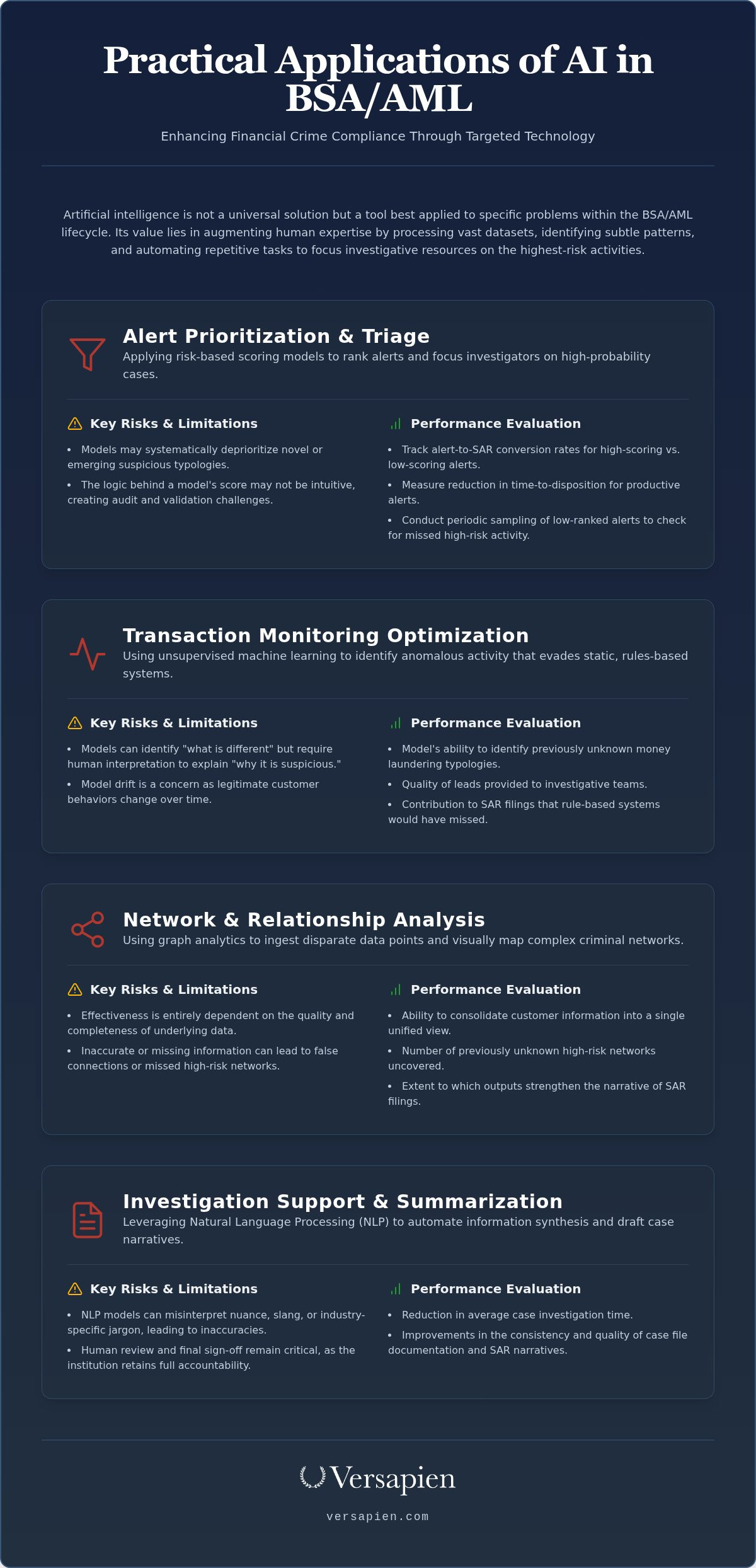
Rather than functioning as a universal solution, AI is most effective when applied to specific problems within the BSA/AML lifecycle. Its value lies in augmenting human expertise by processing vast datasets, identifying subtle patterns, and automating repetitive tasks. Below are several meaningful use cases where AI can support financial crime compliance objectives.
Alert Prioritization and Triage
A persistent challenge in many BSA/AML programs is the high volume of low-quality alerts generated by legacy transaction monitoring (TM) systems. This forces investigators to spend a disproportionate amount of time on cases that are ultimately unproductive. AI, particularly machine learning, can help address this by ingesting alert data and applying a risk-based scoring model. These models analyze dozens of attributes, such as transaction patterns, customer characteristics, and historical alert outcomes, to rank alerts by their probability of being productive. This allows an institution to direct its experienced investigators toward the most complex and high-risk alerts first.
Key Risks and Limitations: A primary risk is the potential for the model to systematically deprioritize novel or emerging typologies that do not match historical patterns. Furthermore, the logic behind a model’s score may not always be intuitive, creating challenges for investigators and auditors.
Performance Evaluation: Efficacy can be measured by tracking the alert-to-SAR conversion rate for high-scoring alerts versus low-scoring ones, analyzing the reduction in the average time to disposition for productive alerts, and conducting periodic sampling of low-ranked alerts to ensure high-risk activity is not being missed.
Transaction Monitoring Optimization
Traditional TM systems rely heavily on static, rules-based scenarios that can struggle to adapt to evolving criminal behaviors. Unsupervised machine learning models can complement these systems by identifying anomalous activity that does not conform to predefined rules. By clustering customers and transactions based on behavior, these models can flag outliers that warrant further investigation. This approach is particularly useful for detecting new forms of money laundering or fraud that have not yet been codified into the TM rule set. For a broader perspective on this topic, institutions can review strategies for BSA/AML program modernization beyond traditional transaction monitoring.
Key Risks and Limitations: Unsupervised models are adept at finding "what is different" but cannot explain "why it is suspicious" without human interpretation. They require skilled analysts to review the outputs and provide the necessary compliance context. Model drift is another concern, as customer behaviors change over time.
Performance Evaluation: Success is demonstrated by the model's ability to identify previously unknown typologies, the quality of leads it provides to investigative teams, and its contribution to SAR filings that would have been missed by rules-based systems alone.
Network and Relationship Analysis
Financial criminals often operate through complex networks of individuals, shell companies, and seemingly unrelated accounts to obscure their activities. Manually tracing these connections is an arduous and often incomplete process. AI-powered graph analytics can ingest disparate data points, such as shared addresses, phone numbers, corporate registration details, and transaction flows, to build a visual map of these networks. This allows investigators to see how entities are connected, identify central figures, and uncover hidden relationships that would be nearly impossible to find through manual review.
Key Risks and Limitations: The effectiveness of network analysis is entirely dependent on the quality and completeness of the underlying data. Inaccurate or missing information can lead to false connections or, more critically, a failure to identify a genuine high-risk network.
Performance Evaluation: The value of these tools can be assessed by their ability to consolidate disparate customer information into a single view, the number of previously unknown high-risk networks they help uncover, and the extent to which their outputs strengthen the narratives of SAR filings.
Investigation Support and Case Summarization
A significant portion of an investigator’s time is consumed by gathering, reading, and synthesizing information from various sources, including transaction histories, customer due diligence files, and unstructured notes. Natural Language Processing (NLP) models can automate aspects of this work. These tools can scan documents to extract key entities and concepts, generate chronological summaries of account activity, and even produce draft SAR narratives based on structured data inputs. This frees up investigators to focus on higher-value analytical tasks and decision-making.
Key Risks and Limitations: NLP models can misinterpret nuance, slang, or industry-specific jargon, potentially leading to inaccurate summaries. Human review and final sign-off remain critical, as the institution retains full accountability for the content of its regulatory filings.
Performance Evaluation: Metrics include the reduction in average case investigation time, improvements in the consistency and quality of case files and SAR narratives, and qualitative feedback from investigators and quality assurance teams.
A Governance Framework for AI in BSA/AML
The implementation of AI in BSA/AML is not merely a technology project; it is a risk management discipline. An effective program requires a governance framework that ensures AI tools are developed, deployed, and maintained in a safe and sound manner. This framework should not be created in a silo but should integrate with the institution's existing enterprise risk, compliance, operational risk, and data governance structures. Depending on its complexity and potential impact, an AI application may be subject to different levels of oversight. Institutions should determine whether and how existing frameworks, such as those for model risk management or third-party risk, apply based on the specific use case.
A structured governance lifecycle provides a roadmap for managing AI-enabled BSA/AML processes from concept through retirement. This ensures each application is controlled, transparent, and auditable.
The AI Governance Lifecycle for BSA/AML
1. AI Use Case Definition → 2. Data Sourcing and Integrity → 3. Testing and Validation → 4. Human Oversight and Accountability → 5. Performance Monitoring → 6. Documentation and Auditability
Data Sourcing and Integrity
The performance of any AI tool is fundamentally constrained by the quality of the data it is trained on. Before deployment, institutions must establish clear data lineage to understand where data comes from, how it is transformed, and what its limitations are. Data quality controls, including checks for accuracy, completeness, and relevance, are essential to prevent the "garbage in, garbage out" problem that can undermine a model's effectiveness and lead to flawed compliance outcomes.
Testing and Validation
Testing must be tailored to the specific AI application and its intended use. For a machine learning model used in alert prioritization, testing may include an assessment of predictive performance, potential unintended biases or blind spots, and user acceptance testing to determine whether the outputs are useful and appropriate for investigators. The validation process should be independent and rigorous, providing credible challenges to the tool's design and performance before it is deployed in a production environment. The principles of a sound AI model validation process are critical here.
Human Oversight and Accountability
AI should be viewed as a tool to augment, not replace, human judgment in BSA/AML compliance. The framework must clearly define the points at which human intervention is required. For example, an AI tool may prioritize or summarize an alert, while appropriately authorized personnel remain accountable for investigative decisions and for SAR filing determinations in accordance with the institution's policies and governance structure. Clear lines of accountability ensure that while technology can inform a decision, a person or defined body remains responsible for the ultimate compliance outcome.
Performance Monitoring and Change Management
Once deployed, AI tools should be monitored at a frequency and level of rigor appropriate to their use, risk, and potential impact. This may include tracking relevant performance indicators and establishing thresholds or triggers for review. This includes tracking key performance indicators and establishing thresholds that, if breached, trigger a formal review. A robust change management process is also necessary to govern any modifications to the AI tool, its underlying data, or the business process it supports. This ensures that any changes are assessed for risk and properly documented before implementation.
Documentation and Auditability
From a regulatory and audit perspective, an institution must be able to explain how its AI-enabled processes work. Documentation should be sufficient to explain the purpose, scope, methodology, data, testing, controls, and ongoing oversight of the AI-enabled process, consistent with its complexity and potential impact. This should include the tool’s purpose and scope, its design and methodology, the data it uses, validation results, and records of ongoing monitoring and human oversight decisions. This documentation provides a clear audit trail and demonstrates that the institution is managing its BSA/AML processes in a controlled and deliberate manner.
Third-Party Dependencies
Many institutions rely on third-party vendors for AI technology. Where institutions rely on third-party providers for AI capabilities, those dependencies should be assessed within the institution's applicable third-party risk management and governance framework. Due diligence should assess the vendor’s technical capabilities, data security controls, and transparency regarding its models. Contracts must include clear provisions for performance standards, data ownership, and the right to audit, ensuring the institution can maintain adequate oversight of the vendor’s activities. A structured approach to managing AI vendor risk is essential for mitigating these challenges.
Executive Takeaways: Actions Management Should Consider
As financial institutions integrate AI into their BSA/AML frameworks, senior management and the board should be prepared to address several critical governance questions:
Which specific BSA/AML problems are the most appropriate candidates for an AI-enabled solution, and what are the expected benefits?
What decisions or activities will remain subject to direct human accountability and sign-off, and how is this distinction documented?
What data, documentation, and independent validation are necessary to support the use case and demonstrate its soundness to internal audit and regulators?
How will the performance of the AI tool be monitored on an ongoing basis, and what constitutes a material change that would require re-validation?
Which existing governance frameworks—such as model risk, third-party risk, or data governance—apply to this use case, and have the relevant stakeholders been engaged?
Are dependencies on third-party vendors, including their data sources and methodologies, adequately understood, documented, and managed?
Can management, the board, and internal audit understand and explain how the AI-enabled process is controlled, monitored, and aligned with the institution’s risk appetite?


Comments