
AI Governance Committees: Roles, Responsibilities, and Board Oversight
As financial institutions move from artificial intelligence experimentation to production use cases, a recurring challenge is determining who has the authority to approve AI use, accept associated risks, impose conditions, and escalate significant issues. An AI governance committee can establish those decision rights, but only if its role is clearly defined within the institution's existing governance structure. Without this clarity, accountability becomes diffuse, risk acceptance is inconsistent, and the adoption of valuable technology can stall or introduce unacceptable risk.
The governance challenge is straightforward: clear decision rights are needed so that AI use cases receive the appropriate level of review, significant risks are escalated, and accountability for final decisions is understood. This requires a formal body chartered to evaluate AI initiatives not merely on their technical merits or business potential, but on their alignment with the institution’s risk appetite and regulatory obligations. Creating this function prevents the alternative: fragmented, ad-hoc decisions made within business or technology silos without a comprehensive view of enterprise-wide implications.
Table of Contents
Establishing the Mandate for an AI Governance Committee
A dedicated AI governance committee serves as a central clearinghouse for risk evaluation and decision-making, addressing a scope that typically exceeds that of existing governance forums. While a Model Risk Management committee is essential for independent validation, its focus is often on technical soundness and performance monitoring. Similarly, a New Product committee assesses market and strategic fit. Neither is typically equipped to adjudicate the full spectrum of AI-related risks, which can include data governance, consumer impact, appropriate use of data, consumer fairness, third-party dependencies, operational resilience, and legal or reputational considerations. A dedicated AI governance committee is not necessarily required. Depending on the institution's size, complexity, and AI use cases, an existing governance forum may be expanded to assume these responsibilities.
The primary purpose of an AI governance committee is to provide a cross-functional venue for holistic review. It ensures that before a significant AI system is deployed, it has been reviewed not just by its developers and business sponsors, but also by independent risk, compliance, legal, and information security functions. This integrated review is fundamental to sound AI governance in financial services, creating a defensible and documented process for approving, conditioning, or rejecting proposed uses of the technology.
Why a Dedicated Committee Is Often Necessary
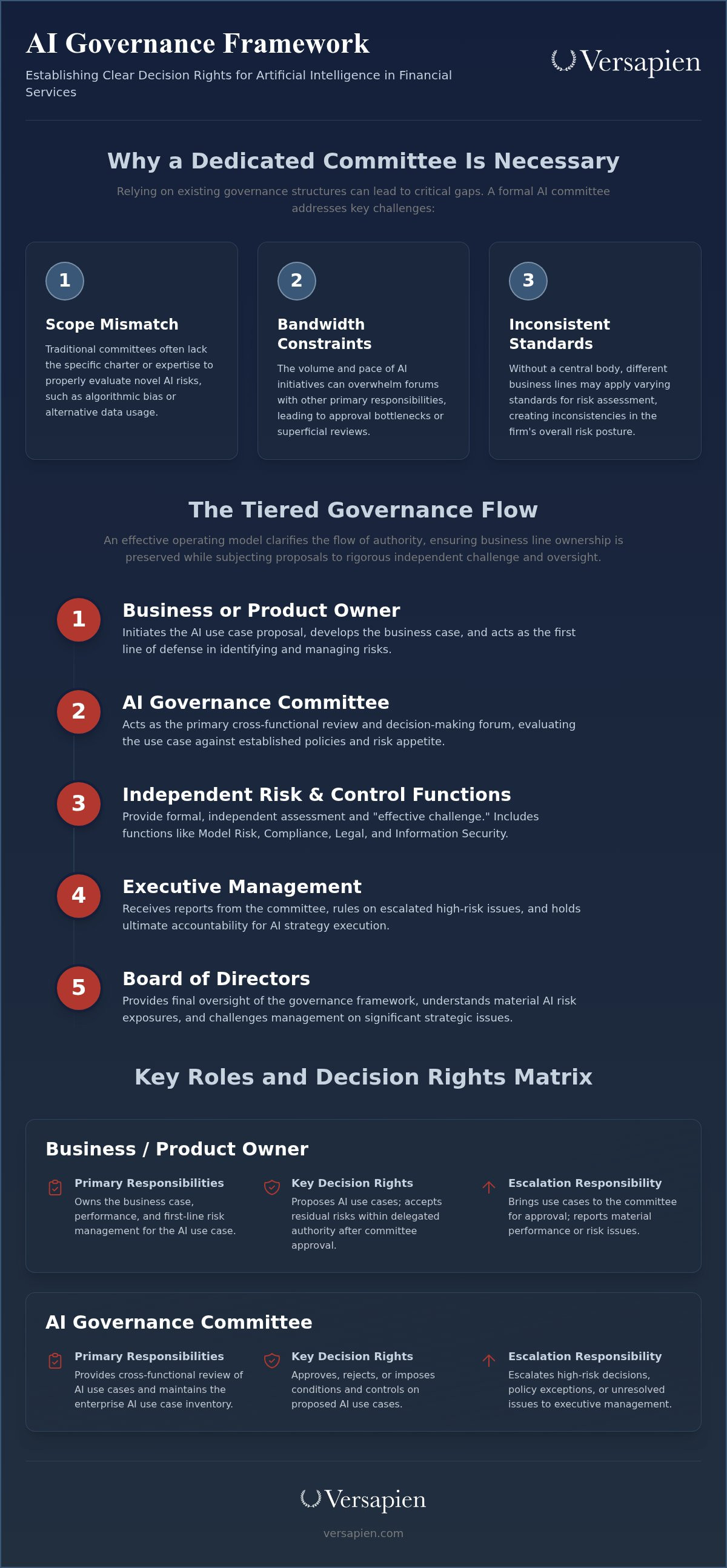
Financial institutions should consider establishing a dedicated committee when AI use cases become material in number, complexity, or potential impact. Relying on existing structures can lead to several challenges:
Scope Mismatch: Traditional committees may lack the specific expertise or charter to properly evaluate novel AI risks, such as the use of alternative data or the potential for algorithmic bias.
Bandwidth Constraints: The volume and pace of AI initiatives can overwhelm committees that have other primary responsibilities, leading to bottlenecked approvals or superficial reviews.
Inconsistent Standards: Without a central body, different business lines may apply different standards for risk assessment and approval, creating inconsistencies in the institution’s overall risk posture.
A formal committee, supported by a clear charter, provides the structure needed to apply consistent standards, develop institutional knowledge, and ensure that decision-making is both efficient and robust.
A Framework for AI Governance Decision Rights
An effective AI governance operating model clarifies the flow of responsibility and authority. While the specific structure should be tailored to an institution's size, complexity, and risk profile, a sound model generally follows a clear path of proposal, review, independent challenge, and oversight. This structure ensures that business line ownership is preserved while subjecting proposals to the necessary scrutiny from control functions and senior management.
The decision-making process can be visualized as a tiered progression:
Business or Product Owner: Initiates the proposal for an AI use case, develops the business case, and serves as the first line of defense in identifying and managing risks.
AI Governance Committee: Acts as the primary review and decision-making forum. It evaluates the use case against established policies, risk appetite, and control standards, drawing on input from all relevant stakeholders.
Independent Risk and Control Functions: Provide formal, independent assessment and challenge. This includes functions like Model Risk Management, Compliance, Legal, and Information Security, which offer their expert opinions to the committee.
Executive Management: Receives reports from the committee, rules on escalated issues, and holds ultimate accountability for the execution of the AI strategy and risk management framework.
Board of Directors: Provides oversight of the overall governance framework, understands the institution's material AI-related risk exposures, and challenges management on significant issues.
Roles and Decision Rights Matrix
Clarifying these roles prevents ambiguity and ensures accountability. The following matrix outlines a typical distribution of responsibilities. Institutions should adapt this model to fit their specific organizational structure.
Committee Operations: From Intake to Oversight
An effective committee is more than a forum for discussion; it is a working body with defined processes. Its operational mechanics should be codified in a formal charter approved by executive management or a Board-level committee.
The AI Use-Case Intake and Review Process
The committee’s work begins with a structured intake process. This requires maintaining a comprehensive, centralized inventory of all AI use cases, from those in development to those in production. When a new use case is proposed, the business owner should submit a standardized package of information for committee review. This documentation should include, at a minimum:
A clear business case outlining the intended use and expected benefits.
A description of the data inputs, the model’s general methodology, and its intended outputs.
A preliminary risk assessment covering operational, compliance, reputational, and other relevant risk types. For example, a lending model proposal would require a specific analysis of potential fair lending risk.
For vendor-provided systems, evidence of thorough third-party risk management due diligence.
An assessment from relevant control functions, such as an initial view from the model risk management team if the system is classified as a model.
Documenting Decisions and Managing Escalations
The committee’s deliberations and decisions must be formally documented in meeting minutes. This creates an auditable record of the evaluation process, the challenges raised, the conditions imposed, and the ultimate rationale for the decision. The committee should have several disposition options:
Approve: The use case may proceed as proposed.
Approve with Conditions: The use case may proceed, but subject to specific mandatory actions, such as additional controls, enhanced monitoring, or limits on its use.
Reject: The use case is denied approval because its risks are determined to be outside the institution's risk appetite or its controls are insufficient.
Escalate: The decision is referred to a higher level of authority, typically an executive risk committee or a designated executive, due to the magnitude of the risk, the need for a policy exception, or a lack of consensus within the committee.
Clear escalation triggers are critical. These should be defined in the charter and may include proposals with a high inherent risk rating, those that involve sensitive customer data in novel ways, or those that could have a significant impact on consumers.
Clarifying Executive and Board Oversight of AI
Senior leadership and the Board of Directors play a crucial oversight role, but their focus should be on the integrity of the governance framework, not the technical details of individual AI systems. Their involvement ensures that the institution's use of AI aligns with its strategic objectives and risk appetite.
What is the Appropriate Role for the Board of Directors in AI Governance?
The Board's duty is one of governance and oversight, not day-to-day management. Regulators and sound practice expect the Board, or a designated committee like the Risk or Technology Committee, to:
Understand Material AI-Related Risks: Directors should be educated on the key types of risks AI presents to the institution and how they are being managed.
Oversee the Governance Framework: The Board should satisfy itself that management has implemented a robust framework for identifying, measuring, monitoring, and controlling AI risks, including a properly chartered AI governance committee.
Receive Appropriate Reporting: Reporting to the Board should be strategic. It should summarize the institution's overall AI risk profile, highlight significant new initiatives, detail material risk events or control failures, and describe emerging external threats or regulatory developments.
Effectively Challenge Management: Directors should probe management on the effectiveness of the governance program, the rationale for accepting significant risks, and the institution’s readiness for future AI-related challenges. A comprehensive view of the governance structure is essential for this role, as outlined in guides on what boards and executive management should know about AI governance.
This strategic oversight ensures that AI is adopted in a manner that is not only innovative but also safe, sound, and consistent with the institution's long-term interests. Versapien’s advisory services often focus on structuring these reporting lines to ensure they are effective and meet supervisory expectations.
Executive Self-Assessment for AI Governance
For executive management and directors, evaluating the maturity of the institution’s AI governance structure is a critical exercise. The following questions can help identify potential gaps and areas for enhancement.
Are AI decision rights clearly defined and documented, or is there ambiguity about who can approve a new AI system?
Is there a formal, defined process for reviewing and approving higher-risk AI use cases before deployment?
Does the review process ensure that relevant perspectives from business, risk, compliance, legal, and technology are all represented and considered?
Are committee decisions, including the rationale for risk acceptance and any conditions for approval, formally documented in a way that can be audited or reviewed by examiners?
Are there clear criteria for escalating material issues or high-risk proposals to executive management and, when appropriate, the Board?
Does reporting to the Board focus on material risks, strategic implications, and the overall health of the governance framework, rather than excessive technical detail?
Addressing these questions is fundamental to building an AI governance function that enables responsible innovation and protects the institution from unforeseen consequences.


Comments