
What Boards and Executive Management Should Know About AI Governance
Table of Contents
The Evolving Regulatory Landscape for AI in Financial Services
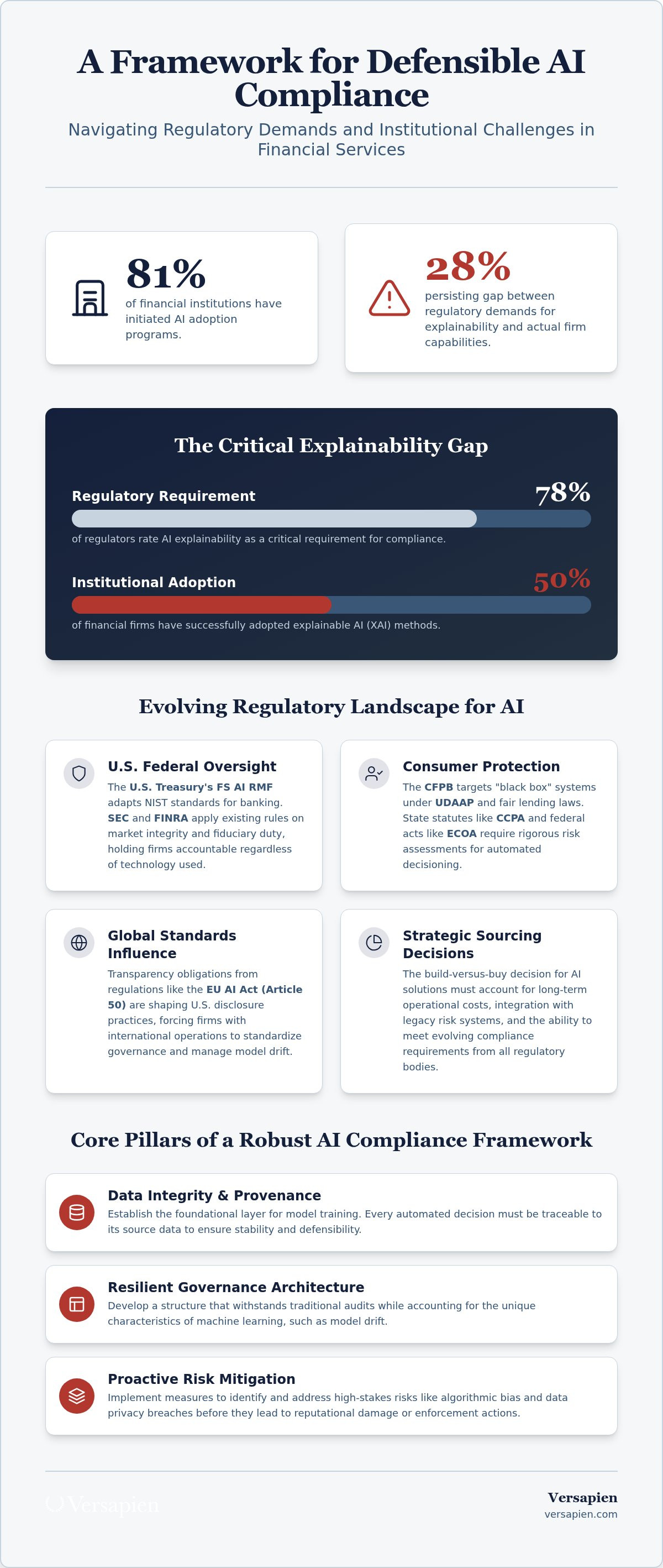
For boards and executive management, the dialogue around artificial intelligence has shifted from strategic potential to regulatory reality. The period of aspirational adoption is closing, replaced by an era of scrutiny where financial regulators apply long-standing principles to new technology. Federal agencies, including the Securities and Exchange Commission (SEC), FINRA, and the Consumer Financial Protection Bureau (CFPB), are operating under a "technology-agnostic" premise: existing rules governing fairness, transparency, and risk management apply to AI just as they do to any other system.
This stance eliminates any grace period for non-compliance. Regulators expect firms to demonstrate robust control over their automated systems now, not after an issue arises. The CFPB, in particular, has intensified its focus on the "black box" nature of complex algorithms, demanding that institutions be able to explain how and why their models reach specific conclusions, especially in consumer credit decisions. This requires a fundamental shift from a reactive compliance posture—fixing problems after an examination—to a proactive governance framework designed to prevent them.
Federal Oversight and the Impact on Consumer Lenders
For institutions in the consumer lending space, such as mortgage and auto finance companies, the implications are immediate. Core consumer protection laws, including the Equal Credit Opportunity Act (ECOA) and prohibitions against Unfair, Deceptive, or Abusive Acts or Practices (UDAAP), are the primary lenses through which regulators will evaluate AI systems. An algorithm that produces disparate impacts on a protected class, even unintentionally, can trigger a fair lending investigation and significant enforcement actions.
The burden of proof rests squarely on the institution. Management must be prepared to defend its automated decisioning systems during CFPB or OCC examinations, detailing everything from data sourcing and model validation to ongoing monitoring for discriminatory outcomes. The risks of failure extend beyond financial penalties; the reputational damage from a public fair lending violation can erode customer trust and attract class-action litigation, creating a cascade of strategic and financial consequences. For leaders in this space, modernizing consumer lending compliance means embedding these principles directly into the AI development lifecycle.
Global Standards Influencing US Compliance Frameworks
While the United States has not yet adopted a single comprehensive AI law, international frameworks like the EU AI Act are setting a global baseline for risk-based governance. US-based financial institutions with international operations or aspirations must monitor these developments, as they often signal future domestic regulatory trends. This creates a strategic imperative to build an AI governance program that is not only compliant with current US rules but also adaptable to emerging global standards.
A critical, often overlooked, challenge is "regulatory drift"—the tendency for a compliant AI model to become non-compliant over time as it learns from new data. This dynamic nature requires a governance structure that fosters constant cross-functional alignment between IT, Legal, Compliance, and Risk. Without this integration, the technical teams managing the model may be disconnected from the legal and compliance teams responsible for interpreting evolving regulatory expectations, creating a significant institutional blind spot.
Core Pillars of a Robust AI Governance Framework
A defensible AI governance framework is not a software solution but a corporate discipline built on foundational pillars of accountability, risk management, and transparency. It begins with establishing clear ownership and extends to rigorous, ongoing validation of every automated system that impacts customers or institutional stability. For the board, the primary objective is to ensure this framework is not merely a theoretical construct but a practical, enterprise-wide reality. To see how leaders can turn complex strategic visions into reality, find out more.
Central to this effort is the integrity of the data used to train and operate AI models. If the underlying data reflects historical biases or is of poor quality, the model will inevitably produce flawed or discriminatory outcomes. Likewise, effective human-in-the-loop (HITL) oversight is non-negotiable. This is not about having a person click "approve" on a machine's recommendation but about designing meaningful intervention points where experienced professionals can challenge, override, or investigate a model's output, particularly for high-stakes decisions.
Governance, Oversight, and Accountability
Effective governance begins with assigning unambiguous ownership of AI risk at the executive level. The board should ask: who is ultimately accountable if an AI model fails a regulatory exam or causes consumer harm? Is it the Chief Risk Officer, the Chief Technology Officer, or a business line executive? Without a clear answer, accountability becomes diffuse, and risk management efforts lose focus.
Many institutions are adapting the traditional "Three Lines of Defense" model for AI.
The First Line (business units and developers) owns the risk, responsible for building, deploying, and monitoring models in a compliant manner.
The Second Line (Risk and Compliance) sets the policies, provides independent oversight, and validates that the first line's controls are effective.
The Third Line (Internal Audit) provides independent assurance to the board that the overall AI governance framework is sound and operating as intended.
Comprehensive documentation is the connective tissue holding this model together. Regulators will expect to see detailed records of a model's design, data inputs, testing, validation, and any changes made over its lifecycle, forming a complete audit trail.
Model Risk Management (MRM) for the AI Era
Traditional Model Risk Management, guided by frameworks like the Federal Reserve's SR 11-7, provides a strong foundation but must be evolved for the dynamic nature of AI. Unlike static statistical models, machine learning systems can change their own logic as they process new information. This requires a shift from periodic validation to continuous performance monitoring.
The core principles of MRM—conceptual soundness, ongoing monitoring, and outcomes analysis—remain critical. However, the methods must adapt. Stress testing, for example, must go beyond historical economic scenarios to include adversarial testing, where the model is intentionally fed unusual or malicious data to see how it responds. The frequency and depth of audits for self-learning systems must also increase, as a model that was compliant last quarter may not be today. This represents a significant operational and technical challenge for many legacy MRM teams, demanding new skills and tools for effective AI implementation for risk management.
Evaluating AI Solutions: The Build vs. Buy Decision
A recurring strategic question for executive leadership is whether to build proprietary AI systems in-house or purchase solutions from third-party vendors. This is not merely a technical or financial decision; it has profound implications for risk, compliance, and long-term strategic agility. The "total cost of ownership" must be assessed beyond the initial price tag to include the ongoing expenses of talent, infrastructure, model maintenance, and regulatory compliance.
Delaying this decision can inadvertently foster the growth of "Shadow AI"—the unapproved use of third-party AI tools by employees. When official, sanctioned solutions are not available, staff may turn to public platforms to improve productivity, introducing unvetted models and data privacy risks into the corporate environment. Therefore, the build vs. buy analysis is a critical governance exercise that should be undertaken proactively.
The Case for Custom In-House Development
Building an AI model internally is a significant undertaking, justified primarily when the institution possesses unique data assets or requires proprietary business logic that cannot be replicated by an off-the-shelf product. For example, a lender with a novel underwriting approach for a niche market may find that no vendor solution can adequately capture its strategy. The primary advantage of an in-house build is complete control over the model's architecture, data, and logic, which can simplify the process of explaining its functionality to regulators.
However, this path requires substantial and sustained investment in specialized talent—including data scientists, machine learning engineers, and risk modelers—as well as the requisite computing infrastructure. The board must critically assess whether the organization has the cultural and financial appetite to support what is effectively a permanent R&D function.
As firms look to attract this specialized expertise, it is helpful to understand how candidates use AI to navigate the hiring process; you can learn more about Rezumi and its role in helping job seekers optimize their resumes for automated systems.
Selecting and Vetting Third-Party AI Vendors
For many institutions, partnering with a specialized AI vendor is the more pragmatic approach. However, this shifts the challenge from development to third-party risk management. Due diligence must be exceptionally rigorous, as regulators hold the financial institution fully accountable for the actions of its vendors. A key risk is the "black box" vendor solution, where the provider is unable or unwilling to disclose the inner workings of their model. This is a significant red flag, as it makes it nearly impossible for the institution to fulfill its own validation and explainability obligations.
When evaluating vendors, leadership should use a checklist that assesses not only the technology but also the vendor's own compliance posture. Key questions include:
Can the vendor provide full documentation of the model's architecture, assumptions, and limitations?
How does the vendor test for and mitigate algorithmic bias?
What are the contractual rights for the institution to conduct its own independent testing and validation?
How are model updates managed, and what is the process for notifying clients of changes that could impact compliance?
Securing strong contractual protections around these issues is essential for mitigating third-party risk in a regulated environment.
Mitigating High-Stakes Risks: Algorithmic Bias and Data Privacy
Among the most significant risks keeping boards and executives awake at night are unintentional discrimination and data privacy breaches. Algorithmic bias occurs when an AI model produces systematically prejudiced outcomes against a particular group, often because it was trained on historical data that reflects societal biases. In credit decisioning, even if protected characteristics like race or gender are removed from the data, the model can still learn to discriminate based on "proxy variables"—data points like ZIP code or educational background that are highly correlated with protected characteristics.
Regulators are acutely aware of this risk and are deploying sophisticated data analysis techniques to scrutinize lending patterns for disparate impact. Simultaneously, the rise of generative AI has introduced new data privacy concerns, particularly when employees input personally identifiable information (PII) or other sensitive corporate data into public large language model (LLM) prompts, creating a risk of data leakage and misuse.
Fair Lending and the CFPB Focus
The CFPB has made it clear that the Equal Credit Opportunity Act (ECOA) applies to AI-driven lending with full force. An institution cannot claim ignorance if its algorithm discriminates; the responsibility to ensure fairness is absolute. For consumer finance, algorithmic bias is defined as any AI-driven decision-making process that results in a disproportionately negative outcome for individuals in a protected class that is not justified by a legitimate business necessity. Conducting a thorough fair lending risk assessment is no longer optional. This involves statistical analysis of model outcomes across different demographic groups, both before deployment and on an ongoing basis, to identify and remediate any discriminatory patterns.
Combating Shadow AI and Unapproved Tools
The threat of Shadow AI is a critical governance challenge. The convenience of public LLMs and other AI tools makes them tempting for employees seeking to automate tasks or analyze data. However, their use for institutional business exposes the firm to significant risks, including data breaches, intellectual property loss, and the introduction of unvetted, potentially biased algorithms into business processes. The first step in combating this is establishing a clear and well-communicated "Acceptable Use Policy" for AI that defines which tools are approved and for what purposes. This policy must be paired with technical controls and automated monitoring where possible to detect and block the use of unauthorized platforms on corporate networks.
Executive Takeaways: Key Priorities for AI Governance
Integrating AI into a financial institution is not a one-time technology project but an ongoing strategic and governance discipline. For boards and executive management, the focus must be on building a durable framework that enables innovation while upholding the core principles of safety, soundness, and fairness. Moving from theoretical understanding to practical implementation requires a clear-eyed view of the challenges and a commitment to rigorous execution.
Many AI initiatives fail not because of flawed technology, but because of poor structural integration. When AI is siloed within an IT department or a single business line, it often struggles to gain the cross-functional support needed to navigate the complex web of risk, legal, and compliance requirements. This is particularly true in areas like anti-money laundering, where effective AI for BSA/AML compliance requires deep integration with existing financial crime programs.
Immediate Priorities for the Board
Establish Clear Ownership: Formally designate an executive-level owner for enterprise AI risk and ensure the "Three Lines of Defense" model is clearly defined and resourced for AI oversight.
Question Everything: Challenge management on the specifics of model validation, bias testing, and vendor due diligence. Ask for evidence, not just assurances.
Invest in Expertise: Ensure the board and senior leadership receive ongoing education on AI technologies and the evolving regulatory landscape to facilitate informed strategic discussions.
Common Governance Pitfalls to Avoid
The "Set It and Forget It" Mindset: Approving an AI model and then failing to provide resources for continuous monitoring and re-validation is a direct path to model drift and non-compliance.
Over-Reliance on Vendors: Outsourcing the technology does not outsource the accountability. A lack of rigorous, independent vendor oversight is a primary concern for examiners.
Treating Governance as a Check-Box Exercise: A paper-only program that is not embedded in the institution's culture and operational workflows will not withstand regulatory scrutiny.
Navigating this complex environment requires a partner who understands the intersection of technology, regulation, and risk management. As a boutique advisory firm specializing in consumer financial services, Versapien helps leaders develop and implement practical AI governance frameworks that reduce risk and enable sustainable growth. By focusing on program management and strategic integration, we help ensure that your institution's approach to AI is both innovative and defensible.


Comments