
AI Governance Exceptions: Setting Approval Thresholds, Expiry Dates and Remediation Ownership
AI governance policies establish the boundaries for how financial institutions develop, deploy, and use artificial intelligence. But those boundaries are often tested when business pressures, technology limitations, or operational challenges lead teams to request exceptions. What may begin as a temporary accommodation can become an unmanaged risk when approval authority is unclear, deadlines are repeatedly extended, or responsibility for remediation is not assigned. Over time, exceptions can undermine the very governance framework intended to keep AI use aligned with the institution's risk appetite and obligations.
For senior management, effective AI governance requires more than an approval process. It requires clear decisions about who has authority to accept an exception, how long that exception may remain in effect, and who is accountable for resolving the underlying issue. This article examines how financial institutions can establish risk-based approval thresholds, enforce meaningful expiry and review conditions, and strengthen remediation ownership so that exceptions remain controlled, transparent, and temporary.
Table of Contents
Why AI Governance Exceptions Require Management Attention
Exceptions arise for understandable reasons. A lender may need to launch a customer-facing tool before a review is complete. A vendor may update a model faster than validation can follow. A business line may need to use a data source that has not yet been approved. Each request can look reasonable alone, and approving it is sometimes the right call.
The risk lies in the accumulation. Every unmanaged exception weakens the policy it departs from. Reviewers learn that deadlines slide, approvers learn that questions are rarely asked, and teams learn that asking forgiveness is cheaper than asking permission. Over time the exception becomes the working practice, and the approved framework describes a control environment that no longer exists.
The consequences reach beyond the governance function.
Business risk. Leaders may rely on controls that are not operating as represented to the board.
Operational risk. Workarounds create inconsistent processing and dependence on individuals who know the history.
Regulatory risk. Examiners and partners may question why a stated policy is routinely set aside.
Customer risk. A credit, servicing, or communications decision made outside approved conditions can affect consumers directly.
Repeated exceptions to the same control are the clearest warning sign. They usually point to a policy that is unworkable, a resourcing gap, or a business process that was never designed around the control. Management should treat that pattern as a signal to fix the policy or the process, not as a stream of separate approvals.
Establishing Approval Authority and Risk-Based Thresholds
Approval authority should scale with the risk the institution is accepting. The institution sets its own thresholds, informed by its risk appetite and established decision rights. No external framework prescribes them. Useful criteria include the following.
The impact of the departure on the decision or process the AI system supports.
Customer impact, including whether the output affects credit, pricing, servicing, or fraud outcomes.
Regulatory implications, including fair lending, UDAAP, and BSA/AML considerations.
The degree of uncertainty about how the system will behave outside approved conditions.
Exposure, meaning the volume of decisions and customers affected.
Compensating controls that limit harm while the exception is open.
These criteria support a tiered model. Routine exceptions with low customer impact and strong compensating controls can sit with a delegated business owner, using documented criteria and a recorded rationale. Matters that affect customers materially, depart from approved intended use, or involve weak compensating controls belong with a senior executive or a governance committee. Risk and compliance provide independent challenge proportionate to the exception's risk and potential impact, while the authorized business owner remains accountable for accepting the business risk.
One boundary needs to be explicit. Management risk acceptance cannot waive legal or other non-waivable obligations. Fair lending requirements, adverse action notice obligations, and sanctions screening duties are not internal preferences that an executive can set aside. If an exception would require a departure from a binding requirement, it is a compliance matter that must be resolved, not a risk to be accepted.
Frameworks can inform this design without dictating it. The NIST AI Risk Management Framework is voluntary guidance, and ISO/IEC 42001:2023 , published by the International Organization for Standardization, is a voluntary management system standard. The EU AI Act is binding law with obligations for high-risk systems, and its application depends on a system's classification and the institution's role. None of these sources sets approval thresholds or remediation deadlines. Those remain management decisions.
Setting Expiry Dates and Ensuring Remediation Accountability
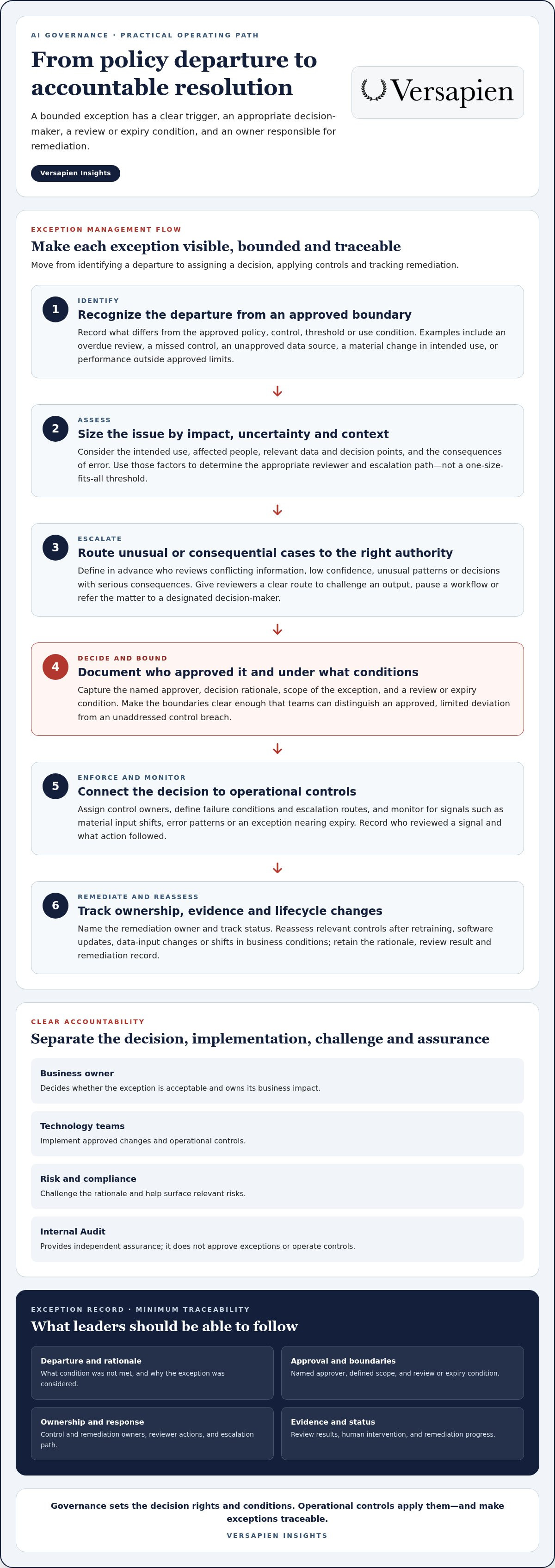
An exception without an end condition is a permanent change to policy made without the scrutiny a policy change would receive. Every approved exception should therefore be temporary, with an expiry tied to the risk it carries. A higher-risk exception warrants a shorter horizon and closer review, and a lower-risk one can run longer. This article does not suggest a universal timeframe, because the right period depends on the use case, the compensating controls, and the time a real fix requires.
A workable lifecycle for a single exception follows six steps.
Record the request, the control or policy affected, and the business rationale.
Assess risk and customer impact against the institution's own criteria.
Obtain approval from the authority matched to that risk tier.
Set the expiry date, review points, and compensating controls.
Assign a management owner and remediation milestones.
Verify closure with evidence before the record is retired.
Repeated extensions deserve particular attention. They may indicate that the remediation plan is unrealistic, resources are inadequate, or the underlying policy or process needs to change. Management should consider escalating recurring extensions to a higher approval level based on the exception's risk, duration, and potential impact.
Remediation needs a named management owner with the authority and budget to act, such as a product head or a technology lead. A committee or a team is not an owner. Overdue items should be tracked visibly, and the owner should explain slippage to the approving body.
Closure should rest on evidence, not on assertion. For an exception involving an unapproved data source, for example, evidence might include the completed review, the approved source or its removal, and confirmation that the control now operates as designed. Independent verification of sustained closure strengthens the result. See the Versapien Insights piece on proving a remediated issue is sustainable.
Integrating Exception Management into Governance and Oversight
Exception data is some of the most useful information available to executive oversight, because it shows where policy and practice diverge. Reporting to senior management and board committees should be selective and focused on judgment. Useful views include:
Open exceptions grouped by risk tier.
Exceptions approaching expiry and those already overdue.
Exceptions that have been extended more than once.
Unresolved control weaknesses behind recurring requests.
High-impact matters affecting customers or regulatory obligations.
Used this way, the register becomes a management tool. A cluster of exceptions in one business line may reveal a resourcing problem. Repeated requests against one control may show that the policy needs revision. For related reading, see designing a practical KRI dashboard for AI risk.
Responsibilities should stay distinct across the institution.
Business units own the risk, request exceptions, and accept the outcome.
Technology implements approved conditions and remediation changes.
Risk management challenges the rationale, tiering, and compensating controls.
Compliance confirms whether legal or regulatory obligations are involved.
Internal Audit independently assesses whether the process works, without approving exceptions or operating controls.
Keeping these roles separate protects the credibility of each. When Internal Audit approves exceptions, its independence is compromised. When risk and compliance own remediation, the business loses accountability for its own decisions. For more on that last line of defense, see independent AI assurance by Internal Audit.
Executive Takeaways
AI governance exceptions are legitimate tools when they are bounded and temporary, and they are a source of hidden risk when they are not. The central management task is to make approval authority, expiry, and remediation ownership explicit for every exception. Leaders who do this can see where policy and practice diverge and act before the gap grows.
Define approval tiers using risk, customer impact, regulatory implications, uncertainty, exposure, and compensating controls.
Reserve senior executive or committee sign-off for exceptions that materially affect customers or intended use.
Confirm that no exception relies on management risk acceptance to bypass a legal or non-waivable obligation.
Require an expiry condition and a named management owner for every approved exception.
Escalate exceptions that have been extended repeatedly or are overdue to a more senior approver.
Keep Internal Audit independent of approvals and require closure evidence before any exception is retired.
How Versapien Can Help
Versapien serves as an advisory partner to leadership teams working to bring discipline to AI governance exceptions. Through its AI Governance & Responsible AI services, which include AI governance frameworks and AI risk assessments, and its Risk Management Consulting, Versapien can help leaders assess current exception practices, identify gaps in approval authority and remediation ownership, clarify accountability across business, technology, risk, compliance, and audit roles, and develop practical recommendations. To discuss your institution's priorities, contact Versapien at versapien.com.



Comments