
Independent AI Assurance: How Internal Audit Can Evaluate Governance Without Rebuilding the Model
AI systems introduce risks that may be difficult to assess through traditional audit procedures alone. Their use can involve complex data flows, third-party models, changing configurations, and outputs that influence customer decisions or business operations. Internal Audit does not need to rebuild an AI model to evaluate whether the organization has established effective governance and controls.
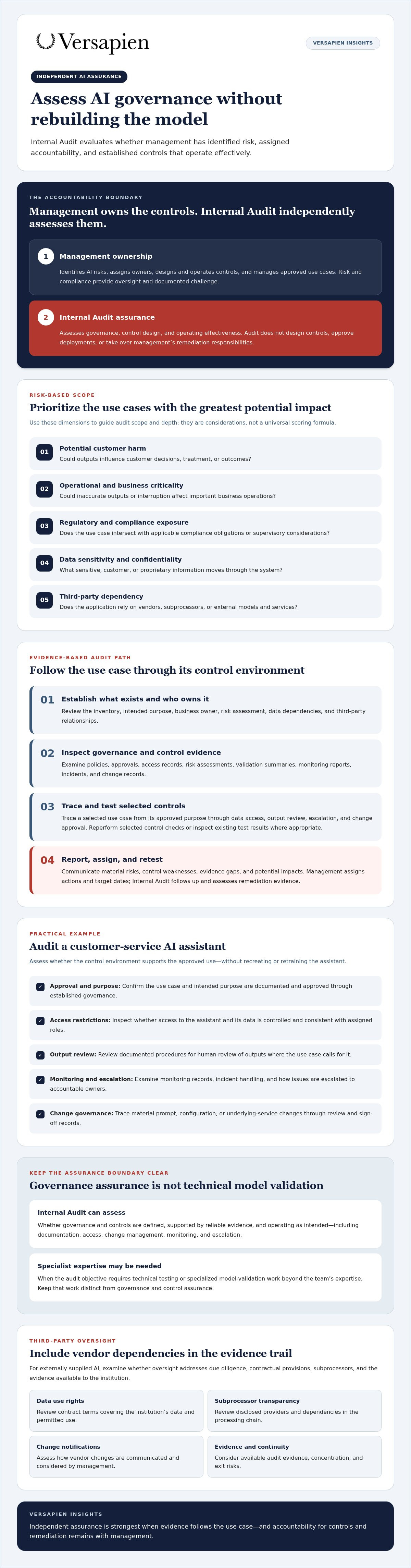
An independent assurance approach focuses on whether management has identified material AI risks, assigned accountability, implemented appropriate controls, and established reliable monitoring and escalation. Auditors can examine governance records, trace selected AI use cases through the control environment, review testing evidence, and independently test whether key controls operate as intended.
The challenge is to provide meaningful assurance while preserving the distinction between management’s responsibility for AI decisions and controls and Internal Audit’s responsibility to provide independent assessment. This article explains how Internal Audit can define its scope, evaluate AI governance evidence, test controls proportionately, and communicate findings that lead to accountable remediation.
Table of Contents
Defining Internal Audit’s Role in AI Governance
The foundation of effective internal audit assurance over artificial intelligence lies in the traditional Three Lines Model. Management, operating in the first line, owns the operational risks, designs business processes, and operates control activities across the AI lifecycle. Risk management and compliance functions, representing the second line, establish policy frameworks, provide risk oversight and challenge, and assess whether business decisions and model assumptions align with approved risk appetite and governance requirements. Internal Audit, as the third line, provides independent assurance over the effectiveness of governance, risk management, and internal controls. Internal Audit, as the third line, provides objective assurance to executive management and the Board of Directors regarding whether governance structures, risk management practices, and internal controls operate effectively.
When auditing complex algorithmic systems, auditors must avoid blurring these lines. To preserve independence, Internal Audit should not assume management’s responsibility for designing and operating controls, approving production deployments, setting risk acceptance decisions, or performing operational model validation. Auditors may provide advice on governance practices, but management must retain decision-making and control ownership. Stepping into operational design or validation compromises the independence required to evaluate those very activities. Instead, audit teams must assess whether first-line teams adhere to approved policies and whether second-line challenge is rigorous, documented, and properly escalated.
Given the rapid proliferation of automated tools across consumer lending, fraud detection, customer support, and financial crimes operations, audit departments cannot evaluate every deployed algorithm with equal depth. Assurance must follow a disciplined, risk-based scoping methodology. When prioritizing systems for testing, audit leaders should weigh distinct risk dimensions:
Potential for Consumer Harm: Does the output influence credit eligibility, adverse action notices, loan pricing, or collections treatment under consumer protection statutes such as the Equal Credit Opportunity Act?
Operational and Business Criticality: Could an inaccurate output, automated hallucination, or service interruption impair core accounting, wire settlement, or regulatory reporting workflows?
Data Sensitivity and Confidentiality: Does the architecture process nonpublic personal information, sensitive consumer attributes, or proprietary banking records through external pipelines?
Regulatory and Compliance Exposure: Does the application intersect with established supervisory expectations, anti-money laundering monitoring rules, or fair lending scrutiny?
Third-Party and Sub-Processor Dependencies: Is the underlying engine an internally trained model, or does it rely on external foundation models subject to unannounced configuration drift?
Clarifying scope boundaries enables internal auditors to conduct defensible reviews without acquiring specialized data science environments. Internal Audit does not need to extract model weights, re-run neural network training scripts, or write bespoke statistical validation code. The audit objective is to determine whether management established adequate guardrails, maintained documentation, enforced role-based access, controlled code and prompt changes, and monitored operational stability over time.
Evaluating AI Governance and Control Design
Inventory, Accountability, and Risk Assessment
A reliable control environment begins with transparency regarding what systems exist and who owns them. Internal Audit should inspect the organization’s central inventory to assess whether deployed, piloted, and developing AI applications are accounted for. Each entry should document the business purpose, operational owner, risk classification, data dependencies, third-party relationships, and associated control activities. Gaps in the inventory can prevent management from applying consistent oversight to use cases operating outside formal governance processes.
Policies, Lifecycle Controls, and Change Management
Auditors must next evaluate lifecycle policies and change management controls. Policies should clearly define acceptable use, prohibited applications, data handling requirements, and mandatory approvals before deployment. Particular attention should be paid to human-in-the-loop controls that dictate when automated recommendations require qualified manual review before taking effect. Furthermore, audit procedures should examine whether management maintains documented protocols for AI change control, ensuring that prompt modifications, threshold adjustments, and underlying foundation-model updates undergo formal review and sign-off rather than ad hoc developer changes.
Third-Party and Foundation-Model Oversight
In financial institutions, external service providers supply an increasing share of automated tools. Assessing AI vendor risk requires auditors to evaluate third-party governance across procurement, contracting, ongoing monitoring, and service changes. Internal Audit should verify that vendor due diligence procedures assess:
Data Use Rights: Contractual provisions that clearly restrict or prohibit the vendor from using the institution’s proprietary data or nonpublic customer information to train or fine-tune generalized models.
Sub-Processor Transparency: Mandatory disclosure of hosting providers, third-party model developers, and cloud computing dependencies involved in the processing chain.
Change Notifications: Contractual obligations, where negotiable and appropriate to the risk, requiring notification of material updates, API deprecations, or other changes that could affect the institution’s controls, service continuity, or risk profile.
Audit and Testing Rights: Sufficient access rights allowing the institution or its designees to inspect relevant control reports, security testing results, and compliance documentation.
Concentration and Exit Planning: Documented contingency arrangements and data retrieval protocols to mitigate operational disruption should a critical AI vendor fail.
When assessing third-party oversight, auditors can consult broader organizational frameworks, such as third-party risk management inventory frameworks, to ensure that external AI tools are integrated into enterprise vendor oversight rather than managed as informal departmental software.
Testing AI Controls Without Rebuilding the Model
Evidence-Based Audit Procedures
Evaluating AI control effectiveness requires concrete, evidence-based audit procedures rather than subjective assessments. Auditors must gather and inspect verifiable audit artifacts across each control stage, verifying that management operates its program according to documented procedures.
Targeted Testing of Selected Use Cases
To demonstrate how these testing procedures operate in practice, consider an internal audit review of an enterprise customer-service AI assistant deployed by a consumer lending institution to summarize customer inquiries, draft representative responses, and recommend account servicing actions.
First, the audit team inspects governance records to verify that the tool received formal sign-off from compliance, legal, and information security before deployment. The auditor reviews documented business requirements, confirming that the tool's approved scope is limited to informational responses, with specific guardrails prohibiting the system from providing credit advice or modifying loan terms autonomously.
Next, the auditor performs a walkthrough of access controls and data pipelines. By sampling interface logs, the team verifies that input filters consistently mask nonpublic personal information, such as Social Security numbers and account balances, before customer inquiries pass to the vendor's foundation model via API. The auditor inspects integration configurations to confirm that the third-party model is accessed under enterprise terms prohibiting data retention for vendor training.
The auditor then tests output verification and exception handling. Internal Audit reviews weekly quality-assurance logs produced by first-line supervisors who sample agent responses. The auditor compares identified response errors against established escalation protocols, testing whether instances of inaccurate fee descriptions or policy disclosures were routed to the compliance team for review within established timeframes.
Finally, the team evaluates change governance. Internal Audit samples recent prompt adjustments and system updates, cross-referencing change tickets against version-control logs. The auditor verifies that changes to system instructions were tested against standard evaluation test suites and approved by designated business owners before deployment to production environments.
Evaluating Exceptions and Limitations
Throughout this walkthrough, the auditor gathers documented AI risk evidence without recalculating mathematical weights, training alternative models, or altering production code. When governance evidence is insufficient to resolve concerns about a high-impact model, Internal Audit should consider involving qualified technical specialists to perform targeted testing or assess model-related limitations. Internal Audit should retain responsibility for the audit scope, evaluation of evidence, findings, and overall assurance conclusions.
Reporting Findings and Driving Accountable Remediation
Communicating Results to Management and the Board
Audit reports must provide executive management and the Board Audit Committee with a clear, objective appraisal of governance design and control operation. Rather than framing issues around abstract algorithmic uncertainty, auditors should articulate findings in terms of operational impact, consumer harm, and compliance risk. Findings should clearly detail:
The specific AI use case, internal business owner, and operational process affected.
The specific control deficiency identified (e.g., failure to enforce prompt change sign-offs, absent vendor notification SLAs, unmonitored output error rates).
The operational, financial, or consumer compliance consequence, such as potential exposure to unfair, deceptive, or abusive acts or practices (UDAAP) or inconsistent servicing treatment.
The underlying root cause, distinguishing between inadequate policy design, resource shortages, or first-line operational lapses.
Tracking Remediation and Retesting Controls
Remediation remains management’s responsibility. Audit reports should require management responses that designate accountable action owners, define implementation steps, and set target completion dates. Internal Audit should track agreed actions and perform follow-up testing to determine whether corrective actions address the finding and operate effectively in practice before the issue is closed.
Building Repeatable AI Assurance
Internal Audit departments can build repeatable assurance capabilities by maintaining informed dialogue with second-line risk officers, information security specialists, and compliance leaders while preserving objective third-line independence. Frameworks such as the NIST AI Risk Management Framework can provide useful reference points for organizing audit criteria, but they do not replace professional judgment or management’s responsibility for the control environment. Technical specialists should support the engagement when questions require model validation, statistical testing, cybersecurity analysis, or other expertise outside the audit team’s capabilities.
Executive Takeaways
Preserve Line Independence: Internal Audit provides objective assurance over AI governance, lifecycle oversight, and control execution; it must never assume management’s responsibility for designing, deploying, or operating AI systems.
Focus on Evidence, Not Model Rebuilding: Meaningful assurance does not require reverse-engineering algorithms. Audit teams can evaluate governance effectively by inspecting use case inventories, access controls, prompt change management, and escalation records.
Implement Risk-Based Audit Scoping: Prioritize audit reviews based on measurable criteria, including the potential for consumer harm, operational criticality, data sensitivity, and external vendor dependency.
Enforce Rigorous Third-Party Guardrails: Audit external AI arrangements for clear data use restrictions, sub-processor transparency, change notification obligations, and verifiable audit rights.
Demand Accountable Remediation: Frame audit findings around root causes and regulatory exposure, requiring designated management owners to complete measurable remediation verified through audit retesting.
How Versapien Can Help
Versapien supports financial institutions, fintech companies, lenders, and financial services technology providers through its AI Governance & Responsible AI, Enterprise Risk, and Regulatory Strategy services. Our work includes AI governance frameworks, AI risk assessments, implementation roadmaps, model governance, third-party risk management, regulatory examination readiness, regulatory remediation, policy and governance, and board reporting. These capabilities help management establish accountable governance and produce evidence that can be evaluated through independent assurance.
Contact Versapien to discuss how our advisory services can help your institution strengthen AI governance, enhance transparency, and prepare your control environment for independent evaluation.



Comments