
AI Risk Evidence: What Financial Institutions Should Document to Demonstrate Effective Governance
Updated: Sep 22
For financial institutions, the conversation around AI governance documentation is often framed as a compliance exercise. This approach, however, misses the strategic purpose of documentation: to create credible, durable evidence that governance processes were not just designed but were actually performed. Effective documentation is not about paperwork; it is the tangible proof of risk ownership, informed decision-making, and active oversight.
The April 17, 2026, interagency Revised Guidance on Model Risk Management serves as a catalyst for this conversation, prompting institutions to re-evaluate how they evidence control over complex systems. While the guidance is non-binding and risk-based, its principles underscore a fundamental truth: a clear evidentiary trail can help an institution demonstrate how it understands, assesses, and manages the risks associated with its AI and quantitative models.
Table of Contents
The Documentation-Execution Gap: From Records to Evidence
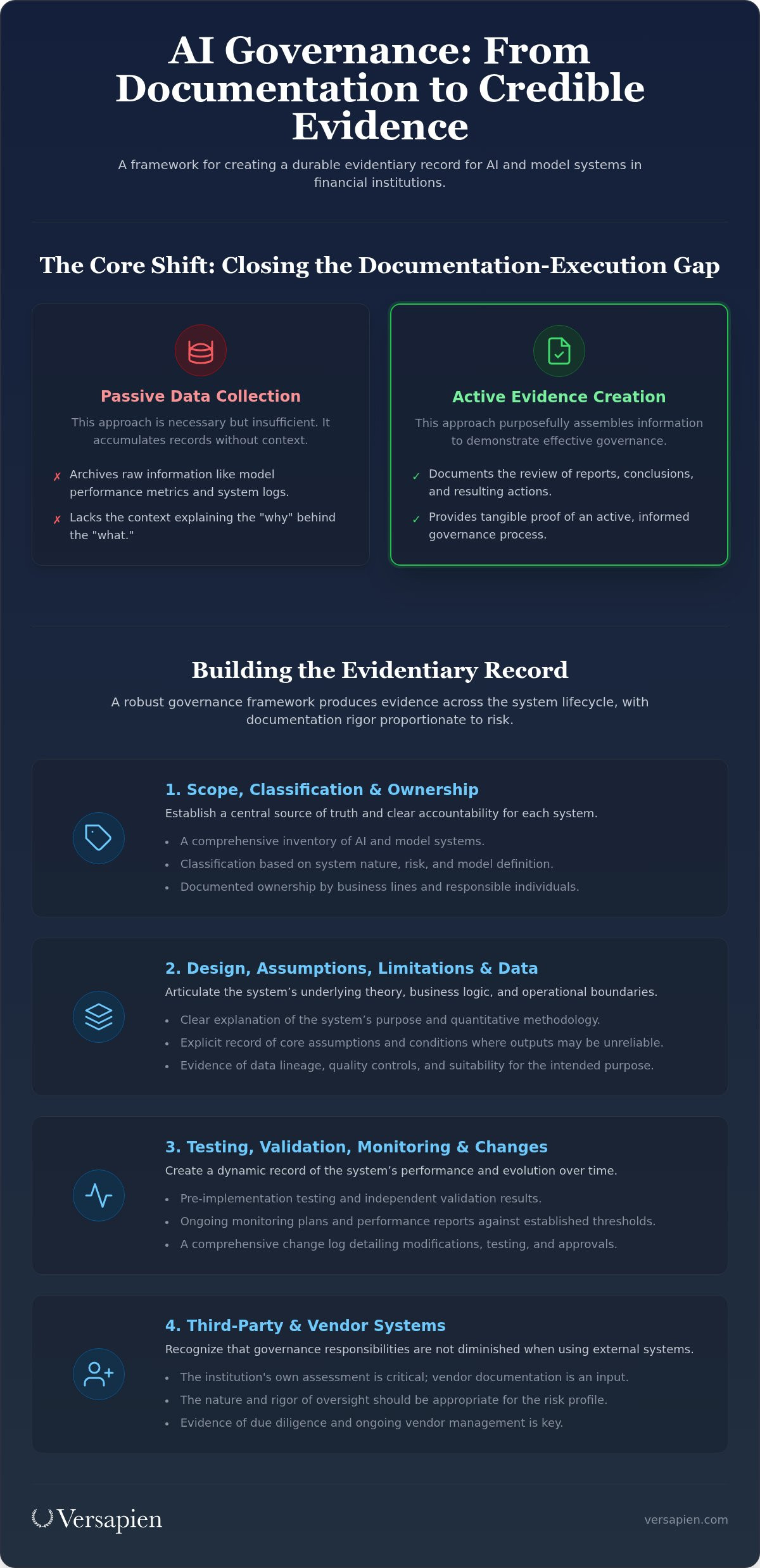
Many institutions suffer from a gap between the technical records they collect and the governance evidence they need. System logs, code repositories, and data dictionaries are necessary but insufficient. True governance evidence contextualizes these technical artifacts, explaining the why behind the what. Closing this gap requires shifting from passive data collection to the active creation of a coherent evidentiary record.
Evidence vs. Data Collection
Data collection is the act of accumulating raw information, such as model performance metrics or change logs. Evidence creation is the purposeful assembly of that information to demonstrate that a specific governance activity occurred and was effective. For example:
A data-collection approach archives monthly model performance reports.
An evidence-based approach documents the review of those reports, including who reviewed them, their conclusions about performance, any issues identified, and the resulting actions or decisions.
The latter provides proof of an active governance process, transforming a static data point into a dynamic record of oversight. This evidence is critical for business continuity, enabling new team members to understand a model’s history and limitations, and for demonstrating sound practice during internal audits or regulatory examinations.
A Risk-Based Approach to Documentation
The level of evidence an institution creates should be proportionate to a system’s risk. Not every algorithm or analytical tool requires the same level of documentation. The 2026 interagency guidance is expected to be most relevant to banking organizations with over $30 billion in assets, and even for those firms, it applies a risk-based lens. Smaller institutions may also find the principles relevant if they have significant model risk exposure due to complex or non-traditional activities. The key is to develop an internal framework that dictates the necessary rigor of documentation based on factors like a system’s materiality, complexity, and potential for consumer harm.
What Financial Institutions Should Document
A robust AI and model governance framework produces evidence across the entire lifecycle. The goal is to build a comprehensive inventory and a detailed record for each system, with the depth of that record tailored to its specific risk profile. This includes documenting scope, design, testing, and oversight activities.
Scope, Classification, and Ownership
The foundation of effective AI governance documentation is a comprehensive inventory of all AI and model systems. This inventory should serve as a central source of truth, classifying each system based on its nature and risk. A critical first step is determining whether a system meets the definition of a "model" under the interagency guidance: a complex quantitative method, system, or approach that applies statistical, economic, or financial theory to process input data into quantitative estimates. Simple arithmetic calculations or deterministic, rule-based software that lack such underlying theories would generally fall outside this definition and require a different, more proportionate level of documentation.
For each system in the inventory, clear ownership should be assigned. Documenting the lines of business that own the system, the individuals responsible for its performance, and the governance bodies overseeing its use is essential evidence of accountability.
Design, Assumptions, Limitations, and Data
Evidence of a system’s design should go beyond technical specifications. It should articulate the underlying theory and business logic. Key artifacts include:
Design and Methodology: A clear explanation of the system’s purpose, its quantitative or logical approach, and the theory supporting its construction.
Assumptions and Limitations: An explicit record of the core assumptions made during development. This documentation should also clearly state the system’s limitations and the conditions under which its outputs may become unreliable. Communicating these limitations to users and decision-makers is a critical governance function.
Data Governance: Evidence of data lineage, quality controls, and assessments of suitability for the intended purpose. This includes documenting any data transformations and the rationale behind them.
Testing, Validation, Monitoring, and Changes
The evidentiary record must be dynamic, capturing the system’s performance and evolution over time. For systems classified as models, this may include validation activities appropriate to the model's risk, purpose, complexity, and use. As outlined in our guide to AI model validation, this independent review provides critical evidence of a model's soundness. Other documentation may include:
Pre-implementation testing and validation results, including back-testing, sensitivity analysis, and benchmark comparisons.
Ongoing monitoring plans and performance reports, which track the system against established thresholds and metrics.
A comprehensive change log that details all modifications to a system’s code, data, or assumptions, along with the associated testing and approvals for each change.
Third-Party and Non-Model AI Systems
When an institution uses a third-party or vendor system, its governance responsibilities do not diminish. While vendor-provided documentation can be a useful input, it is not a substitute for the institution’s own assessment. The nature and rigor of oversight should be appropriate to the model, its use, and its risk. The institution should document its assessment of the vendor's product and controls, along with appropriate validation, testing, and ongoing monitoring activities based on the model's use and risk. For more on this, see our framework for third-party risk management for AI vendors.
For AI systems that do not meet the formal definition of a "model," such as many generative or agentic AI tools, a different governance approach is needed. While these systems are outside the scope of the 2026 model risk guidance, they are not outside the scope of enterprise risk management. Institutions should document the risk assessment performed, the controls implemented, and the usage policies established for these tools, with the level of evidence proportionate to the associated risks.
Documenting Effective Challenge and Oversight
One of the most critical, and often poorly documented, governance processes is "effective challenge." It involves critical analysis by appropriately qualified individuals with sufficient independence, expertise, and organizational standing to provide meaningful challenge. Creating evidence of this process is paramount to demonstrating a healthy governance culture.
What Effective Challenge Means
Effective challenge is more than a simple review or quality check. It is a critical analysis conducted by appropriately qualified individuals who have sufficient independence, expertise, and organizational standing to provide a meaningful and credible challenge to a system’s developers and users. Their role is not necessarily to mandate changes, but to ensure that their findings and recommendations are considered and addressed by accountable decision-makers. The process relies on substantive, evidence-based debate rather than hierarchical authority.
Evidence of Challenge and Issue Resolution
Effective challenge cannot be demonstrated by a simple sign-off. The documentation should capture the substance of the review and the resulting dialogue. Credible evidence includes:
Formal validation or review reports that detail the scope of the review, the methods used, the findings, and the recommendations.
Meeting minutes or summary memos from review and challenge sessions, documenting the key points of discussion, dissenting opinions, and decisions reached.
An issue tracking log that records all identified issues, assigns ownership for remediation, tracks progress, and documents the final resolution and closure.
Evidence of escalation, where applicable, showing that significant disagreements or high-risk issues were raised to the appropriate level of management or governance committee for resolution.
Roles of Business, Risk, Validation, and Internal Audit
Clear roles and responsibilities are essential for effective challenge. The documentation should reflect this separation of duties. While the business line owns the system and its associated risks, the model validation or independent review function provides the primary challenge. The second-line risk and compliance functions set the governance framework and provide oversight of the process. Internal Audit can provide independent assurance over the effectiveness of the institution's model risk management framework and related governance processes, consistent with its audit mandate and organizational structure.
Turning Evidence Into Management and Board Insight
The ultimate purpose of creating governance evidence is to enable better risk management and strategic decision-making. A well-organized body of documentation allows an institution to move beyond managing individual system risks in silos and toward a holistic view of its aggregate risk exposure.
Aggregate Risk and Dependencies
A comprehensive inventory and robust documentation for each system are prerequisites for understanding aggregate risk. By analyzing the documented assumptions, data sources, and methodologies across multiple systems, an institution can identify hidden concentrations and dependencies. For example, several different models across credit, marketing, and finance may rely on the same economic forecasts or behavioral assumptions. Documenting these links is the first step toward managing the risk that a single flawed assumption could have a cascading impact across the enterprise.
Management Reporting and Board Oversight
Technical documentation is not suitable for senior management or board-level reporting. A key governance skill is the ability to synthesize detailed evidence into concise, insightful reports. These reports should translate technical findings into business implications, summarizing aggregate risk exposures, highlighting key model limitations, and tracking the status of high-risk issues. This level of reporting provides leadership with the information it needs to align the institution’s use of AI and models with its overall risk appetite. For boards seeking to enhance their oversight, a clear understanding of the institution's AI risk profile is essential, a topic further explored in our practical governance guide for boards.
Examination Readiness and Ongoing Governance
An institution that incorporates evidence-based AI governance into its normal business processes can be better positioned to respond to supervisory reviews. Instead of scrambling to assemble documentation in response to an examination request, the evidence is created and maintained as a part of normal business operations. This approach demonstrates a mature, proactive governance culture. More importantly, it embeds risk management into the daily rhythm of the institution, making governance a continuous, value-adding activity rather than a periodic, reactive exercise.
Executive Takeaways
Shift from "paperwork" to "evidence." The primary goal of AI governance documentation is not to fill a file, but to create a credible record demonstrating how governance processes were performed and how decisions were reached and decisions were well-informed.
Adopt a risk-based, proportionate approach. Not every AI system requires the same level of documentation. Classify systems based on risk and complexity to right-size the evidentiary requirements, aligning with the principles of the 2026 interagency guidance.
Clarify the definition of a "model." Differentiate between complex quantitative models that fall under the guidance and other AI systems. While generative and agentic AI models are outside the scope of SR 26-2, institutions should consider what governance, risk-management, and documentation practices are appropriate for those systems under their broader risk frameworks.
Document the "effective challenge" process explicitly. Evidence of effective challenge should include not just the findings but the debate, resolution, and escalation of issues, demonstrating a culture of rigorous, independent review.
Use evidence to drive strategic oversight. Synthesize technical documentation into management and board-level reporting that clarifies aggregate risks, system limitations, and alignment with the institution’s risk appetite.
Integrate documentation into daily operations. Building an evidentiary trail should be a routine part of the AI and model lifecycle, not a reactive exercise performed in anticipation of an audit or exam.
How Versapien Can Help
Versapien helps financial institutions design and implement practical AI and model risk governance frameworks that produce credible evidence of effective oversight. Our senior-led teams provide expertise in developing risk-based documentation standards, establishing robust validation and effective challenge processes, and creating management and board reporting that translates technical detail into strategic insight. We focus on building sustainable programs that align with supervisory principles and enable responsible innovation.


Comments