
Third-Party Risk Management for Fintech and AI Vendors
Updated: Sep 22
The proliferation of fintech partnerships and the integration of third-party artificial intelligence (AI) create dependencies that extend well beyond traditional vendor oversight. When third parties influence customer interactions, automated decision-making, data management, payment flows, or other critical operations, financial institutions assume responsibilities that require a more dynamic and integrated approach to risk management. The challenge is not merely to monitor vendor performance but to govern the institutional risks that arise from these complex relationships.
Effective third-party risk management (TPRM) provides a structured methodology for identifying, assessing, and controlling these risks throughout the relationship lifecycle. It moves beyond procurement-focused due diligence to establish clear accountability, proportionate oversight, and credible contingency plans aligned with the institution’s overall risk appetite. This is particularly critical where vendors introduce new technologies or business models, such as Banking-as-a-Service (BaaS), that can alter an institution’s operational and compliance profile.
Table of Contents
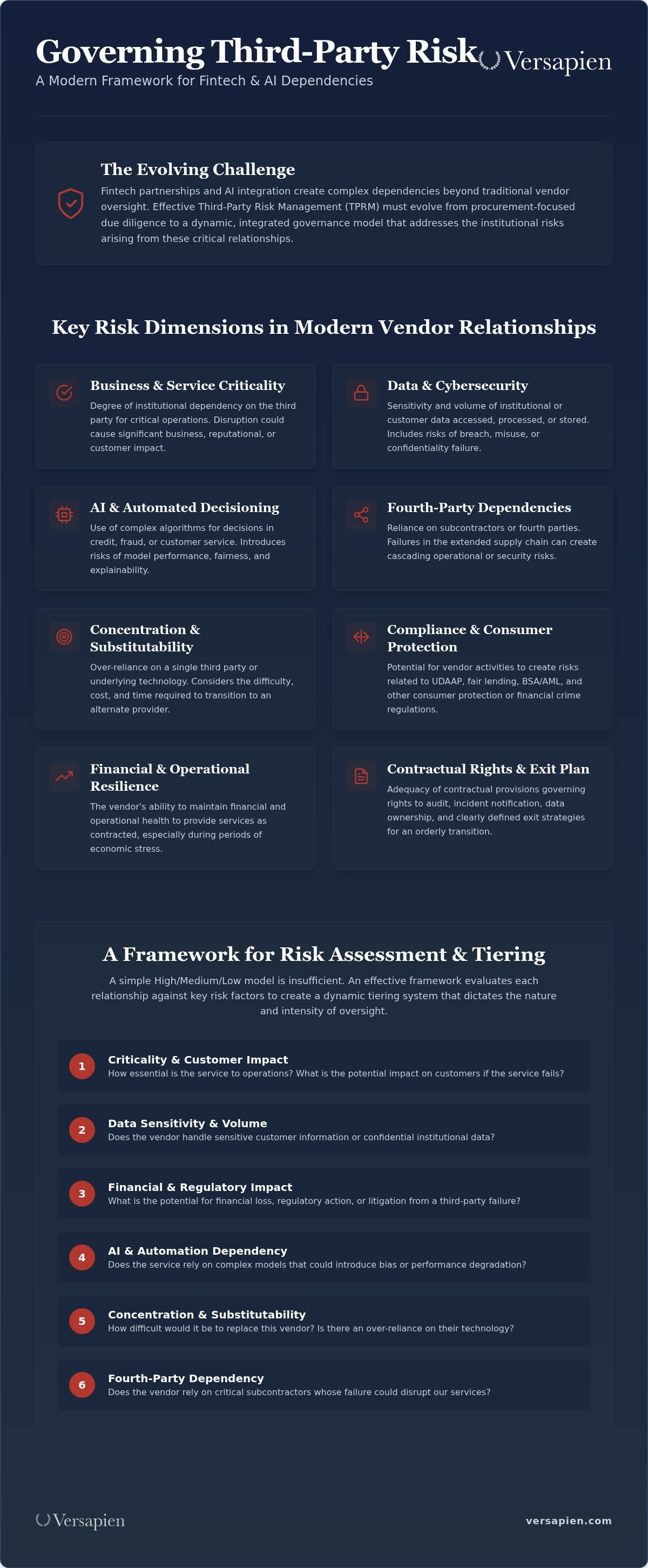
Key Risk Dimensions in Modern Vendor Relationships
The unique characteristics of fintech and AI vendors demand a risk assessment process that evaluates a broader set of potential impacts. While traditional vendor reviews focus on financial stability and basic operational controls, modern TPRM frameworks must incorporate a more nuanced understanding of how these partners integrate with the institution. An effective program should assess relationships across several key dimensions to determine the appropriate level of due diligence and ongoing oversight.
Business and Service Criticality: The degree to which the institution depends on the third party for critical operations. A disruption of a critical service could have a significant impact on the institution’s business, reputation, or customers.
Data Access, Cybersecurity, and Privacy: The sensitivity and volume of institutional or customer data that the third party accesses, processes, or stores. This includes the potential for data breaches, misuse, or failures in confidentiality and integrity.
AI and Automated Decision-Making: The extent to which a third-party service uses AI or other complex algorithms for decision-making, particularly in areas like credit underwriting, fraud detection, or customer service. This introduces risks related to model performance, fairness, and explainability.
Fourth-Party and Technology Dependencies: The reliance of the third party on its own critical vendors (subcontractors or fourth parties). A failure within this extended supply chain can create cascading operational or security risks for the institution.
Concentration and Substitutability Risk: The risk created by over-reliance on a single third party for a critical service or by using multiple vendors that depend on the same underlying subcontractor or technology. This dimension also considers the difficulty, cost, and time required to transition the service to an alternate provider.
Consumer Protection and Compliance Dependencies: The potential for the third party’s activities to create dependencies involving consumer protection regulations, including fair lending and prohibitions against Unfair, Deceptive, or Abusive Acts or Practices (UDAAP), or financial crime compliance obligations such as the Bank Secrecy Act (BSA), anti-money laundering (AML), and sanctions screening.
Financial Condition and Operational Resilience: The third party’s ability to maintain its financial and operational health to ensure it can provide services as contracted, especially during periods of economic stress or business disruption.
Contractual Rights and Exit Planning: The adequacy of contractual provisions that govern the relationship, including rights to audit, incident notification requirements, data ownership, and clearly defined exit strategies that allow for an orderly transition of services.
A Framework for Third-Party Risk Assessment and Tiering
A simple high, medium, and low tiering model is often insufficient for capturing the multifaceted risks posed by fintech and AI vendors. A more effective approach uses a risk assessment framework that evaluates each relationship against the key risk dimensions. The resulting risk tier should not be a static label but a dynamic driver that dictates the nature and intensity of oversight throughout the vendor lifecycle.
Management can develop a weighted scoring system based on factors relevant to the institution’s specific business model and risk appetite. This framework helps ensure that governance efforts are proportionate to the potential impact of each relationship.
Third-Party Risk Assessment Factors
Criticality & Customer Impact: How essential is this service to our operations? What is the potential impact on customers if the service is disrupted or fails?
Data Sensitivity & Volume: Does the vendor access, process, or store sensitive customer information or confidential institutional data?
Financial & Regulatory Impact: What is the potential for financial loss, regulatory enforcement action, or litigation resulting from a failure of the third party?
AI & Automation Dependency: Does the service rely on complex models or automated decision-making that could introduce bias, performance degradation, or other model-related risks?
Concentration & Substitutability: How difficult would it be to replace this vendor? Do we have an over-reliance on this vendor or its underlying technology?
Fourth-Party Dependency: Does the vendor rely on critical subcontractors whose failure could disrupt our services?
The combined assessment of these factors determines the relationship’s overall risk tier. This tier then directly informs the required intensity of due diligence, the seniority of approval authorities, the stringency of contract terms, the frequency of monitoring, and the rigor of contingency and exit planning.
The Third-Party Risk Management Lifecycle
Effective governance is not a one-time event but a continuous lifecycle. The risk tier assigned during the assessment phase should influence the level of scrutiny and resources dedicated to each stage of the relationship.
Inventory: Maintaining a comprehensive and current inventory of all third-party relationships, including those managed by individual business lines, is the foundation of any TPRM program.
Risk Assessment: Applying a consistent risk assessment framework to each relationship to determine its inherent risk and assign a corresponding tier.
Due Diligence: Conducting a level of due diligence proportionate to the assessed risk. High-risk relationships require more extensive reviews of controls, finances, operational resilience, and compliance programs.
Approval: Ensuring that new relationships, particularly those deemed high-risk, are approved by the appropriate level of management or a designated committee.
Contracting: Negotiating contracts that include clauses appropriate for the risk level, covering areas such as performance standards, data security, audit rights, incident notification, and termination or exit strategies.
Ongoing Monitoring: Implementing a monitoring program that is also risk-based. High-risk relationships may require more frequent performance reviews, control assessments, and analysis of financial health.
Issue Management: Establishing a formal process for identifying, tracking, and resolving issues that arise during the relationship, with clear escalation paths for significant problems.
Renewal or Exit: Making a deliberate decision to renew, renegotiate, or terminate the relationship based on performance, risk, and strategic alignment, supported by a well-defined exit plan.
Governance Considerations for Specialized Vendors
Certain types of vendors, particularly those providing AI-enabled services or impacting compliance functions, require specialized governance considerations that integrate with broader enterprise risk management programs.
AI and Automated Decision-Making
When a third party provides an AI-enabled service, an institution should determine how that service fits within its existing governance structures. This includes not only third-party risk management but also disciplines such as model risk management, operational risk, data governance, and cybersecurity. The application of specific standards, such as those outlined in SR 11-7 for model risk management, depends on the nature of the service and its potential impact, not automatically on the presence of AI.
The objective is to ensure that controls are proportionate to the use case. For example, a vendor’s AI model used for high-stakes decisions like credit underwriting warrants a far more intensive level of validation and ongoing performance monitoring than a simple chatbot used for basic customer inquiries. The institution retains responsibility for understanding the vendor’s technology to a degree sufficient to manage its own risks.
Consumer Protection and Financial Crime Compliance
Institutions should assess whether third-party activities create dependencies related to specific regulatory obligations. A fintech partnership that involves marketing, application processing, or servicing for a consumer credit product, for instance, may introduce fair lending or UDAAP risks. The institution should conduct sufficient due diligence and ongoing monitoring to ensure the partner’s activities align with its own compliance management system.
Similarly, a third-party technology provider that supports customer onboarding or transaction monitoring can create dependencies related to BSA/AML and sanctions compliance. The institution is responsible for understanding how the vendor’s systems function and for validating that they are operating effectively within its own financial crime compliance framework. This does not mean the institution is automatically liable for every vendor error, but rather that it must demonstrate adequate oversight of the functions it has outsourced.
Implementing Risk-Based Ongoing Monitoring
For many third-party relationships, particularly those that are dynamic or high-risk, periodic annual reviews may be insufficient to identify emerging issues. An effective ongoing monitoring program is risk-based and incorporates specific triggers that prompt out-of-cycle assessments. These triggers should be designed to provide early warnings of changes that could materially alter the relationship’s risk profile.
Key monitoring triggers may include:
Material changes in the services provided or the functionality of AI models
Cybersecurity incidents or significant operational disruptions at the third party
Evidence of financial deterioration or adverse media attention
Significant regulatory or legal developments affecting the third party
Changes in the third party’s use of critical subcontractors (fourth parties)
An increase in customer complaints or identified control failures related to the service
A significant increase in the volume of activity or the institution’s dependency on the vendor
Executive Takeaways: Actions Management Should Consider
Senior management and the Board should ensure the institution’s TPRM framework is equipped to govern the risks arising from its use of fintech and AI vendors. The following questions can help guide a review of the program’s effectiveness:
Do we have a complete and accurate inventory of all critical fintech and AI dependencies across the enterprise?
Does our risk-tiering methodology accurately reflect the potential customer, operational, regulatory, and concentration exposures created by each relationship?
Can we identify and assess material fourth-party dependencies within our most critical vendor relationships?
Are our third-party contracts sufficiently robust and aligned with the risk profile of each relationship, particularly regarding audit rights, incident notification, and data governance?
Do our ongoing monitoring activities include triggers that provide timely identification of meaningful changes in a vendor’s risk profile?
Do we have credible and tested contingency and exit plans for our most critical third-party services?
Does reporting to senior management and the Board focus on material dependencies, risk exposures, and key oversight decisions rather than just program metrics?


Comments