
AI Governance Maturity: A Roadmap for Financial Institutions
Updated: Sep 22
Financial institutions are moving from AI experimentation toward broader deployment across business, risk, compliance, and operational functions. As AI use expands, the governance challenge is not simply to create a new set of controls. It is to establish a practical framework for identifying AI use cases, assessing their risks, assigning accountability, and integrating appropriate controls into existing risk management and governance processes. AI governance maturity should therefore be viewed as an evolving capability rather than a fixed end state. The appropriate governance approach will depend on an institution's size, complexity, risk profile, and the nature and potential impact of its AI use cases.
Table of Contents
The Convergence of Artificial Intelligence and Regulatory Oversight
Effective AI governance in financial services is the systemic framework of policies, procedures, and controls designed to ensure that artificial intelligence systems are developed and used responsibly and in compliance with legal and regulatory expectations. The primary challenge is not the creation of a net-new governance structure but the thoughtful extension of existing risk management disciplines to address the unique characteristics of AI. This requires a clear understanding of how AI-related risks intersect with established risk categories and how legacy supervisory guidance is adapting to new technologies.
AI Governance and Existing Risk Frameworks
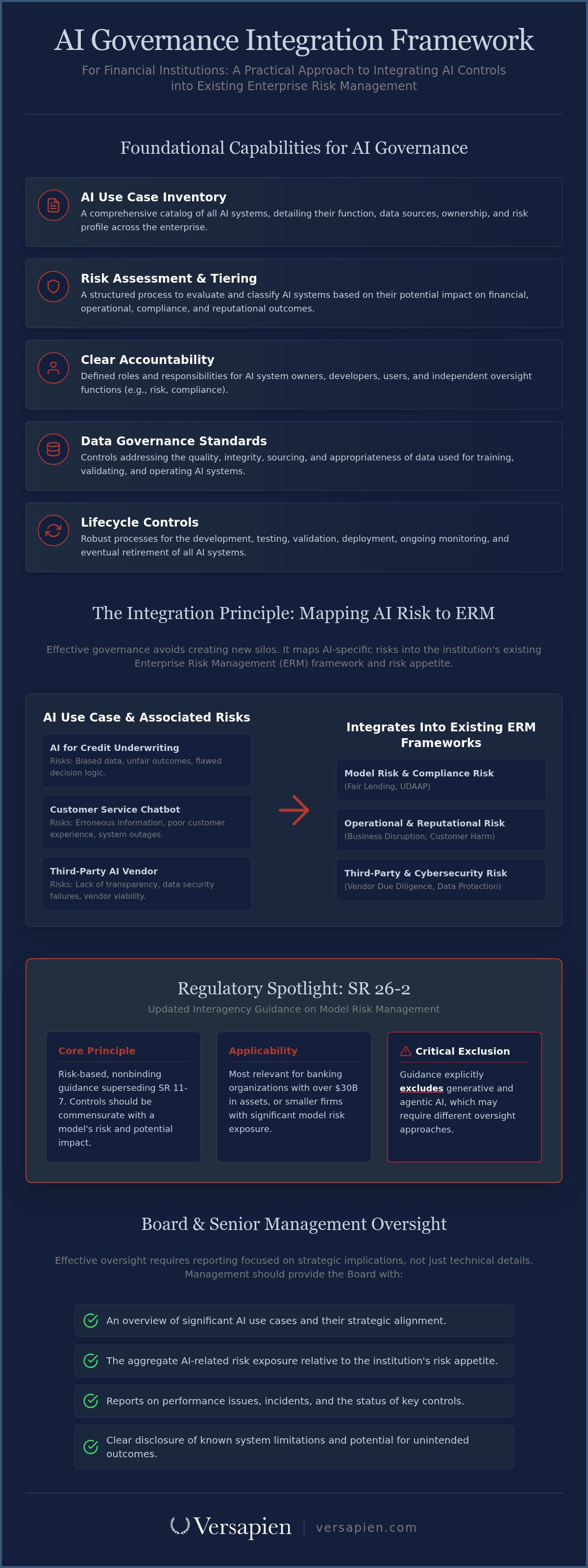
Rather than operating in a silo, AI-related risks manifest across multiple established risk taxonomies within a financial institution. A comprehensive governance program acknowledges these intersections. For example, flawed or biased training data can create model risk and compliance risk, particularly in consumer-facing applications. The failure of an AI system used in transaction monitoring can introduce operational risk and financial crime compliance risk. Similarly, reliance on third-party AI vendors without adequate due diligence creates significant third-party and cybersecurity risk. An integrated approach ensures that AI is not treated as an isolated technological issue but as a business activity with implications for model, operational, technology, data, compliance, and consumer protection risk management programs.
Model Risk Management and SR 26-2
The foundational principles of model risk management remain central to the oversight of many AI systems. In April 2026, federal banking agencies issued updated interagency guidance on model risk management, SR 26-2, which superseded the longstanding SR 11-7. This guidance is risk-based, nonbinding, and does not create new legal obligations. It is expected to be most relevant for banking organizations with more than $30 billion in total consolidated assets, although it may also be relevant to banking organizations with $30 billion or less in total assets that have significant exposure to model risk because of the prevalence or complexity of their models or activities outside the scope of traditional community banking.
Critically, the guidance explicitly excludes generative and agentic AI from its scope, acknowledging that these technologies may require different oversight approaches. For in-scope models, including those from third-party vendors, the expectation is that an institution’s controls will be commensurate with the model’s risk and use. This requires a nuanced approach to validation and monitoring, where the level of rigor applied to a vendor model is based on its potential impact on the institution’s safety, soundness, and consumer protection obligations. For a deeper analysis of these expectations, institutions can review established practices for model risk management in the age of artificial intelligence.
The AI Governance Integration Matrix for Financial Institutions
Developing a mature AI governance capability involves establishing foundational processes and integrating them into the institution's existing Enterprise Risk Management (ERM) program. This approach avoids the inefficiency of creating a separate, siloed governance structure for AI and instead leverages established committees, risk assessment methodologies, and reporting channels. The goal is to build a sustainable program that can adapt as AI use cases and technologies evolve.
Foundational Capabilities for AI Governance
Instead of a rigid, one-size-fits-all model, effective AI governance is built upon a set of core capabilities that can be scaled according to risk. These foundational elements include:
An inventory of all AI use cases across the enterprise, capturing key information about their function, data sources, owners, and risk profile.
A risk assessment process to evaluate and tier AI systems based on their potential impact on financial, operational, reputational, and compliance outcomes.
Clear accountability, with defined roles and responsibilities for AI system owners, developers, users, and oversight functions.
Data governance standards that address the quality, integrity, and appropriateness of data used for training and operating AI systems.
Lifecycle controls appropriate to the development, acquisition, testing, deployment, monitoring, modification, and retirement of AI systems.
Ongoing monitoring and testing procedures to detect performance degradation, model drift, or unintended outcomes.
Defined escalation protocols for reporting and addressing incidents, control failures, or newly identified risks.
Integrating AI into Enterprise Risk Management
The most durable approach to AI governance involves mapping AI-specific risks into the existing ERM framework. For example, an AI system used for credit underwriting can be assessed through the institution's established credit risk, compliance risk, and model risk appetite statements. A customer service chatbot can be evaluated within the operational and reputational risk frameworks. This integration allows the organization to use familiar tools for risk identification, measurement, and reporting. While some institutions may find cross-functional committees useful for coordinating AI strategy and oversight, such structures are not universally required and should be implemented based on the institution's specific needs and complexity.
Board and Senior Management Oversight
The board of directors and senior management have a critical role in overseeing the institution's AI strategy and risk management. To fulfill this responsibility, they require timely and relevant information, not just technical details. Effective reporting focuses on the strategic implications of AI adoption. Key information for the board and its committees may include an overview of significant AI use cases, the aggregate AI-related risk exposure, the status of key controls, reports on performance issues or incidents, known system limitations, and analysis of emerging AI-related risks. This level of reporting enables leadership to provide effective challenge and strategic direction without becoming involved in the day-to-day management of individual systems. For more on this topic, see our guide on what boards and executive management should know about AI governance.
Addressing Fair Lending and UDAAP Risks in Automated Decisioning
The use of AI and complex algorithms in consumer lending brings heightened attention to fair lending and consumer protection obligations. Regulators, particularly the Consumer Financial Protection Bureau (CFPB), have emphasized that institutions remain responsible for complying with laws like the Equal Credit Opportunity Act (ECOA) and prohibitions on Unfair, Deceptive, or Abusive Acts or Practices (UDAAP), regardless of the technology used.
ECOA, Fair Lending, and AI Explainability
A central compliance challenge involves the intersection of complex algorithms and consumer protection laws. Under ECOA and its implementing Regulation B, creditors must provide applicants with specific and accurate principal reasons for adverse actions, such as a credit denial. The use of a "black box" model does not absolve a lender of this requirement. While various explainable AI (XAI) techniques exist, regulators have not prescribed any specific method, such as SHAP or LIME. The focus remains on the outcome: the lender’s ability to produce a legally compliant adverse action notice. This is a distinct requirement from the broader practice of fair lending risk assessment, which involves analyzing lending data for potential disparities.
Risk-Based Approaches to Algorithmic Bias
Managing the risk of algorithmic bias requires a risk-based approach tailored to the specific lending activity and applicable laws. Practices such as testing for proxy variables, conducting disparate impact analysis, and documenting the search for less discriminatory alternatives (LDAs) are important controls. However, the appropriate level and type of analysis depend on the context. The appropriate level and type of analysis should depend on the nature of the AI use case, the decisions or recommendations it supports, its potential consumer impact, and applicable legal and regulatory requirements. Higher-risk consumer lending applications may warrant more extensive pre- and post-deployment analysis than lower-impact AI applications that do not influence credit, pricing, eligibility, or other significant consumer outcomes.
Institutionalizing Responsible AI for Long-Term Stability
Achieving AI governance maturity is a continuous process of developing and refining capabilities. It is not a one-time project but an ongoing discipline that aligns with the institution's strategic objectives and risk appetite. A mature program provides the structure needed to adopt new technologies responsibly, manage their risks effectively, and demonstrate sound oversight to internal and external stakeholders.
A Maturity-Based Approach to AI Governance
Viewing AI governance as a progression of capabilities allows an institution to build its program incrementally. Early stages may focus on creating a comprehensive use-case inventory and establishing a risk-tiering methodology. As the program matures, the institution can develop more sophisticated controls for high-risk systems, such as enhanced monitoring for model drift and more detailed board-level reporting. This evolutionary approach ensures that governance keeps pace with the institution's adoption of AI, providing stability and confidence as the use of the technology expands.
Practical Actions for Senior Risk and Compliance Leaders
Senior leaders can take several practical steps to assess and advance their institution's AI governance maturity. These actions form a roadmap for building a durable and effective framework:
Develop and maintain a comprehensive AI use-case inventory to provide a single source of truth for all AI and machine learning applications.
Establish clear risk-tiering criteria to differentiate between high-risk systems requiring extensive oversight and low-risk systems that can be managed with standard controls.
Assign clear ownership and accountability for each AI system, ensuring that business, technology, and risk stakeholders understand their roles.
Integrate the oversight of third-party AI systems into the existing vendor governance program, adding specific diligence and monitoring for AI-related risks. Integrate the oversight of third-party AI systems into the existing vendor governance program, with diligence, contractual provisions, monitoring, and other controls appropriate to the nature and risk of the relationship.
Define monitoring and escalation protocols that are appropriate for the risk level of each use case.
Periodically reassess the governance framework to ensure it remains effective as AI use cases, technologies, and regulatory expectations evolve.
Executive Takeaways
AI governance should be integrated into existing Enterprise Risk Management, Model Risk Management, and Third-Party Risk Management frameworks, not developed as a separate silo.
Regulatory guidance for model risk management, such as SR 26-2, is risk-based and nonbinding, with a scope that currently excludes generative and agentic AI.
Board and senior management oversight depends on receiving strategic, risk-focused information, including an inventory of significant use cases, aggregate risk exposure, and reports on incidents or control issues.
Compliance with fair lending laws like ECOA requires the ability to provide specific, accurate reasons for adverse actions, regardless of the complexity of the underlying algorithm.
Practical steps toward maturity include creating an AI use-case inventory, establishing risk-tiering criteria, assigning clear ownership, and defining risk-appropriate monitoring and escalation processes.
An effective AI governance program is an evolving capability that adapts to the institution's size, complexity, and risk profile, rather than a fixed set of prescriptive controls.
How Versapien Can Help
Versapien helps financial institutions build and strengthen their AI governance frameworks to support responsible innovation. We work with senior management and boards to assess existing AI governance capabilities, develop enterprise-wide inventories and risk-assessment methodologies, and integrate AI oversight into ERM, model risk, and third-party risk management programs. Our senior-led advisory teams help clients strengthen board and management reporting, develop practical implementation roadmaps, and adapt governance capabilities as AI use cases, technologies, and the regulatory environment evolve.



Comments