
Model Risk Management in the Age of Artificial Intelligence
Updated: Sep 22
The operational friction between rapid AI model deployment and the deliberative pace of traditional model risk management frameworks has become a primary governance challenge for financial institutions. Legacy processes, designed for static statistical models, struggle to accommodate the volume, velocity, and complexity of modern AI systems. This misalignment creates a risk that either innovation is stifled by outdated compliance gates or that unvetted models introduce unacceptable levels of operational, regulatory, and reputational risk.
Addressing this requires more than incremental adjustments; it demands a structural evolution in how organizations approach model governance. The focus is shifting from a rigid, one-size-fits-all validation process to an adaptive, risk-informed lifecycle. This modern approach aligns the intensity of oversight with the specific risk profile of each model, ensuring that governance enables, rather than inhibits, responsible innovation.
Table of Contents
The Structural Evolution of Model Risk Management Frameworks
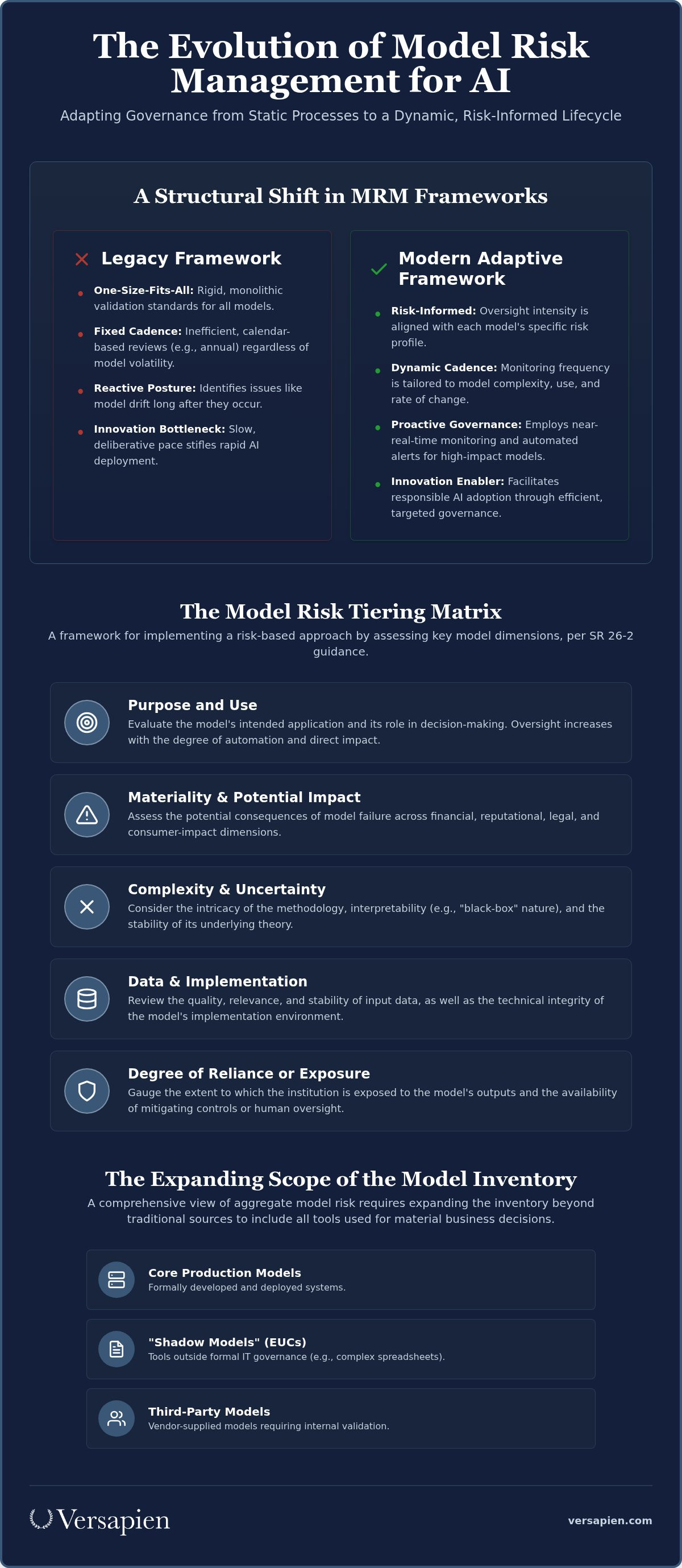
Traditional model risk management (MRM) frameworks were built on a linear, periodic validation path. This structure is proving increasingly inefficient against the backdrop of modern data environments and complex AI. The systemic challenge lies in the inability of these legacy processes to manage the sheer volume of new models and the dynamic nature of their inputs. A reactive posture, centered on annual reviews, is insufficient for systems that may exhibit performance degradation or drift in a matter of weeks.
The modern MRM lifecycle, therefore, is being re-envisioned as an adaptive feedback loop. This requires a fundamental shift in how risk appetite is defined and applied. Instead of a single, monolithic standard for all models, leading institutions are developing more nuanced risk appetite statements that account for increased model complexity and diverse use cases. This allows for a proactive governance posture, where resources are dynamically allocated to the highest-risk areas.
From Rigid Schedules to Risk-Based Cadence
The inefficiency of fixed annual validation cycles is particularly acute for models that are designed to adapt. For example, a fraud detection model that retrains on weekly data streams cannot be effectively governed by a review process that occurs only once a year. The core principle of a modern framework is that the nature, frequency, and rigor of validation and monitoring should be tailored to the model's characteristics, use, materiality, rate of change, and potential impact.
This necessitates a move toward dynamic threshold setting and risk-based monitoring schedules. For high-impact, volatile models, this might involve near-real-time performance monitoring and automated alerts. For simpler, more stable models, a less frequent, traditional review may remain appropriate. The objective is to align oversight intensity with actual model risk, optimizing the use of specialized validation talent.
The Expanding Scope of the Model Inventory
As financial institutions adopt more sophisticated quantitative tools, the scope of the model inventory is expanding. There is a renewed focus on tools developed outside of formal IT governance, including complex spreadsheets and other forms of end-user computing (EUC). These "shadow models" can introduce significant, unmeasured risk if they are used to support material business decisions without undergoing formal validation and oversight.
A comprehensive model inventory is the foundation of any effective MRM program. It must provide sufficient information to understand both individual and aggregate model risks. This includes not only core production models but also significant EUCs and models developed by third parties, ensuring that the board and senior management have a complete and accurate view of the institution's model risk landscape. For more on managing vendor-related risks, see our analysis of questions every financial institution should ask its AI vendors.
Applying SR 26-2 to AI-Related Model Risk
In April 2026, federal banking regulators issued new supervisory guidance on model risk management, commonly referred to as SR 26-2, which superseded the prior SR 11-7 guidance. While SR 26-2 retains foundational principles of sound model governance, it formally emphasizes a risk-based approach tailored to each institution's model risk profile and the specific purpose, use, and materiality of its models. This advisory, non-binding guidance applies to banking organizations with total assets over $30 billion, though smaller institutions with significant model risk exposure may also find its principles relevant.
For institutions deploying AI, this guidance provides a flexible framework for aligning innovation with regulatory expectations. The three traditional pillars of MRM (i.e., model development, validation, and governance) remain central, but their application is expected to be proportional to the model's potential impact. For example, the challenge of demonstrating conceptual soundness is more pronounced in AI systems where feature engineering is automated. Under SR 26-2, the expectation for documentation and transparency in such "black-box" models would be significantly higher than for a simple regression model, reflecting the increased uncertainty and potential risk.
The Model Risk Tiering Matrix
To implement the risk-based approach articulated in SR 26-2, institutions can use a model risk tiering matrix to categorize models and determine the appropriate level of validation and ongoing monitoring. This framework moves beyond simple metrics to create a multidimensional view of risk, allowing for a more defensible and efficient allocation of MRM resources. The key dimensions for assessment should include:
Purpose and Use: The model's intended application and its role in decision-making processes. Is it informational, or does it drive automated actions?
Materiality and Potential Impact: The potential financial, reputational, legal, and consumer-impact consequences of model failure or incorrect performance.
Complexity and Uncertainty: The intricacy of the model's methodology, including its interpretability and the stability of its underlying theory.
Data and Implementation Considerations: The quality, relevance, and stability of input data, as well as the technical integrity of the model's implementation environment.
Degree of Reliance or Exposure: The extent to which the institution and its customers are exposed to the model's outputs and the availability of mitigating controls.
Effective Challenge in the Age of AI
A cornerstone of sound model risk management is the principle of effective challenge, which requires credible and objective review by qualified, independent parties. In the context of advanced neural networks or other complex AI, what constitutes an "effective" challenge becomes more demanding. Validators must possess not only traditional quantitative skills but also a deep understanding of computer science, data architecture, and the specific failure modes of AI systems.
This may involve the use of novel techniques, such as employing synthetic data to stress-test a model's resilience against unforeseen scenarios or using advanced explainability tools to probe the logic behind its decisions. The goal is to ensure that the validation function can rigorously question model assumptions and limitations, even when faced with highly sophisticated and non-traditional methodologies. A robust approach to AI model validation is critical before deployment to meet these expectations.
Advancements in Automated Model Validation and Monitoring
In response to the growing complexity of model inventories and shortages of specialized talent, many financial institutions are turning to automation. Automated tools for compliance and model risk management can help streamline routine tasks, enabling MRM teams to focus their expertise on high-risk models and complex validation activities. This trend is not about replacing human judgment but augmenting it with technology to create a more efficient and effective governance process.
Key areas for automation include integrating drift detection directly into model risk dashboards, using robotic process automation (RPA) to streamline updates to the model inventory, and generating standardized validation reports to support internal audit and regulatory exam readiness. When implemented thoughtfully, these tools can significantly enhance the capacity and effectiveness of an institution's MRM function.
Tailored Monitoring of Model Performance and Bias
Automation enables a more sophisticated and risk-sensitive approach to model monitoring. For high-impact models, such as those used in credit underwriting or fraud detection, real-time alerts can be configured to flag performance degradation or significant data drift as soon as it occurs. This allows for rapid intervention before the issue results in material financial or consumer harm.
Similarly, automated fairness testing has become a critical tool for managing compliance risk, particularly for models used in consumer-facing decisions. For relevant models, ongoing automated tests can help prevent violations of fair lending laws or prohibitions against Unfair, Deceptive, or Abusive Acts or Practices (UDAAP) by identifying discriminatory outcomes that may emerge as the model operates over time.
The Interplay of Data Quality and Model Integrity
The integrity of any model is fundamentally dependent on the quality of its input data. Automated data lineage tools strengthen the conceptual soundness of models by providing a clear, auditable trail of data from its source to its use in the model. This transparency is essential for validation, debugging, and regulatory review.
However, automation also introduces new potential points of failure. A common source of model risk is a breakdown in an automated data pipeline, which can feed corrupted or inappropriate data into a model, leading to flawed outputs. Robust controls, monitoring, and validation of the data pipeline itself are therefore essential components of a modern model risk management framework.
Integrating Responsible AI Governance into the MRM Lifecycle
As AI becomes more integrated into core business functions, institutions should determine how model risk management and broader AI governance frameworks work together to address the risks associated with AI use. This means treating AI ethics, fairness, and transparency not as separate considerations but as core components of model risk. A mature governance framework establishes clear lines of accountability for algorithmic systems, ensuring that their development and use align with the institution's risk appetite and ethical standards.
The Board Risk Committee plays a crucial role in this process, providing oversight for high-impact algorithmic decisions and ensuring that senior management has a credible plan for managing the unique risks associated with AI. As demonstrated in applications like BSA/AML compliance, effective AI implementation hinges on a strong governance foundation that balances technological capability with rigorous risk management.
The AI Governance Checklist
To assess the maturity of their AI oversight, senior leaders should consider a targeted set of questions that bridge traditional MRM with AI-specific risks. This checklist can help identify gaps in the existing governance framework:
Risk-Based Testing: Does the institution's testing approach address relevant risks—such as performance, explainability, fairness, resilience, or security—based on the system's purpose, use, and potential impact?
Human Oversight and Escalation: Where appropriate, has the institution defined meaningful human oversight, intervention, escalation, or other controls based on the nature and potential impact of the AI-enabled decision?
Board and Senior Management Reporting: Does reporting provide the Board and executive leadership with sufficient insight into the performance and risk profile of high-impact AI systems, including key limitations and dependencies?
Ethical Impact Assessment: Is there a formal process for evaluating the potential ethical and societal impacts of new AI use cases before development begins, particularly those affecting consumers?
Executive Takeaways
The evolution of model risk management is shifting the function from a compliance-focused gatekeeper to a strategic enabler of responsible innovation. For executive leadership, the priority is to foster a culture where rigorous governance is viewed not as a cost center but as a competitive differentiator that builds trust with customers and regulators. As firms like Versapien help clients navigate these complexities, the focus remains on practical implementation that aligns advanced technology with durable risk management principles.
To evaluate the maturity of your institution's current framework, senior management and the board should consider the following questions:
Does our current MRM framework explicitly accommodate the risk-based, tailored approach reflected in current regulatory guidance, or does it rely on a rigid, one-size-fits-all process?
Have we equipped our model validation and audit teams with the specialized skills and tools required to provide an effective challenge to complex AI systems?
Is our AI governance framework fully integrated with our enterprise risk management program, or does it operate in a separate silo?
How are we ensuring that our model inventory is comprehensive and accurately reflects the risks associated with third-party models and significant end-user computing applications?


Comments