
What Boards and Executive Management Should Know About AI Governance
Table of Contents
Why AI Governance Is an Executive and Board Issue
As artificial intelligence transitions from a peripheral technology to a core component of institutional strategy, its governance can no longer be delegated solely to technology or data science teams. As AI becomes more widely used across financial institutions, it is creating new opportunities and risks across customer interactions, operations, decision-making, financial crime, and third-party relationships. For executive management and the board of directors, the central challenge is not to master the technical intricacies of machine learning but to establish a durable framework for strategic oversight, risk management, and accountability.
Effective AI governance for boards and executive management is a prerequisite for sustainable innovation. Without it, institutions risk fragmented adoption, inconsistent risk assessment, and potential blind spots that can lead to regulatory scrutiny, financial loss, or reputational damage. When AI models influence material outcomes—such as loan approvals, fraud alerts, or investment recommendations—their performance becomes a direct concern for the institution’s senior leadership. The objective is to create a governance structure that enables the responsible deployment of AI, aligning its use with the organization’s strategic goals and risk appetite.
An Adaptive Framework for AI Governance
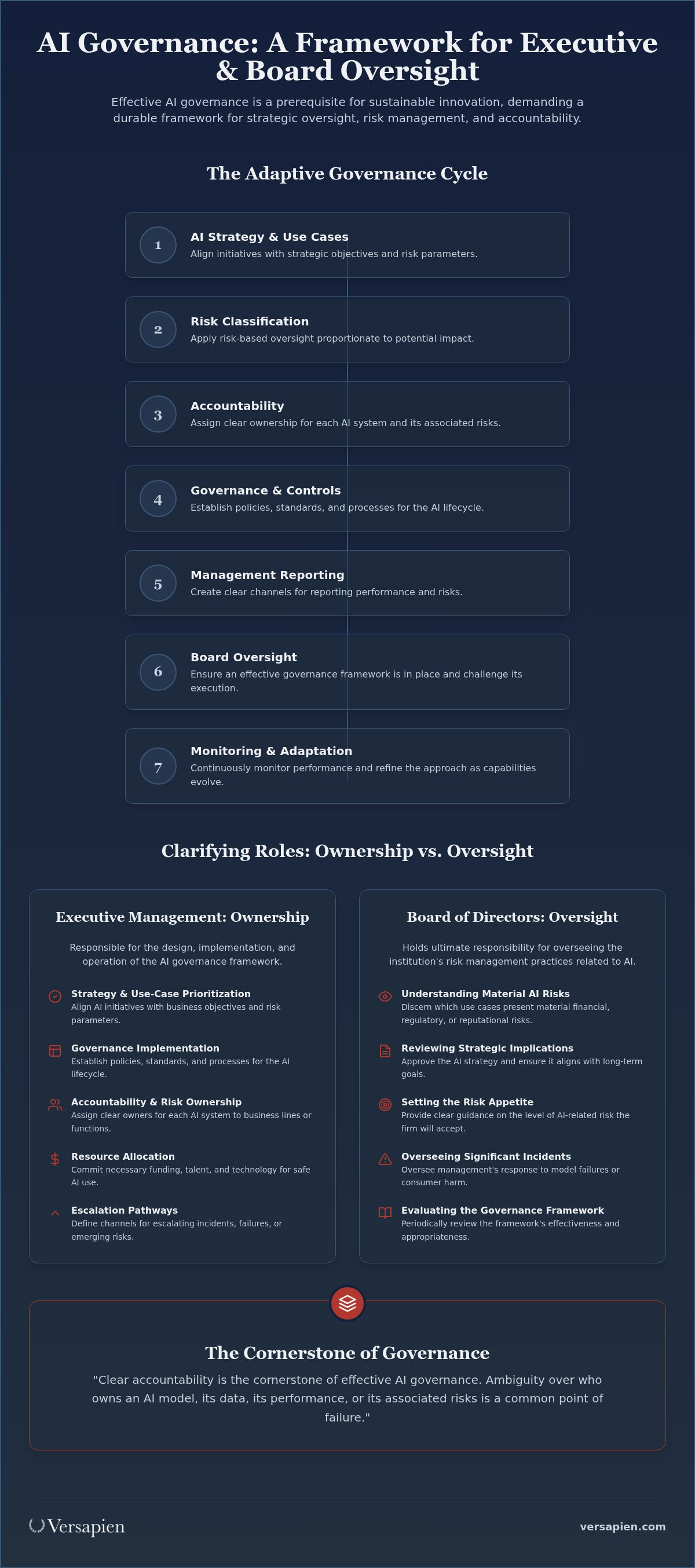
A robust AI governance framework is not a static checklist but a dynamic cycle that adapts to the specific context and risk of each AI application. Rather than applying a single, rigid set of controls to all use cases, leadership should promote a risk-based approach where the intensity of oversight is proportionate to the potential impact. Low-risk applications, such as internal process automation, may require streamlined governance, while high-risk systems affecting consumer outcomes demand comprehensive validation and monitoring.
This adaptive cycle ensures that governance is both effective and efficient, focusing resources where the risks are most significant. The process can be visualized as a continuous loop:
AI Strategy & Use Cases →
Risk Classification →
Accountability →
Governance & Controls →
Management Reporting →
Board Oversight →
Monitoring & Adaptation
Each stage informs the next, creating a feedback loop that allows the organization to refine its approach as its AI capabilities and the external environment evolve. This structure helps leadership ask the right questions at each stage, from initial strategic alignment to ongoing performance monitoring.
What Decisions Should Executive Management Own?
While the board provides oversight, executive management is responsible for the design, implementation, and operation of the AI governance framework. Management’s role is active and hands-on, translating the board’s risk appetite into concrete policies, procedures, and controls. Key decisions owned by the executive team include:
Strategy and Use-Case Prioritization: Aligning AI initiatives with the institution’s strategic objectives and determining which use cases offer the greatest value within acceptable risk parameters.
Governance Implementation: Establishing the policies, standards, and processes that govern the entire AI lifecycle, from data acquisition and model development to deployment and decommissioning.
Accountability and Risk Ownership: Assigning clear ownership for each AI system and its associated risks to specific business lines or functions. This ensures that responsibility does not default to technology teams alone.
Resource Allocation: Committing the necessary funding, talent, and technology to support the safe and effective use of AI, including investments in risk management and compliance functions.
Escalation Pathways: Defining clear criteria and channels for escalating significant AI-related incidents, control failures, or emerging risks to senior management and, when appropriate, the board.
What Is the Board's Role?
The Board of Directors, or an appropriate Board committee, provides oversight of the institution's risk management framework, including material risks arising from the use of AI. The board’s role is not to manage individual AI projects but to ensure that an effective governance framework is in place and to challenge management on its execution. Effective board oversight focuses on several key areas:
Understanding Material AI Risks: Directors should understand the portfolio of AI use cases and which among them present material risks to the institution, whether financial, regulatory, or reputational.
Reviewing Strategic Implications: The board should review and approve the overall AI strategy, ensuring it aligns with the institution’s long-term goals and that management has considered the competitive and operational implications.
Setting the Risk Appetite: The board is responsible for setting the institution’s risk appetite for AI, providing clear guidance on the level of risk the organization is willing to accept in pursuit of its objectives.
Overseeing Significant Incidents: When material incidents occur, such as a model failure leading to consumer harm or significant financial loss, the board should oversee management’s response and remediation efforts.
Evaluating the Governance Framework: The board should periodically review the effectiveness of management’s AI governance framework, confirming that it is appropriate for the scale and complexity of the institution’s AI usage. This includes understanding the roles and responsibilities of key AI governance committees and functions.
How Should Accountability Be Defined?
Clear accountability is the cornerstone of effective AI governance. Ambiguity over who owns an AI model, its data, its performance, or its associated risks is a common point of failure. A well-defined accountability structure clarifies decision rights and responsibilities across the organization, ensuring that every material AI system has a designated owner.
While the classic Three Lines of Defense model provides a useful starting point, its application to AI requires careful definition. Accountability should be explicitly assigned across key functions:
Business Lines: Own the AI systems used to achieve their objectives, including the business case, performance, and ultimate outcomes.
Technology and Data Science: Responsible for the technical development, implementation, and maintenance of AI models in accordance with established standards.
Risk Management: Provides independent oversight and challenge, establishing risk assessment methodologies and validating that controls are designed and operating effectively.
Compliance and Legal: Advise on regulatory requirements and legal risks, including issues related to consumer protection, data privacy, and fair lending.
Internal Audit: Provides independent assurance to the board that the AI governance framework and its associated controls are effective.
By defining these roles, the institution can avoid the diffusion of responsibility and ensure that risks are identified, managed, and escalated appropriately.
What Information Should Leadership Receive?
For both executive management and the board, effective oversight depends on receiving the right information at the right time. Reporting should be designed to support strategic decision-making, not to produce large volumes of technical data. The goal is to provide a clear, concise view of the institution’s AI risk posture.
Meaningful reporting for leadership should include:
An Inventory of Material AI Use Cases: A catalog of the institution's most significant AI systems, including their purpose, owners, and risk classification.
Risk and Performance Dashboards: Summaries of key risk indicators (KRIs) and key performance indicators (KPIs) for high-risk models, highlighting any breaches of established thresholds.
Significant Incident Reports: Timely and transparent reporting on any material AI-related incidents, including root cause analysis and management’s remediation plan.
Control Effectiveness Summaries: Periodic assessments from risk management and internal audit on the effectiveness of key controls within the AI governance framework.
Third-Party AI Dependencies: An overview of critical dependencies on third-party AI vendors and the associated third-party risk management posture.
Emerging Risks and Trends: Forward-looking analysis of emerging AI-related risks, new regulatory developments, and evolving industry practices.
How Should Governance Evolve?
AI technology and its applications in financial services are evolving rapidly. A governance framework established today may not be sufficient for the challenges of tomorrow. Consequently, institutions must build their governance programs to be adaptive. This requires a commitment to continuous learning and improvement, ensuring that policies, controls, and oversight practices keep pace with technological change.
An evolving governance model should incorporate several key elements:
Regular Framework Reviews: Management should periodically review and update the AI governance framework in response to new technologies, expanded AI use, and changes in the regulatory environment.
Training and Education: Ongoing training for executives, board members, and employees is critical to maintaining a high level of awareness regarding AI risks and governance responsibilities.
Scenario Analysis: Conducting forward-looking scenario analysis can help leadership anticipate future risks and assess the institution’s preparedness.
External Benchmarking: Comparing the institution’s governance practices against those of peers and evolving industry standards can identify opportunities for enhancement.
Executive Takeaways: Questions Leadership Should Be Asking
To translate these principles into action, boards and executive management should continuously engage with a set of core questions to guide their oversight and decision-making. These questions serve as a practical tool for assessing the health and maturity of the institution’s AI governance program.
Where are we using AI today, and which applications create the greatest potential value or risk for the institution?
Are accountability and decision rights for our material AI systems clearly defined and understood across the business, technology, and risk functions?
Does our governance process effectively distinguish between low- and higher-impact AI use cases, applying proportionate levels of oversight and control?
What information does executive management need to make informed decisions about AI strategy and risk, and is our current reporting providing that insight?
What material AI risks, incidents, or strategic changes are significant enough that they should be escalated to the board or a board committee?
Do we have a clear understanding of our dependencies on third-party AI models and vendors, and are we managing those risks effectively?
How will our governance framework adapt as our use of AI expands and the underlying technologies and regulatory expectations evolve?


Comments