
Third-Party Risk Management for AI and Fintech Vendors
As financial institutions increase their reliance on AI providers, fintech partners, cloud platforms, and other specialized third parties, the challenge is no longer simply identifying vendors. It is understanding which relationships are critical, what risks they introduce, how those risks are monitored, and whether the institution can respond when a third party experiences a failure, control weakness, or material change.
The proliferation of complex, technology-driven partnerships does not require an entirely separate AI vendor-risk framework. Instead, it demands that existing third-party risk management (TPRM) practices become more risk-sensitive, dynamic, and better integrated into the organization’s overall governance structure. The fundamental principles of sound risk management still apply, but their application must be adapted to address the unique attributes of AI and fintech relationships.
This analysis outlines the key stages of a modern TPRM lifecycle, highlighting specific considerations and common gaps for institutions managing AI and fintech vendors. The objective is to move beyond periodic, compliance-driven activities toward a continuous governance model that supports both innovation and operational resilience.
Table of Contents
A Risk-Based Approach to the Third-Party Lifecycle
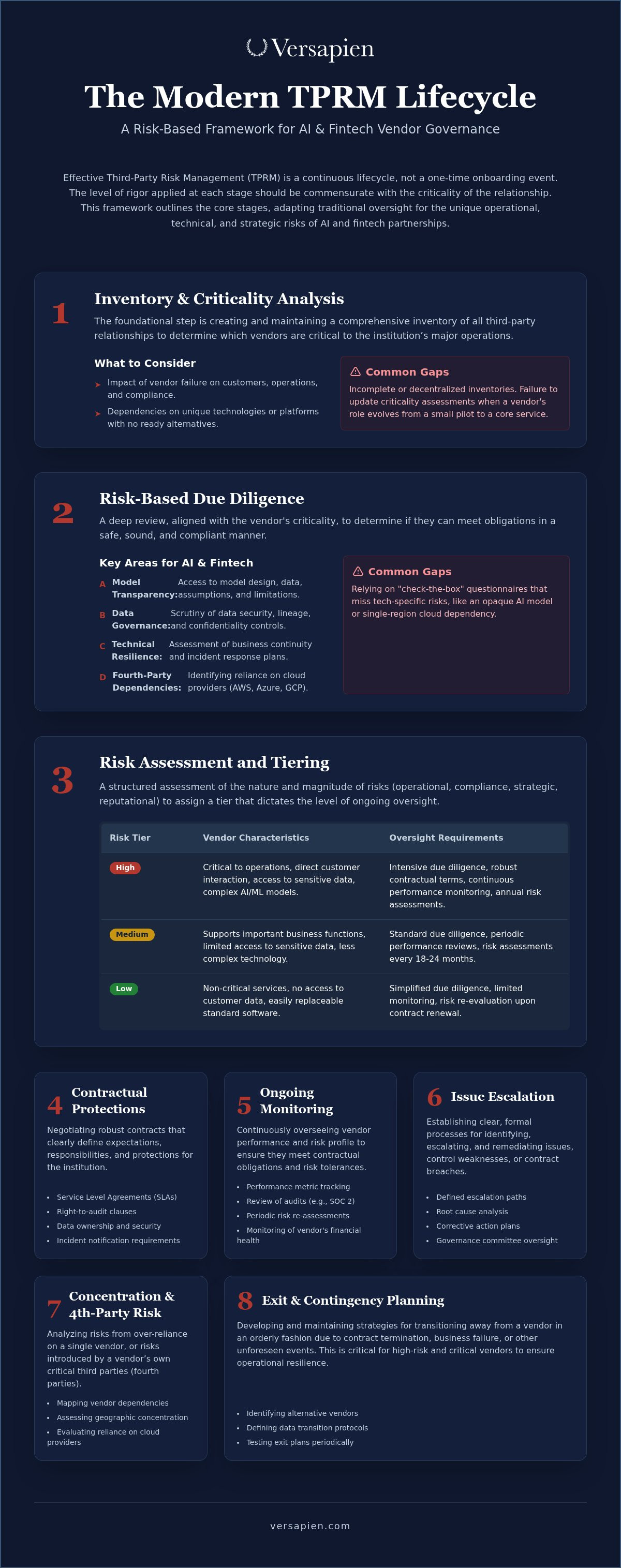
Effective TPRM is a continuous lifecycle, not a one-time onboarding event. The level of rigor applied at each stage should be commensurate with the criticality of the relationship, the services provided, and the potential impact of a failure on the institution’s operations, finances, reputation, and customers. For AI and fintech vendors, this means adapting traditional oversight to account for new sources of operational, technical, and strategic risk.
The core stages of this lifecycle include:
Inventory & Criticality Analysis
Risk-Based Due Diligence
Risk Assessment and Tiering
Contractual Protections and Negotiation
Ongoing Monitoring and Performance Management
Issue Escalation and Remediation
Concentration and Fourth-Party Risk Analysis
Exit and Contingency Planning
1. Inventory & Criticality Analysis
What it is: The foundational step is creating and maintaining a comprehensive inventory of all third-party relationships. This inventory serves as the basis for determining which vendors are critical to the institution’s major operations. A fintech partner providing a core banking platform or an AI provider whose model underwrites a significant loan portfolio would likely be deemed critical.
What to consider: Criticality is not just about the size of the contract. An institution should assess the potential impact of a vendor’s failure or service disruption on its customers, operations, and regulatory compliance. For AI and fintech vendors, this includes evaluating dependencies on unique technologies or platforms where alternatives are not readily available.
Common gaps: Many institutions struggle with incomplete or decentralized inventories, often missing relationships managed within individual business lines. Another frequent oversight is failing to update criticality assessments when a vendor’s role evolves, for example, when a small pilot project with a fintech expands to become a primary customer-facing service.
2. Risk-Based Due Diligence
What it is: Due diligence is the process of collecting and analyzing information to determine if a third party can meet its obligations and operate in a safe, sound, and compliant manner. The depth of this review should align with the vendor's criticality and risk profile.
What to consider for AI and fintech vendors:
Model Transparency: Can the vendor provide sufficient information about an AI model’s design, data inputs, assumptions, and limitations? This is essential for the institution to conduct its own independent review and challenge, consistent with internal model risk management standards informed by guidance like SR 11-7.
Data Governance: How does the vendor manage data access, confidentiality, and ownership? Scrutinize data security controls, data lineage, and the vendor’s ability to protect sensitive customer information.
Technical and Operational Resilience: Assess the vendor’s business continuity and incident response plans. How would they respond to a significant service disruption, and what are their recovery time objectives?
Subcontractor Dependencies: Identify the vendor’s own critical third parties (i.e., fourth parties), particularly their reliance on major cloud infrastructure providers like AWS, Azure, or Google Cloud.
Common gaps: A common mistake is relying on standardized, "check-the-box" due diligence questionnaires that fail to address the specific risks of a technology-driven service. For example, a standard financial health check may not reveal the operational risks embedded in a vendor’s opaque AI model or its dependence on a single cloud hosting region.
3. Risk Assessment and Tiering
What it is: Following due diligence, the institution should perform a structured risk assessment to understand the nature and magnitude of risks the relationship presents. This assessment informs a tiering decision (e.g., high, medium, low risk), which dictates the level of ongoing oversight required.
What to consider: Risks can span multiple domains, including operational, compliance, strategic, and reputational. For certain fintech relationships, such as those involving payment processing or customer onboarding, financial crime risks (e.g., AML/KYC, sanctions) become a relevant part of the assessment. However, it is a mistake to apply this lens universally; a vendor providing internal HR software presents a different risk profile than one facilitating cross-border payments.
A simple tiering matrix can help structure this process:
Common gaps: Risk assessments are often static, performed once at onboarding and rarely updated. They may also focus too narrowly on cybersecurity risks while overlooking equally important operational or compliance risks, such as potential UDAAP or fair lending issues arising from a third-party marketing algorithm.
4. Contractual Protections and Negotiation
What it is: The contract is a critical risk management tool. It should clearly define the rights and responsibilities of both parties and include specific provisions to mitigate identified risks.
What to consider for AI and fintech vendors:
Right to Audit: The contract should grant the institution sufficient audit and information access rights to verify the vendor’s controls and performance.
Notification of Changes: Require the vendor to provide timely notification of material changes to its services, controls, or financial condition, including substantive updates to AI models or APIs.
Data Portability and Transition Support: Ensure the contract specifies how the institution can retrieve its data in a usable format upon termination, and define the vendor's role in supporting a transition to an alternative provider.
Service Level Agreements (SLAs): Define clear, measurable performance metrics, including system uptime, response times, and data accuracy, with associated penalties for non-performance.
Common gaps: Institutions may accept a vendor’s standard boilerplate contract without negotiating terms critical to their own risk profile. This is particularly common with large technology providers, but even small concessions on terms like audit rights or notification requirements can significantly improve an institution's oversight capabilities.
5. Ongoing Monitoring and Performance Management
What it is: Risk management does not end after the contract is signed. Ongoing monitoring involves tracking a vendor’s performance against SLAs, reviewing control attestations (e.g., SOC reports), and staying informed about any changes that could affect its risk profile.
What to consider: Monitoring activities should be risk-based. For a high-risk AI vendor, this might include periodic reviews of model performance reports and validation documentation. For a low-risk office supply vendor, it may be limited to tracking invoice accuracy. The goal is to establish dynamic triggers for out-of-cycle risk assessments, rather than relying solely on a fixed annual review schedule.
Common gaps: The most common gap is a "set it and forget it" mentality. Monitoring becomes a perfunctory, "check-the-box" exercise that fails to identify emerging risks. Another is a lack of clear ownership, with no single individual or function responsible for consolidating monitoring results and assessing their collective impact.
6. Issue Escalation and Remediation
What it is: A formal process must exist for identifying, escalating, and remediating issues that arise from a third-party relationship, whether from a control failure, a security incident, or a performance problem.
What to consider: The process should define clear thresholds for escalation to senior management and the board. Remediation plans should include specific actions, owners, and timelines, with a structured process for tracking them to completion. This process is a critical component of an effective operational risk management framework.
Common gaps: Issues are often tracked informally in spreadsheets or email, leading to a lack of visibility and accountability. Without a centralized process, institutions cannot identify systemic problems that may affect multiple third-party relationships.
7. Concentration and Fourth-Party Risk Analysis
What it is: Concentration risk arises when an institution relies too heavily on a single third party for multiple activities or when multiple vendors rely on the same subcontractor (a fourth party). This is a significant concern in the technology space.
What to consider: An institution may use several fintech vendors that appear independent but all run on the same cloud infrastructure provider. A service outage at that single fourth party could disrupt multiple "independent" services simultaneously. This type of concentration risk can exist even when individual vendor relationships appear manageable in isolation. Mapping these dependencies is a critical, and often overlooked, aspect of modern TPRM.
Common gaps: Most institutions are effective at identifying concentration risk with their direct vendors but lack the visibility to assess fourth-party dependencies. This requires actively requesting and reviewing information from vendors about their own critical subcontractors during the due diligence process.
8. Exit and Contingency Planning
What it is: For critical relationships, institutions should consider whether documented exit and contingency plans are appropriate based on the nature of the service, the feasibility of transition, and the potential impact of disruption. This plan outlines the steps required to transition the service to another vendor or bring it in-house with minimal disruption.
What to consider for AI and fintech vendors: Exit planning can be especially complex for these relationships. Key considerations include data and intellectual property portability, the technical feasibility of transitioning a deeply integrated platform, and the availability of viable alternative providers. The plan should be more than a theoretical document; it should be a practical guide that is periodically reviewed and tested.
Common gaps: Exit strategies are often drafted at the beginning of a relationship and never updated. As a result, they fail to account for changes in technology, personnel, or the market, rendering them ineffective when a disruption actually occurs.
Executive Takeaways
As reliance on third parties grows, boards and senior management should challenge their organizations by asking a series of fundamental governance questions:
Do we know which of our AI and fintech relationships are truly critical to our operations?
Can we identify and measure our material fourth-party and concentration dependencies, particularly in our technology supply chain?
Do our contracts provide sufficient access to information, audit rights, change notifications, and transition support to manage our risks effectively?
Are our ongoing monitoring activities aligned to the actual risk of each relationship, or are we applying a one-size-fits-all approach?
Has the institution developed and tested credible contingency and exit plans for our most critical vendors?
Can we respond effectively and quickly to a vendor failure or a material change in their services?
Answering these questions can help management strengthen oversight of critical third-party relationships and better understand where vendor dependencies could create material operational, compliance, or customer impacts.


Comments