
Digital Asset Compliance: Governance Considerations for Financial Institutions
Updated: Sep 22
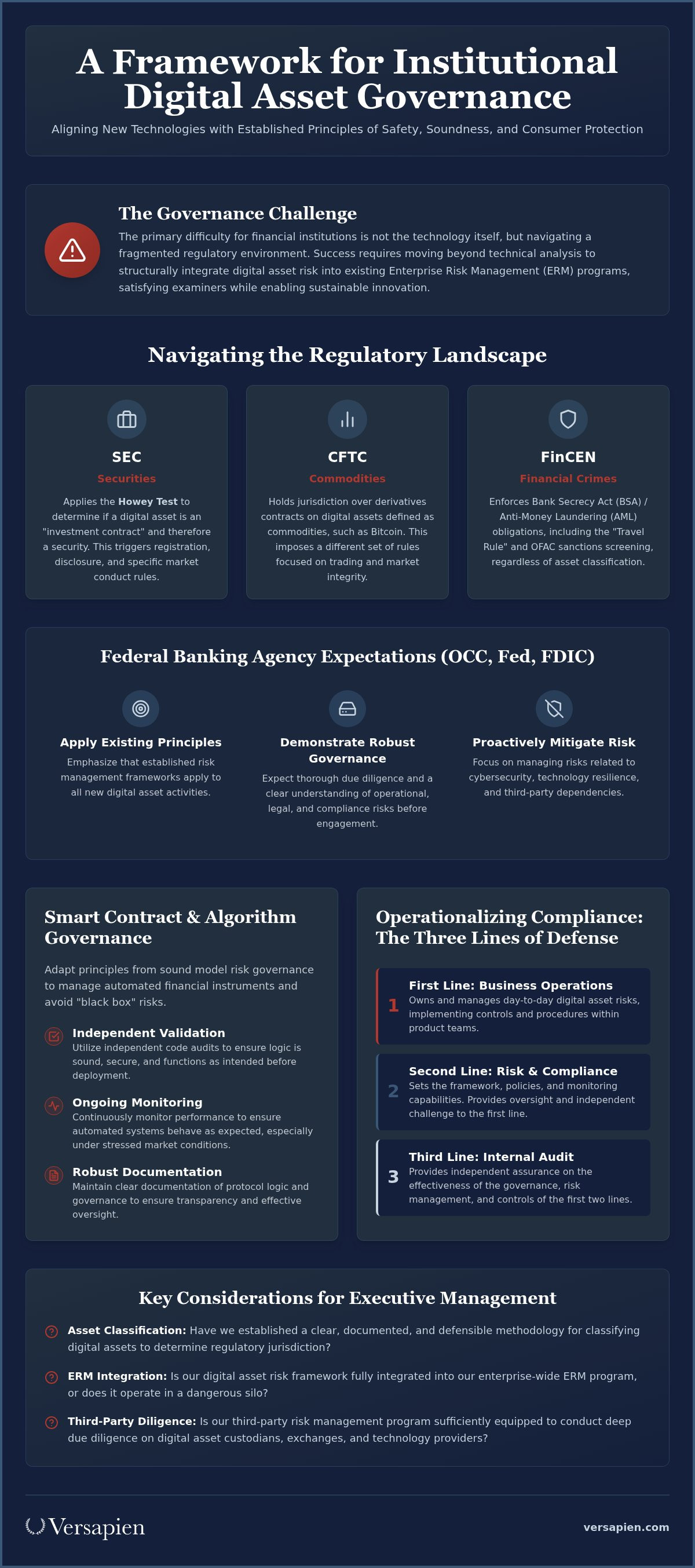
The integration of digital assets into the U.S. financial system presents a distinct governance challenge for institutional leadership. As products move from decentralized experimentation to regulated deployment, financial institutions must align new technologies with established principles of safety, soundness, and consumer protection. The primary difficulty lies not in the technology itself, but in navigating the fragmented regulatory environment where the mandates of the Securities and Exchange Commission (SEC), Commodity Futures Trading Commission (CFTC), and Financial Crimes Enforcement Network (FinCEN) create complex jurisdictional overlaps.
For Chief Risk and Compliance Officers, the objective is to build a durable digital asset compliance framework that satisfies examiners and enables sustainable product innovation. This requires moving beyond technical analysis of blockchain protocols and focusing on the structural integration of digital asset risk into existing enterprise risk management (ERM) programs. Success depends on a clear understanding of asset classification, the application of model risk governance principles to new technologies, and a strategic approach to operationalizing compliance across the three lines of defense.
Table of Contents
Navigating the Institutional Digital Asset Regulatory Landscape
The regulatory treatment of a digital asset dictates nearly every subsequent compliance obligation, from securities registration to transaction reporting. Financial institutions must develop a clear, documented methodology for classifying assets, as this determination directly impacts which regulatory bodies have primary jurisdiction. This landscape is further complicated by guidance from federal banking agencies, whose expectations are increasingly shaping the supervisory approach to digital asset custody, stablecoin issuance, and distributed ledger technology (DLT) activities.
Key Regulatory Bodies and Their Mandates
The central question for any digital asset strategy is whether an asset constitutes a security, a commodity, or another classification. The SEC generally applies the Howey Test to determine if an asset is an investment contract and therefore a security, focusing on the investment of money in a common enterprise with a reasonable expectation of profits derived from the efforts of others. In contrast, the CFTC holds jurisdiction over derivatives contracts on digital assets it defines as commodities, such as Bitcoin. This distinction is critical, as it triggers fundamentally different registration, disclosure, and market conduct rules.
Regardless of an asset's classification, Bank Secrecy Act (BSA) and Anti-Money Laundering (AML) obligations apply. FinCEN requires financial institutions to implement risk-based AML programs that address the specific risks of virtual currencies. This includes the practical challenges of complying with the "Travel Rule," which mandates the collection and transmission of originator and beneficiary information for transactions above a certain threshold. In a wallet-based, decentralized environment, gathering this information presents significant operational hurdles. Furthermore, OFAC sanctions screening must be adapted to account for blockchain addresses and privacy-enhancing technologies, requiring specialized tools and processes to prevent sanctions evasion.
The Impact of Federal Banking Agency Guidance
Federal banking agencies, including the Office of the Comptroller of the Currency (OCC), the Federal Reserve, and the FDIC, have emphasized that existing risk management principles apply to all new activities, including those involving digital assets. Rather than issuing prescriptive rules, their guidance focuses on the need for robust, risk-based governance. Institutions must conduct thorough due diligence and demonstrate a clear understanding of the operational, legal, and compliance risks associated with any proposed digital asset activity before engagement.
Federal banking agencies expect institutions to evaluate new or emerging activities within their existing safety and soundness, risk management, and governance frameworks. This involves assessing the current regulatory framework applicable to the specific product or service and identifying relevant risks before implementation. Depending on the activity, these risks may include cybersecurity, technology resilience, financial crime, consumer protection, operational, legal, and third-party risks.
Integrating Digital Assets into Enterprise Risk Management Frameworks
Treating digital asset compliance as a siloed technical function is a common organizational mistake. To be effective, digital asset risk must be fully integrated into the institution’s existing ERM structure. This ensures that risks are identified, measured, monitored, and reported using a consistent methodology that the board and senior management already understand. It involves adapting established frameworks, such as model risk management and third-party risk management, to the unique characteristics of smart contracts and decentralized protocols.
Model Risk and Smart Contract Governance
While smart contracts and algorithmic protocols may not always meet the formal definition of a “model” under applicable regulatory guidance, the principles of sound model risk management can provide a useful framework for governing automated financial systems.
In April 2026, the Federal Reserve, OCC, and FDIC issued revised interagency guidance on model risk management (SR 26-2). The guidance adopts a risk-based approach and defines a model as a complex quantitative method, system, or approach that applies statistical, economic, or financial theories to process input data into quantitative estimates. Deterministic rule-based processes and software that lack such underlying theories may fall outside that definition.
For smart contracts and other automated protocols, governance should be tailored to the specific use case and risk profile of the technology. Depending on the activity and its potential impact, appropriate controls may include independent code audits, testing, documentation, change management, performance monitoring, and effective challenge before and after deployment. The objective is to establish sufficient governance to provide confidence that the automated system performs as intended and that material risks are identified and appropriately managed, including under stressed or unusual conditions.
Third-Party and Vendor Risk Management
Many institutions will rely on third-party custodians, exchanges, and technology providers to support their digital asset offerings. The due diligence and ongoing oversight for these relationships must be managed through a robust third-party risk management (TPRM) program. The rigor of this oversight should follow a risk-based approach, with the level of scrutiny depending on the vendor’s criticality to the institution and the materiality, complexity, and potential impact of the services provided.
While a SOC 2 report may be a useful component of initial due diligence, relying on it exclusively is insufficient. A SOC 2 audit provides a point-in-time assurance over a predefined set of controls but is not a substitute for a comprehensive, risk-based assessment of the specific vendor relationship. Depending on the nature, criticality, and risk profile of the relationship, institutions should evaluate relevant aspects of the provider's governance, financial condition, cybersecurity controls, operational resilience, and business continuity capabilities. Establishing clear key performance indicators (KPIs) and service-level agreements (SLAs) for digital asset service providers is essential for effective ongoing monitoring and performance management. For a deeper look at this topic, explore our guide to third-party risk management for AI and fintech vendors.
Operationalizing Digital Asset Compliance: A Strategic Roadmap
Building a regulator-ready digital asset compliance program requires a methodical, phased approach. An effective roadmap moves an institution from an initial assessment of its current capabilities to the implementation of a sustainable, auditable framework. This process ensures that policies, procedures, technology, and talent are aligned to manage digital asset risks effectively.
Phase 1: Diagnostic and Risk Assessment. The first step is to conduct a comprehensive gap analysis of the existing compliance management system (CMS) against the requirements of digital asset activities. This involves identifying how products and services intersect with AML, sanctions, securities, and commodities regulations to define the scope of the compliance program.
Phase 2: Framework Design. Based on the risk assessment, the institution must develop a suite of policies and procedures tailored to digital assets. This includes drafting specific policies for institutional custody and private key management, establishing transaction monitoring rules for blockchain-based typologies, and defining the governance structure for financial crime oversight.
Phase 3: Implementation and Training. This phase focuses on operationalizing the designed framework. It involves integrating crypto-native transaction monitoring tools with existing BSA/AML infrastructure and, critically, upskilling compliance and risk teams to recognize digital asset-specific red flags and money laundering typologies.
Phase 4: Ongoing Oversight and Audit. A compliance program is not static. The final phase establishes a continuous loop of regulatory change management and independent testing. Internal audit plays a key role in validating the effectiveness of the controls and ensuring the program adapts to new regulatory guidance and emerging threats.
Developing a Regulator-Ready Policy Suite
A core component of any digital asset compliance program is a set of clear, enforceable policies. For custody, this means documenting detailed procedures for private key generation, storage, and usage within a multi-signature or MPC (multi-party computation) environment to mitigate the risk of theft or loss. Transaction monitoring policies must be updated to incorporate blockchain analytics tools, allowing compliance teams to trace the source and destination of funds and identify exposure to high-risk entities like sanctioned wallets or darknet markets. The objective is to create an auditable trail demonstrating that the institution is applying a risk-based approach consistent with BSA/AML requirements.
The Role of AI in Digital Asset Monitoring
The vast and complex nature of public blockchain data can make AI-driven analytics particularly valuable for digital asset compliance. AI and machine learning tools can help analyze large volumes of transactional and blockchain data to identify complex patterns, such as chain-hopping or the use of mixers and tumblers, that may be difficult to detect through manual or purely rule-based approaches. As discussed in our analysis of how AI is transforming BSA/AML compliance, these technologies can significantly enhance the effectiveness of a monitoring program. However, their implementation requires strong governance, including a human-in-the-loop oversight process to review, investigate, and disposition AI-generated alerts, ensuring accountability and sound decision-making.
Governance as a Catalyst: Moving Beyond Reactive Compliance
For leading institutions, compliance is not merely a cost center or a defensive necessity; it is a strategic enabler of innovation. A robust governance framework provides the stability and regulatory clarity required to develop and launch new digital asset products with confidence. This transforms the compliance function from a reactive gatekeeper into a proactive partner in the institution's growth strategy. This approach requires clear communication of risk at the board level and a commitment from senior leadership to embed governance into the product development lifecycle.
Board Reporting and Executive Oversight
Effective board oversight depends on transparent and actionable reporting. Management must develop frameworks for communicating emerging technology risks in the context of the institution's overall strategic objectives and stability. This means translating technical risks—such as smart contract vulnerabilities or protocol forks—into business impacts that the board can understand and act upon. A critical function of this reporting is to demonstrate how the institution’s digital asset strategy aligns with its board-approved risk appetite statement, ensuring that innovation does not come at the expense of safety and soundness.
Executive Takeaways
As financial institutions develop their digital asset strategies, senior management and boards should consider the following questions:
Does our organization have a documented, defensible methodology for classifying digital assets to determine regulatory jurisdiction (e.g., SEC vs. CFTC)?
How have we integrated digital asset risk into our existing Enterprise Risk Management (ERM) framework, rather than treating it as a separate, technical silo?
Is our third-party risk management program equipped to conduct deep due diligence on digital asset custodians and technology providers beyond a standard SOC 2 report?
What steps have we taken to adapt the principles of model risk governance (e.g., independent validation, ongoing monitoring) to our use of smart contracts and other automated protocols?
How does our board-level reporting translate the technical risks of digital assets into clear business impacts aligned with our institution's overall risk appetite?
How Versapien Can Help
Versapien helps financial institutions build and implement the governance frameworks necessary to manage digital asset risk effectively. As a senior-led boutique advisory firm with deep experience across regulatory compliance and enterprise risk, we provide practical, implementation-focused solutions designed to withstand regulatory scrutiny from the OCC, Federal Reserve, and other key agencies. Our approach is founded on the principle that proactive governance is the foundation for sustainable innovation, enabling our clients to adopt new technologies while maintaining institutional resilience.


Comments