
Modernizing Consumer Lending Compliance Without Increasing Regulatory Risk
Updated: Sep 22
Consumer lenders face persistent pressure to modernize. The strategic objectives are clear: replace aging legacy systems, automate manual processes, and leverage data to enhance decision-making and improve the customer experience. Yet, transformation initiatives designed to reduce long-term risk often introduce significant, unforeseen compliance failures during implementation. The transition period between the old and the new is when carefully constructed controls are most likely to break down.
Many modernization projects fail not because the intended future state is flawed, but because the process of getting there is poorly governed. A new loan origination system (LOS) can introduce fair lending risk through a faulty algorithm. A data migration can corrupt information critical for accurate disclosures. An automated workflow can systemically violate servicing requirements if its logic is unsound. The central challenge is not whether to innovate, but how to manage the inherent risks of operational and technological change.
Successfully navigating this landscape requires a disciplined framework that embeds compliance and control considerations into every stage of the modernization lifecycle. Modernization should be treated as a significant source of regulatory and operational risk. Managing that risk requires a structured approach that identifies compliance requirements, preserves critical controls, validates changes, and monitors outcomes after implementation. This requires a structured methodology for identifying, measuring, and mitigating the compliance risks that arise from change itself.
Table of Contents
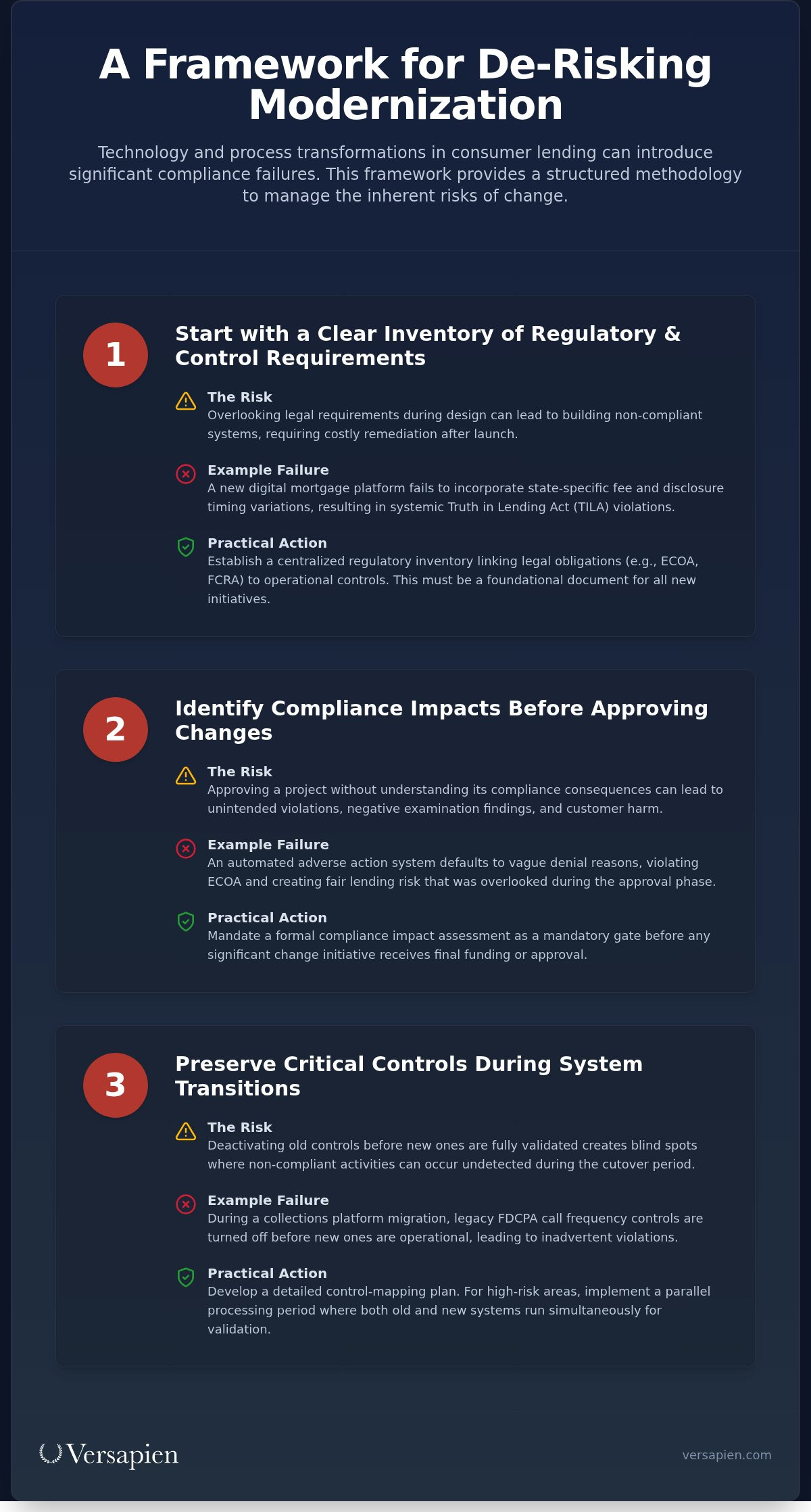
A Framework for De-Risking Modernization in Consumer Lending
A proactive approach to managing modernization risk moves compliance from a downstream validation function to an integral part of project design and execution. The following principles provide a structured framework for consumer lenders to guide technology, data, and process transformations without increasing regulatory exposure.
1. Start with a Clear Inventory of Regulatory and Control Requirements
Modernization often begins with a focus on business requirements and technical specifications, while regulatory obligations are addressed later in the process. This sequence creates significant risk, as systems and workflows may be designed without a complete understanding of the compliance guardrails.
The Risk: Overlooking critical legal or regulatory requirements during the design phase can lead to building non-compliant systems from the ground up, requiring costly and time-consuming remediation after launch.
What Can Go Wrong: A project team designs a new digital mortgage application platform, focusing on user experience. They fail to incorporate a comprehensive map of state-specific fee and disclosure timing variations, resulting in systemic Truth in Lending Act (TILA) violations for a segment of the portfolio upon launch.
Questions for Management: Do we maintain a comprehensive, up-to-date library of all applicable federal and state consumer lending laws? How are these legal requirements mapped to our existing controls, processes, and system functionalities? Is this inventory a mandatory input for all new product or system development?
Practical Actions: Establish and maintain a centralized regulatory inventory that links specific legal obligations (e.g., Equal Credit Opportunity Act, Fair Credit Reporting Act) to the operational controls designed to ensure compliance. This inventory should serve as a foundational document for writing business requirements for any modernization initiative.
2. Identify Compliance Impacts Before Approving Major Changes
Many organizations approve significant technology and operational changes based primarily on projections of efficiency gains or cost savings. Without a formal process for evaluating compliance impacts, project sponsors may be blind to the potential for negative regulatory or consumer-protection outcomes.
The Risk: "Greenlighting" a project without a full understanding of its downstream compliance consequences can lead to unintended violations, negative examination findings, and customer harm.
What Can Go Wrong: A proposal to automate the generation of adverse action notices is approved to reduce manual effort. The initial impact assessment overlooks the complexity of providing accurate and specific reasons for credit denial as required by ECOA, and the new system defaults to using vague, generic language that exposes the institution to fair lending risk.
Questions for Management: Is a formal compliance risk assessment a mandatory gate in our project approval process? Does the compliance function have the authority to challenge or place conditions on a project based on its findings? Who is ultimately accountable for signing off on this assessment?
Practical Actions: Mandate that a formal compliance impact assessment is completed before any significant change initiative receives final funding or approval. This process should be owned or independently reviewed by the compliance department and should result in a clear articulation of potential risks and required mitigating controls.
3. Preserve Critical Controls During System and Process Transitions
The moment of transition—when a legacy system is decommissioned and a new one is activated—is one of the most vulnerable points in any modernization project. If not managed with precision, this cutover period can create temporary or even permanent gaps in the control environment.
The Risk: Deactivating old controls before new ones are fully validated and proven effective can create blind spots where non-compliant activities can occur undetected.
What Can Go Wrong: During the migration to a new collections platform, the legacy system's controls for monitoring compliance with call frequency limitations under the Fair Debt Collection Practices Act (FDCPA) are turned off. The new system's controls are not yet fully operational, leading to a period of several days where agents can inadvertently violate calling restrictions.
Questions for Management: What is our plan to ensure the continuity of critical controls during the transition? Have we identified which controls require a period of parallel operation? What are our manual workaround procedures if a new automated control fails at launch?
Practical Actions: Develop a detailed control-mapping plan that explicitly documents how each existing control will be replicated or replaced in the new environment. For high-risk areas, implement a parallel processing period where both old and new systems run simultaneously to allow for reconciliation and validation. Define clear, evidence-based exit criteria before decommissioning legacy controls.
4. Validate Data Before, During, and After Migration
The success of any new system is contingent on the quality of the data it uses. Data migration is a high-risk activity where information can be corrupted, lost, or incorrectly mapped, leading to flawed calculations, inaccurate reporting, and poor customer outcomes.
The Risk: Flawed data conversion can undermine the integrity of core processes, from credit decisioning to loan servicing and regulatory reporting.
What Can Go Wrong: When migrating customer data to a new loan servicing platform, a field containing information about active-duty military status is incorrectly mapped. As a result, the new system fails to apply interest rate protections required by the Servicemembers Civil Relief Act (SCRA), leading to overcharges for protected borrowers.
Questions for Management: What is our data governance framework for this project? Who is responsible for defining data quality standards and validating the accuracy of the migration? How will we reconcile data between the source and target systems to prove the conversion was successful?
Practical Actions: Conduct pre-migration data cleansing to resolve known issues in the source system. Use detailed data-mapping documents that are formally reviewed and approved by business, technology, and compliance stakeholders. Perform multiple reconciliation cycles, including record counts, field-level validation of critical data elements, and financial balance tie-outs.
5. Test Automated Decisioning, Calculations, and Disclosures
As lenders increasingly rely on automated systems for underwriting, pricing, and generating disclosures, the risk of a single flaw in system logic creating systemic compliance failures grows exponentially. Insufficient testing is a leading cause of post-implementation issues.
The Risk: Undetected flaws in new system logic, rules engines, or AI models can cause widespread, systemic errors in credit decisions, pricing, fee calculations, or customer disclosures, triggering significant fair lending or UDAAP (Unfair, Deceptive, or Abusive Acts or Practices) risk.
What Can Go Wrong: A lender implements a new automated underwriting system (AUS) that uses advanced analytics. The model was not adequately tested for disparate impact, and it inadvertently penalizes applicants from certain geographies or demographic groups, creating a significant fair lending violation that goes undetected for months.
Questions for Management: Is our testing plan sufficiently comprehensive to cover all critical calculations, decision points, and disclosure outputs? How are we specifically testing for potential bias or discriminatory outcomes in our algorithms? Does the compliance team have a formal role in reviewing test plans and certifying results?
Practical Actions: Develop a robust testing strategy that includes unit, system, integration, and user acceptance testing. Create detailed test scripts that cover positive, negative, and edge-case scenarios for all critical functions. For AI or machine-learning systems, testing should be supported by governance and validation practices appropriate to the model's use, complexity, and potential impact. This testing must be supported by a strong model risk management framework that includes validation of conceptual soundness, ongoing monitoring, and fairness testing.
6. Strengthen Change Governance and Accountability
Modernization projects are complex, cross-functional efforts. Without a strong governance structure and clear lines of accountability, it is easy for critical tasks to fall through the cracks, especially those at the intersection of technology, operations, and compliance.
The Risk: A lack of clear ownership and defined roles can lead to diffused responsibility, making it unclear who is ultimately accountable for ensuring a project delivers a compliant outcome.
What Can Go Wrong: A project to update the institution’s fee schedule in the core servicing system fails. The technology team implements the changes, the operations team provides the data, and the compliance team offers guidance, but no single executive is held accountable for the end-to-end validation. The result is incorrect fee disclosures being sent to thousands of customers.
Questions for Management: Who is the single, accountable executive for the compliance outcomes of this project? How does our project governance structure ensure that all key stakeholders, including compliance and legal, are consistently engaged?
Practical Actions: Establish a formal steering committee for major initiatives with senior representation from all impacted functions. Use a RACI (Responsible, Accountable, Consulted, Informed) matrix to clarify roles and responsibilities for key deliverables. Integrate specific compliance-related milestones and approvals into the official project plan. This approach is a core element of modernizing a compliance management system to handle the pace of change.
7. Apply Effective Oversight to Third-Party Technology Providers
Lenders increasingly rely on fintech vendors and other third parties for core technology and specialized services. Engaging a third party does not eliminate the financial institution's responsibility for appropriately overseeing activities performed on its behalf and managing the associated compliance risks.
The Risk: Assuming a technology vendor is managing compliance can lead to significant gaps, as the lender is ultimately responsible for ensuring all third-party activities adhere to regulatory requirements.
What Can Go Wrong: A regional bank partners with a fintech firm to launch a new online lending product. The bank’s due diligence process focuses on the vendor's cybersecurity controls but fails to adequately vet its compliance with state-by-state lending and licensing laws. The bank is later cited by regulators for violations originating from the vendor's platform.
Questions for Management: How deeply have we reviewed our key technology vendors' internal control environments and compliance management systems? What are our contractual rights to audit, test, and monitor the vendor's performance against our specific compliance requirements?
Practical Actions: Implement a rigorous third-party risk management program that goes beyond standard due diligence. Define explicit compliance-related service-level agreements (SLAs) in vendor contracts. Establish a regular cadence of monitoring that includes reviewing performance reports, conducting periodic assessments, and tracking any issues through to resolution.
8. Monitor Outcomes and Emerging Issues After Implementation
A project is not complete at "go-live." The period immediately following implementation is critical for identifying unintended consequences, performance degradation, or emerging compliance issues that were not caught during testing.
The Risk: A "set it and forget it" mindset can allow unforeseen problems to escalate into major compliance or operational failures.
What Can Go Wrong: A financial institution launches a new automated workflow for handling credit reporting disputes. Initial reports show improved processing times, and the project is declared a success. However, weak post-implementation monitoring fails to detect a gradual increase in consumer complaints related to the accuracy of dispute resolutions, signaling a potential Fair Credit Reporting Act (FCRA) and UDAAP issue.
Questions for Management: What key performance indicators (KPIs) and key risk indicators (KRIs) will we use to monitor the health of the new system or process? Who is responsible for this ongoing monitoring, and what is the defined escalation path for identified issues?
Practical Actions: Formally define a post-implementation validation period (e.g., 30-90 days) where performance is tracked against a heightened set of metrics. Closely monitor data on operational error rates, system downtime, transaction volumes, and customer complaint trends related to the new process. Conduct a formal project post-mortem to capture lessons learned for future initiatives.
Executive Takeaways: Integrating Compliance into the Modernization Lifecycle
Modernization does not automatically reduce compliance risk. Changes to systems, processes, data, products, and third-party relationships can create new control failures even when the intended outcome is greater efficiency or accuracy.
Effective modernization requires compliance considerations to be incorporated into project design, governance, testing, implementation, and post-launch monitoring. The goal is not to slow change, but to ensure that critical requirements and controls remain effective throughout the transition.
For executive leadership, the priority is straightforward: treat significant transformation as a source of risk, establish clear accountability, validate critical changes before and after implementation, and use the results to identify and correct emerging issues quickly.
For executive leadership, the key actions are to:
Frame modernization as a source of risk. Every major technology or process change should be managed with the same rigor as any other significant operational risk.
Embed compliance expertise at the start. Ensure compliance stakeholders are involved in the earliest stages of project conception and design, not just as a final review before launch.
Demand rigorous governance and testing. Insist on clear accountability, comprehensive testing protocols, and evidence-based validation that new systems and processes are performing as intended.
Foster a culture of controlled change. The goal is not to slow innovation but to ensure it proceeds in a manner that is safe, sound, and protects both the institution and its customers.


Comments