
Preparing for an OCC or FDIC Examination: A Readiness Checklist
Updated: Sep 22
When an OCC or FDIC examination is announced, the first challenge for management is determining whether the institution can efficiently demonstrate that its governance, risk management, controls, and supporting documentation are operating as intended. Examination readiness should not begin when the examination is announced. Institutions that maintain effective governance, documentation, issue management, and internal oversight are generally better positioned to respond efficiently when examiners arrive.
This state of readiness is the natural byproduct of a mature, integrated risk management system. It is an operating environment in which the institution can routinely produce evidence of control effectiveness without relying on a reactive, resource-intensive effort. Achieving this state requires a disciplined approach to self-assessment and a commitment to addressing foundational weaknesses before they become supervisory concerns.
Table of Contents
The Role of a Compliance Gap Analysis
A compliance gap analysis serves as a critical diagnostic tool for assessing an institution’s readiness. Its purpose is to identify and measure the delta between the organization's current state and the benchmarks set by regulatory requirements and supervisory expectations. A well-executed analysis moves beyond a simple policy review to test the operational effectiveness of the controls designed to ensure compliance.
The analysis can incorporate risk information, testing results, audit findings, complaints, incidents, and other relevant evidence to identify systemic risks that may not be apparent through routine monitoring. Depending on the institution's charter, size, complexity, and risk profile, the scope of this analysis can vary significantly, but its core function remains the same: to provide an objective view of the control environment.
The Diagnostic Phase: Scoping and Data Collection
The initial phase involves carefully defining the scope of the review. This requires mapping internal controls to specific regulatory requirements, such as those related to the Bank Secrecy Act/Anti-Money Laundering (BSA/AML), fair lending, or consumer protection (UDAAP). A primary objective is to identify potential blind spots, particularly in areas of high risk like third-party vendor management, new product implementation, or the governance of automated decision-making systems. Data collection must be thorough, assembling policies, procedures, risk assessments, committee minutes, audit reports, and testing results to form a comprehensive picture of the compliance posture.
Reporting and Prioritization of Findings
Once data is collected and analyzed, the findings must be translated into a clear, risk-based roadmap for remediation. This involves more than simply listing deficiencies. The reporting should prioritize gaps based on their potential impact on the institution and its customers, distinguishing between isolated exceptions and systemic control failures. For the Board of Directors and executive management, technical findings must be distilled into concise, executive-level reports that articulate the associated business and regulatory risks, enabling informed decision-making and resource allocation.
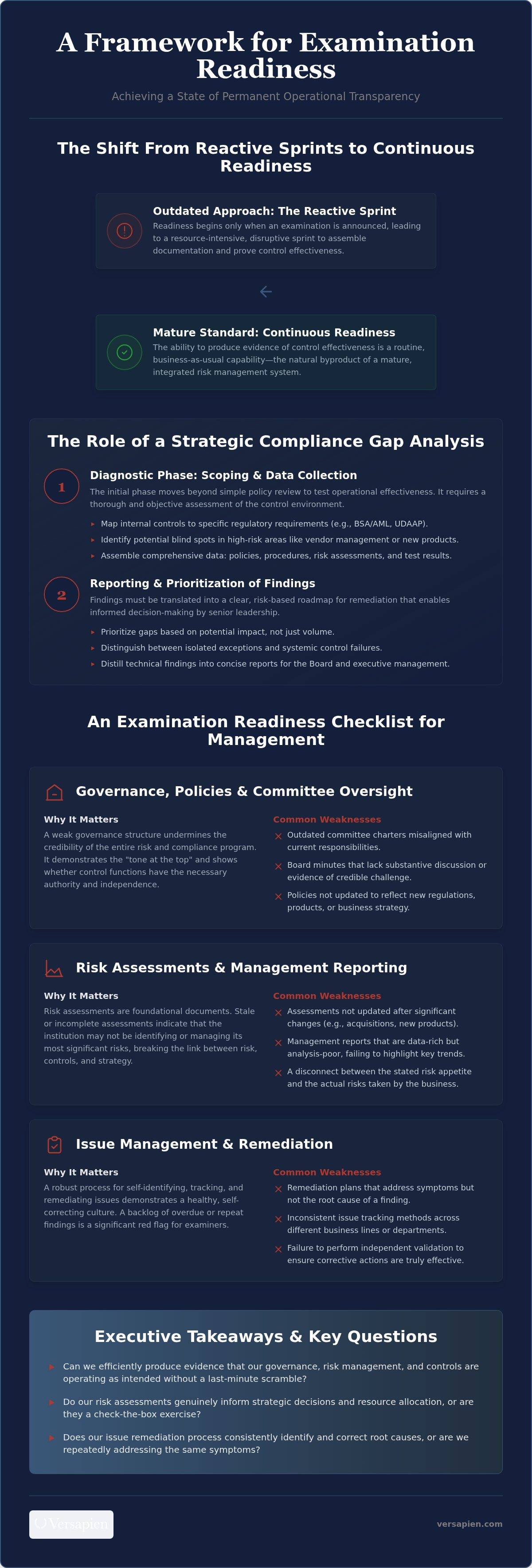
An Examination Readiness Checklist for Management
A formal examination readiness checklist provides a structured framework for assessing preparedness across the organization. It establishes clear ownership and ensures that all relevant components of the governance and control infrastructure are reviewed. Institutions should consider evaluating the following areas to identify and address potential weaknesses before an examination begins.
Governance, Policies, and Committee Oversight
This area demonstrates the "tone at the top" and the formal structures for managing risk. Examiners often begin by reviewing the governance framework to understand how strategy is set, how policies are approved, and whether the Board provides credible challenge to management.
Why it matters: A weak governance structure undermines the credibility of the entire risk and compliance program. It suggests that control functions may lack the necessary authority and independence.
Common weaknesses: Outdated committee charters that do not reflect current responsibilities; Board and committee minutes that lack substantive discussion or evidence of challenge; policies that have not been reviewed or updated to reflect changes in regulation, products, or business strategy.
Risk Assessments and Management Reporting
Risk assessments are foundational documents that demonstrate an institution's understanding of its own risk profile. They should be dynamic, updated regularly, and used to inform strategic decisions. The quality of information provided to management and the Board is a direct reflection of the institution's risk management maturity.
Why it matters: Stale or incomplete risk assessments indicate that the institution may not be identifying or managing its most significant risks. Examiners expect to see a clear link between the identified risks, the control environment, and the institution's risk appetite. For more on this, see our guidance on building a defensible financial crime risk assessment.
Common weaknesses: Risk assessments that are not updated following significant changes (e.g., new products, system conversions, or acquisitions); management reports that are data-rich but analysis-poor, failing to highlight key trends or emerging risks; a disconnect between the risk appetite statement and the actual risks being taken by the business.
Issue Management and Remediation
An institution’s ability to self-identify, track, and remediate issues is a key indicator of a healthy compliance culture. This includes findings from regulatory examinations, internal audits, compliance testing, and self-identified issues.
Why it matters: A robust issue management process demonstrates that the organization is capable of self-correction. Conversely, a backlog of overdue findings, particularly repeat issues, is a significant red flag for examiners and often leads to heightened supervisory attention. Many institutions struggle with common deficiencies, which can be reviewed in our breakdown of 10 common compliance gaps.
Common weaknesses: Remediation plans that address the symptom but not the root cause of the finding; inconsistent tracking of issues across different departments; failure to perform independent validation to ensure corrective actions are effective and sustainable.
Compliance Monitoring, Testing, and Internal Audit
The second and third lines of defense provide independent assurance that controls are designed appropriately and operating effectively. Examiners may consider the scope, quality, and independence of work performed by these functions when assessing the control environment and determining the appropriate focus of their review and may rely on the work performed by these functions.
Why it matters: A credible and independent assurance program allows for early detection and correction of control weaknesses. If examiners find the work of internal audit or compliance testing to be unreliable, they will likely expand the scope and depth of their own transaction testing, prolonging the examination.
Common weaknesses: Insufficient resources or subject-matter expertise within assurance functions; testing scopes that are too narrow or fail to cover high-risk areas; a lack of independence or authority for the Chief Audit Executive or Chief Compliance Officer.
Examination Coordination and Document Management
The logistical aspects of managing an examination are critical to its success. A disorganized response can create an impression of chaos and may lead to unnecessary delays and examiner frustration.
Why it matters: An efficient, centralized process for managing document requests and examiner inquiries ensures consistency and accuracy in the information provided. It minimizes business disruption and allows the institution to present its narrative in a clear and organized manner.
Common weaknesses: No single point of contact to coordinate the examination; delays in producing requested documents; inconsistent or contradictory information provided by different business units; failure to adequately prepare subject-matter experts for interviews with examiners; reviewing responses for accuracy, consistency, and appropriate escalation before information is provided to examiners.
Effective Remediation of Supervisory Findings
Responding to a Matter Requiring Attention (MRA) or other supervisory finding is not a simple box-checking exercise. The effectiveness of an institution's remediation efforts is a primary focus in subsequent examinations. A superficial approach increases the likelihood that the underlying weakness will persist or recur and may result in increased supervisory concern. Effective remediation requires a disciplined process focused on three practical questions.
1. Has the root cause of the issue been identified?
The most common remediation failure is addressing the symptom of a finding rather than its underlying cause. For example, if a finding cites errors in regulatory reporting, the root cause may not be employee carelessness but rather a flawed system, inadequate training, or a lack of management oversight. A thorough root cause analysis is essential to developing a corrective action plan that prevents recurrence.
2. Is the remediation plan appropriately governed, resourced, and tracked?
A successful remediation plan requires clear ownership, adequate resources, and realistic timelines. It should be formally tracked, with regular progress reports provided to senior management and the Board. This governance structure ensures accountability and provides a mechanism for escalating obstacles that may delay completion. Without this oversight, remediation efforts can stall, leading to missed deadlines and a loss of credibility with regulators.
3. Has management validated that the corrective action is sustainable?
Simply implementing a fix is not enough. Management must validate that the corrective action is operating effectively over time and is sustainable. This validation should ideally be performed by a party independent of the corrective action's implementation, such as internal audit or a compliance testing team. This step provides objective evidence that the root cause has been addressed and the control weakness has been durably corrected.
Executive Takeaways
As leadership assesses the institution’s examination readiness, the focus should remain on the sustainability and effectiveness of the existing risk management framework. The goal is to cultivate a culture where readiness is a continuous state, not a project. Management and the Board should consider the following questions:
Are significant regulatory, audit, and internally identified issues being remediated in a timely and effective manner?
Can management and business lines quickly produce reliable evidence that key controls are operating as intended?
Are the roles and responsibilities for the examination process clearly defined and understood across the organization?
Have likely subject-matter experts been identified and prepared to discuss their areas of responsibility with examiners?
Does the institution have a clear and centralized process for coordinating document requests and responding to examiner questions?
Are recurring issues being analyzed to determine if they point to a more significant, systemic weakness in governance or controls?


Comments