
Preparing for Your Next Banking Regulatory Exam: 10 Common Compliance Gaps
A banking regulatory examination is a non-negotiable test of a financial institution’s governance, risk management, and control frameworks. While many organizations invest significant resources in pre-examination preparations, success is often determined long before examiners arrive. The most effective approach to regulatory exam readiness is not a last-minute exercise in document collection but a continuous process of identifying and remediating underlying weaknesses within the compliance management system (CMS).
This analysis focuses on the specific control gaps and programmatic deficiencies that frequently lead to examination findings, Matters Requiring Attention (MRAs), or enforcement actions. It is designed to help senior leaders and control executives answer a critical question: “If examiners reviewed our program today, what weaknesses might they identify?”
For guidance on the logistical and governance aspects of managing the examination process itself, please refer to our companion article, Preparing for an OCC or FDIC Examination: A Readiness Checklist. The focus here is on the substantive gaps that must be addressed to build a defensible and regulator-ready program.
Table of Contents
10 Common Gaps in Regulatory Exam Readiness
The following ten areas represent common points of failure observed during regulatory examinations. Each gap can signal a disconnect between an institution's governance framework, documented requirements, and actual operational practices. Addressing them proactively is fundamental to demonstrating a mature and effective compliance culture.
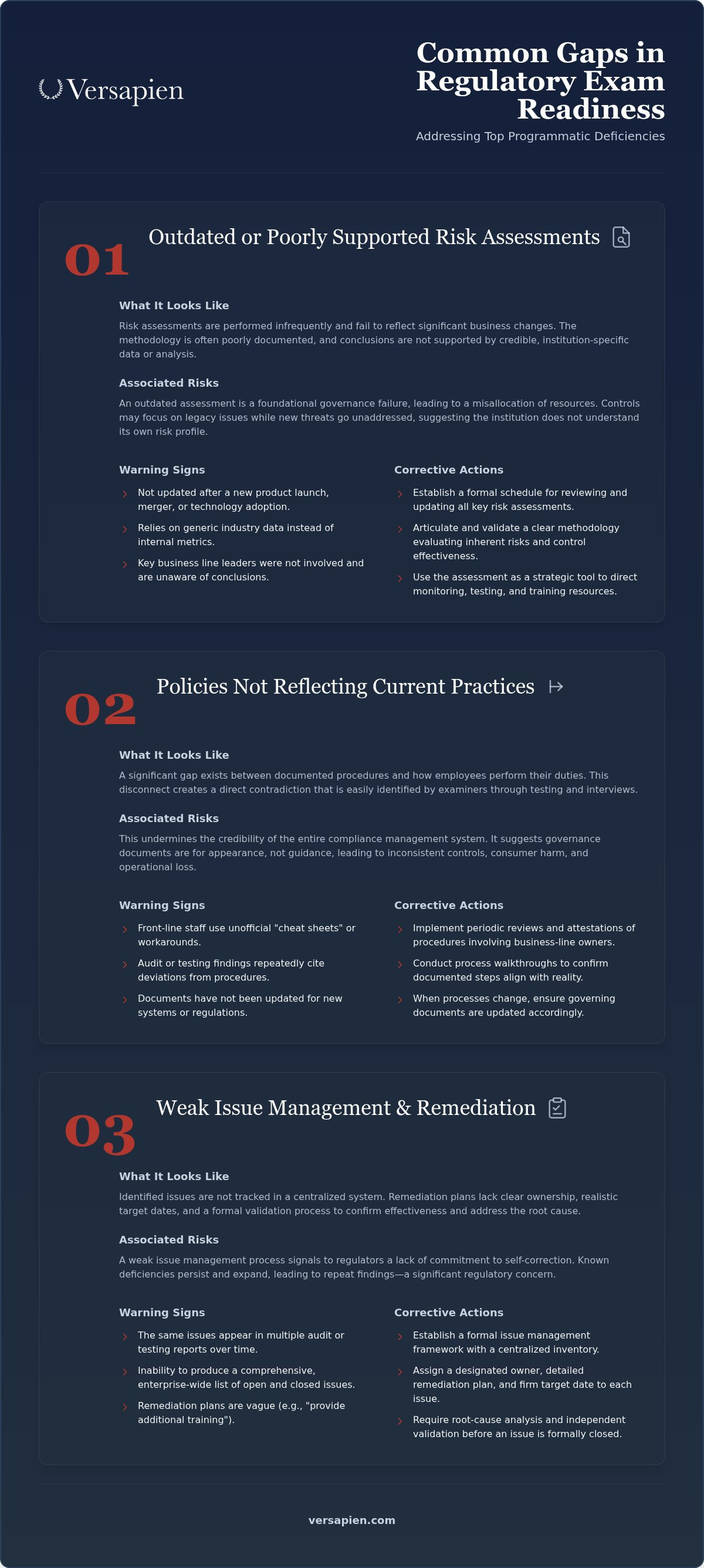
1. Outdated or Poorly Supported Risk Assessments
What It Looks Like: The institution’s risk assessments—for areas like consumer compliance, BSA/AML, or operational risk—are either not performed on a regular cadence or fail to reflect significant changes in products, services, customers, or geographic footprint. The methodology may be poorly documented, and the conclusions may not be supported by credible data or analysis.
Associated Risks: A risk assessment is the foundation of a risk-based compliance program. An outdated assessment leads to a misallocation of resources, with controls potentially focused on legacy risks while new and emerging threats go unaddressed. Examiners view this as a fundamental failure in governance, as it suggests the institution does not adequately understand its own risk profile.
Warning Signs:
The assessment has not been updated following a new product launch, a merger or acquisition, or the adoption of new technology.
The document relies on generic industry data without incorporating the institution’s specific transaction volumes, customer demographics, or complaint data.
Key business line leaders were not involved in the assessment process and are unaware of its conclusions.
Corrective Actions: Establish a formal, documented schedule for reviewing and updating all key risk assessments (e.g., annually or upon a triggering event). The methodology should be clearly articulated and validated, ensuring that both inherent risks and the effectiveness of corresponding controls are evaluated. The final output must be more than a document; it should be a strategic tool used to direct monitoring, testing, and training resources. For more on this, see our guide on building a defensible financial crime risk assessment framework.
2. Policies and Procedures That Do Not Reflect Current Practices
What It Looks Like: A significant gap exists between what is documented in official policies and procedures and how employees actually perform their duties. For example, a policy may require dual sign-off for a specific transaction, but in practice, the process has been automated or is consistently bypassed. This creates a direct contradiction that examiners can easily identify through transaction testing and staff interviews.
Associated Risks: This disconnect undermines the credibility of the entire CMS. It suggests that governance documents are created for appearance rather than for practical guidance. This can lead to inconsistent application of controls, create consumer harm, and expose the institution to operational losses. Regulators may conclude that management lacks visibility into its own operations.
Warning Signs:
Front-line staff use unofficial “cheat sheets” or workarounds instead of relying on official procedure manuals.
Internal audit or compliance testing findings repeatedly cite deviations from documented procedures.
Procedures have not been updated to reflect new systems, regulations, or organizational structures.
Corrective Actions: Implement a process for periodically reviewing and attesting to the accuracy of policies and procedures, involving the business-line owners who are responsible for execution. Conduct process walkthroughs and interviews to confirm that documented steps align with reality. When a deviation is necessary, a formal exception process should be documented and approved; when a process has permanently changed, the governing documents must be updated accordingly.
3. Weak Issue Management and Remediation Governance
What It Looks Like: Issues identified by internal audit, compliance testing, or self-assessments are not formally tracked in a centralized system. Remediation plans lack clear ownership, realistic target dates, and defined deliverables. There is no formal process for validating that a corrective action was effectively implemented and has addressed the root cause of the deficiency.
Associated Risks: A weak issue management process signals to regulators that the institution is not serious about self-correction. It increases the likelihood that known deficiencies will persist and expand, potentially leading to repeat examination findings, which are viewed with significant concern. Failure to address root causes means the institution is likely to face the same problems again in the future.
Warning Signs:
The same issues appear in multiple audit or testing reports over time.
It is difficult to produce a comprehensive, enterprise-wide list of open and closed compliance issues.
Remediation plans are vaguely worded, such as “provide additional training,” without specifying the content, audience, and success metrics.
Corrective Actions: Establish a formal issue management framework with a centralized inventory of all identified issues. Each issue must have a designated owner, a detailed remediation plan, and a firm target date. Implement a mandatory root-cause analysis for all significant findings. Finally, require an independent validation (typically by internal audit or a control group) to confirm that the corrective action is complete and effective before an issue is formally closed.
4. Inadequate Management Information and Reporting
What It Looks Like: Reports provided to senior management and the Board are either too voluminous to be useful or lack the key metrics needed to assess compliance program health. For example, a report might show the number of completed training modules but not the results of post-training knowledge assessments. The data is often stale, manually aggregated, and lacks trend analysis or actionable insights.
Associated Risks: If leadership does not receive clear, concise, and risk-focused information, it cannot provide effective oversight and credible challenge. Examiners may interpret poor reporting as evidence that the Board and senior management are not sufficiently engaged in their oversight responsibilities. It also hampers the organization’s ability to identify and respond to emerging risk trends proactively.
Warning Signs:
Board packages are hundreds of pages long, filled with raw data rather than synthesized analysis.
Metrics focus on activity (e.g., number of alerts reviewed) rather than outcomes (e.g., SAR filing quality or false positive rates).
Management is unable to answer basic questions about risk trends without requesting a special report that takes weeks to produce.
Corrective Actions: Redesign management and Board reporting to focus on key risk indicators (KRIs) and key performance indicators (KPIs) that are directly tied to the institution’s risk appetite. Reports should include trend analysis, peer comparisons where available, and a clear narrative that explains what the data means. The goal is to facilitate strategic discussion and decision-making, not simply to present data.
5. Insufficient Board and Senior Management Oversight
What It Looks Like: Board and committee meeting minutes lack substantive discussion or challenge on key compliance and risk topics. Management may present reports, but there is little evidence of follow-up questions, debate, or direction from the Board. Senior management outside of risk and compliance functions demonstrates a limited understanding of their role in managing risk.
Associated Risks: Regulators hold the Board of Directors ultimately responsible for the safety and soundness of the institution and its compliance with laws and regulations. Insufficient oversight is a serious governance failure that can lead to formal or informal enforcement actions directed at the Board itself. It fosters a culture where compliance is seen as the job of the compliance department alone, rather than an enterprise-wide responsibility.
Warning Signs:
Meeting minutes are superficial, simply stating that “a report was presented.”
The Chief Compliance or Risk Officer is not given sufficient time or standing on meeting agendas.
Board members do not receive targeted training on new or emerging risk areas relevant to the institution’s strategy.
Corrective Actions: Ensure meeting minutes accurately reflect the substance of discussions, including questions asked, challenges made, and decisions reached. The Board should periodically review its own structure and composition to ensure it has the requisite expertise to oversee key risks. Implement formal training sessions for the Board and senior management on critical topics, and foster a culture where robust debate and credible challenge are expected.
6. Gaps in Monitoring, Testing, and Quality Assurance
What It Looks Like: The institution’s second-line-of-defense compliance testing is ad-hoc, has a limited scope, or uses sample sizes or testing methodologies that are not appropriate for the nature, scope, and risk of the activity being reviewed. In other cases, first-line-of-defense quality assurance (QA) programs are either non-existent or lack independence from the operational staff they are reviewing.
Associated Risks: Without robust monitoring and testing, management has no objective evidence that its controls are working as intended. This is a critical feedback loop for the CMS. Examiners expect to see a structured testing program that provides reasonable assurance of compliance. A lack of testing means that control weaknesses may go undetected until they result in a compliance failure or are discovered during an external audit or examination.
Warning Signs:
The annual compliance testing plan is not risk-based and does not focus on the areas of highest regulatory risk.
Testing reports only identify minor issues or are consistently “clean,” which may suggest the review is not sufficiently rigorous.
There is no clear distinction between the ongoing QA performed by the business and the independent testing performed by compliance.
Corrective Actions: Develop a risk-based annual testing plan that covers key regulatory requirements, with the scope and frequency of testing determined by the institution’s risk assessment. Ensure the testing function is independent and has qualified staff. For the first line of defense, establish formal QA programs to provide real-time feedback on process adherence and quality, which can help identify and fix issues before they become widespread.
7. Weak Third-Party Risk Management
What It Looks Like: Due diligence on new vendors is a check-the-box exercise, with little consideration for the specific risks posed by the outsourced activity. Contracts lack clear clauses regarding compliance, data security, and audit rights. Ongoing monitoring is limited to reviewing a vendor’s annual SOC report without any performance-based oversight.
Associated Risks: Regulators have consistently emphasized that an institution cannot outsource its responsibility for compliance. Weaknesses in a third party’s control environment are treated as weaknesses of the institution itself. This is particularly acute for critical vendors handling sensitive customer data or performing compliance-related functions, creating significant regulatory, reputational, and operational risk.
Warning Signs:
The inventory of third-party relationships is incomplete or inaccurate, especially for vendors engaged by individual business units.
Risk assessments for vendors are not tiered, treating a low-risk office supply provider with the same level of scrutiny as a core processing platform.
There are no defined service-level agreements (SLAs) for performance, and no process for monitoring against them.
Corrective Actions: Implement a robust, lifecycle-based third-party risk management program. This includes rigorous initial due diligence, risk-tiered contracting standards, and ongoing monitoring that is proportionate to the level of risk. The program must be governed by a clear policy and supported by sufficient resources. For specialized vendors, such as those providing AI models, the diligence process must be enhanced to address unique risks, a topic explored further in our article on third-party risk management for AI and fintech vendors.
8. Poor Documentation of Decisions, Exceptions, and Control Activities
What It Looks Like: Key decisions, such as the approval of a high-risk customer or an exception to policy, are not formally documented. Control activities, like the review of a daily monitoring report, are performed but there is no auditable evidence (e.g., a sign-off, a system log) to prove it. When examiners ask “how do you know?” or “show me the evidence,” the institution can only provide verbal assurances.
Associated Risks: From an examiner’s perspective, an undocumented action or decision effectively did not happen. A lack of documentation makes it impossible to test the effectiveness of controls or to hold individuals accountable. This can lead to a finding of a control weakness even if the control is, in fact, being performed.
Warning Signs:
Key approvals are communicated via informal channels like instant messages or hallway conversations.
Control performance is dependent on the memory of a single individual.
During internal audits, staff struggle to provide evidence to support their assertions about how processes are managed.
Corrective Actions: Instill a discipline of documentation throughout the organization. For significant decisions, require a formal write-up of the rationale and approval. For recurring control activities, ensure that performance is evidenced through a system-generated log, a checklist, or a formal sign-off. The standard should be that a knowledgeable third party, such as an auditor or examiner, can understand what was done, why it was done, and who approved it, simply by reviewing the available documentation.
9. Incomplete Remediation Validation and Failure to Address Root Causes
What It Looks Like: An institution closes a compliance issue once the immediate “fix” is implemented, but fails to conduct a deeper root-cause analysis. For example, after identifying erroneous fee calculations, the bank corrects the affected accounts but does not investigate the system coding error, flawed procedure, or lack of training that caused the problem. Consequently, the validation process only confirms the immediate fix, not the prevention of recurrence.
Associated Risks: This gap is a primary driver of repeat examination findings. By only addressing the symptom, the underlying disease is left to fester, guaranteeing the problem will re-emerge. Examiners view this as a sign of an immature compliance program that is reactive rather than proactive and lacks a commitment to sustainable, long-term risk reduction.
Warning Signs:
The root-cause analysis section of an issue-tracking form is consistently blank or filled with superficial explanations like “human error.”
Corrective action plans focus exclusively on addressing the specific instances identified (e.g., "fix the 10 loans in the sample") rather than the broader process.
The validation process consists of a simple confirmation from the business line owner that the action is "complete."
Corrective Actions: Integrate a mandatory root-cause analysis into the issue management process for all moderate and high-risk findings. Train staff on simple techniques like the “5 Whys” to move beyond surface-level explanations. The validation step must be independent and structured to test both the specific fix and the effectiveness of the changes made to prevent recurrence. This may involve re-performance of the control or testing a new sample of transactions after the fix has been implemented.
10. Weak Change Management for New Initiatives
What It Looks Like: The institution launches a new product, enters a new market, or implements a new technology system without formally assessing the associated compliance risks. The compliance department is brought into the process late, after key decisions have already been made. There is no structured process for identifying new regulatory requirements, updating policies, training staff, and implementing new controls before launch.
Associated Risks: A poor change management process can inadvertently introduce significant compliance failures into the organization. New products may have unforeseen UDAAP implications, new systems may not capture required data for regulatory reporting, and new business lines may trigger new licensing requirements. Regulators expect a controlled, well-governed process for managing change to ensure risks are identified and mitigated before they can cause consumer harm or safety and soundness issues.
Warning Signs:
Project plans for new initiatives lack a dedicated workstream for legal, risk, and compliance review.
The compliance department frequently learns about new products or system changes from internal announcements or after they have already been launched.
There is no formal “new product approval” process that requires sign-off from key control functions.
Corrective Actions: Establish a formal change management governance process, such as a New Product and Services Committee, that is responsible for reviewing and approving all significant initiatives. This process must require a comprehensive risk assessment at the outset, with input from all relevant control functions. Compliance requirements should be built into the project plan from the beginning, not bolted on at the end. For more complex changes, such as modernizing a compliance management system, a dedicated project management discipline is essential.
10 Questions to Ask Before the Examiners Arrive
This list of questions, derived from the gaps detailed above, can serve as a high-level self-assessment tool for senior management and the Board to gauge the institution’s readiness.
Is our most recent risk assessment a true reflection of our current business model, products, and risk profile?
Can we demonstrate that our written policies and procedures are aligned with our actual day-to-day practices?
Are significant issues supported by clear ownership, robust root-cause analysis, and validated remediation plans?
Does the information we provide to the Board and management facilitate strategic risk oversight or obscure it with excessive data?
Do our Board meeting minutes provide clear evidence of active engagement, credible challenge, and informed oversight of compliance risk?
Does our compliance testing program provide objective assurance that our most critical controls are working effectively?
Have we conducted sufficient due diligence and established ongoing monitoring for our critical third-party relationships?
If an examiner asked for evidence of a specific control being performed, could we produce clear and timely documentation?
When we close an issue, are we confident that we have addressed the root cause and not just the symptom?
Do we have a formal governance process to ensure that compliance risks are identified and managed before we launch new products or services?
From Identifying Gaps to Building a Defensible Program
Successful regulatory exam readiness is not achieved in the weeks leading up to an examination. It is the outcome of a durable, well-governed compliance program where weaknesses are continuously identified, escalated, and remediated. By focusing on these ten common gaps, institutions can move beyond a reactive posture and build a control infrastructure that is not only prepared for regulatory scrutiny but also serves as a strategic foundation for responsible growth and innovation.
Addressing these foundational issues often requires an independent perspective and dedicated expertise. Successful regulatory exam readiness is not achieved in the weeks before examiners arrive. It is the result of continuously identifying weaknesses, addressing their underlying causes, and maintaining evidence that controls are operating as intended. By addressing these ten common gaps, institutions can reduce the likelihood of preventable findings and enter the examination process with a clearer understanding of their risk and control environment.


Comments