
Preparing for Your Next Banking Regulatory Exam: 10 Common Compliance Gaps
How can a financial institution maintain a steady state of oversight when regulatory expectations for AI and digital assets are accelerating so rapidly? Many senior leaders find that the surge of activity preceding an audit creates only a temporary veneer of compliance rather than sustainable operational stability. This article provides an executive framework for transitioning from reactive preparation to a continuous state of regulatory exam readiness and governance integrity. We'll explore the systemic shifts required to move beyond a check-the-box mentality toward a durable, integrated architecture that withstands rigorous scrutiny.
Achieving this level of resilience demands a disciplined focus on both traditional mandates and emerging frontiers. We will examine ten common compliance gaps, including model risk management and third-party oversight, while addressing the specific challenges of AI transparency and digital asset monitoring. By refining board-level reporting and institutionalizing readiness, leadership can turn compliance from a periodic burden into a strategic source of institutional health.
Table of Contents
The Transition from Periodic Preparation to Continuous Regulatory Resilience
Fragmented data, isolated business units, and inconsistent reporting often characterize the traditional approach to supervision. While individual departments may achieve localized compliance, this siloed readiness fails to provide a unified view of institutional risk. True regulatory exam readiness isn't a periodic exercise triggered by an agency letter; it's a continuous state of governance integrity. By embedding compliance into daily operations, institutions move away from the high-stress fire drill mentality toward a durable framework that withstands the complexities of U.S. banking regulation.
A governance-first approach views compliance as a catalyst for growth rather than a restrictive cost center. The current supervisory climate, driven by the Federal Reserve and the OCC, has shifted focus toward operational resilience and the ability of an institution to maintain core functions during periods of stress. Moving beyond a check-the-box mentality requires a disciplined integration of policy, execution, and oversight. This transition ensures that the institution remains regulator-ready, regardless of the examination schedule.
Evaluating the Shifting Supervisory Landscape
Regulators like the FFIEC and CFPB are increasingly scrutinizing consumer protection within automated decisioning systems. As AI models become more prevalent in lending, the demand for transparency and algorithmic bias mitigation has intensified. This shift necessitates robust board-level reporting and a clear line of accountability for model outcomes. Enhanced transparency isn't just a requirement; it's a tool for demonstrating deep-seated competence to examiners.
The Cost of Reactive Remediation
Matter Requiring Attention (MRA) findings carry significant financial and reputational weight, often leading to restricted growth or heightened capital requirements. Reactive remediation forces institutions to divert resources from innovation to retrospective fixes, creating a cycle of inefficiency. Maintaining a state of proactive regulatory exam readiness provides a strategic advantage by reducing the likelihood of enforcement actions and fostering a culture of structural integrity.
Structural Components of a Regulator-Ready Compliance Management System
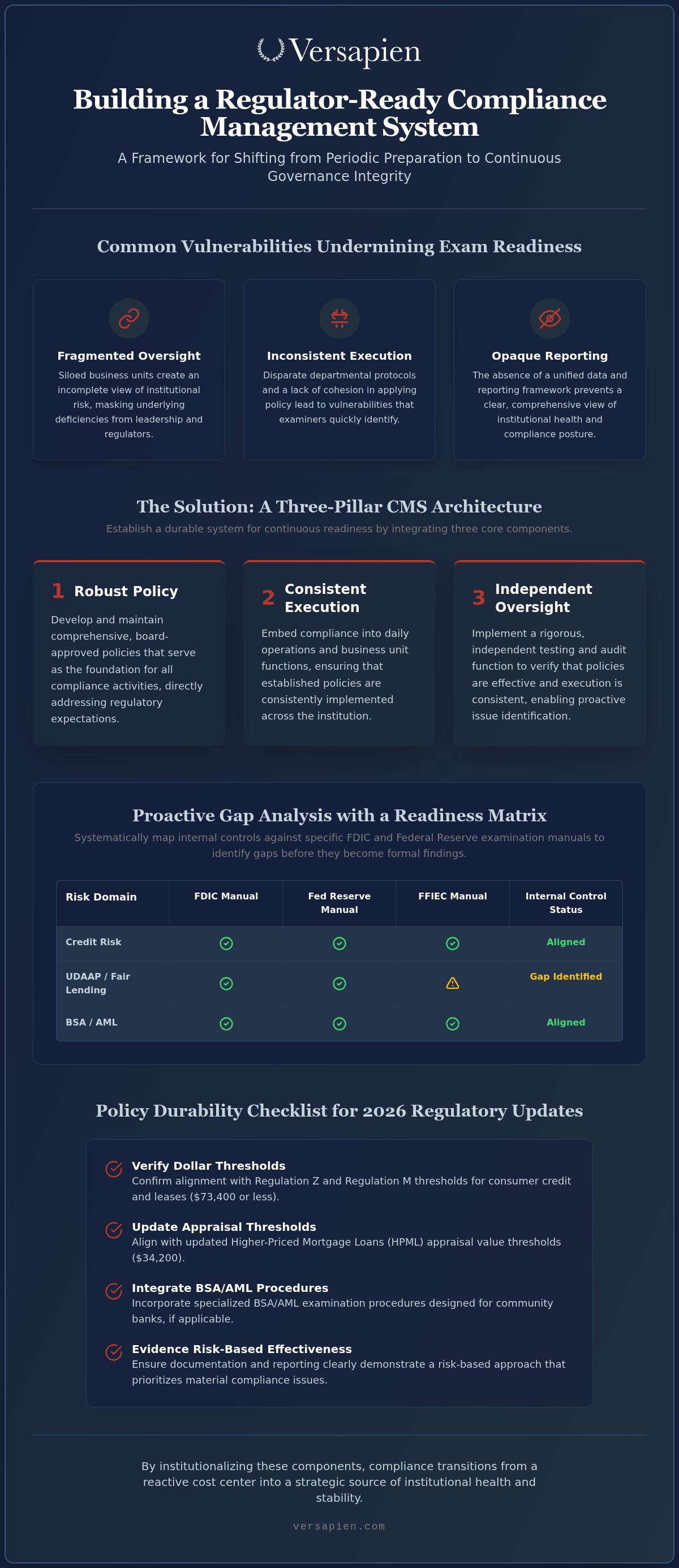
Fragmented oversight, inconsistent execution, and opaque reporting often undermine an institution's standing during supervision. While many banks maintain separate protocols for different departments, this lack of cohesion creates vulnerabilities that examiners quickly identify. A robust Compliance Management System (CMS) remedies these systemic inefficiencies by establishing a three-part architecture: robust policy, consistent execution, and independent oversight. This structure ensures that regulatory exam readiness remains a constant state rather than an annual project.
To maintain structural integrity, internal controls must map directly to the specific examination manuals of the FDIC and Federal Reserve. Utilizing a Readiness Matrix allows leadership to visualize how specific regulatory requirements intersect with enterprise risk domains, such as liquidity or credit risk. This proactive mapping identifies gaps before they escalate into formal findings. Strategic compliance management system modernization is particularly effective in reducing UDAAP and fair lending risks by providing a more granular view of consumer interactions.
Aligning Governance with Enterprise Risk Frameworks
A unified model integrates operational risk, financial crime, and consumer compliance into a single view of institutional health. This prevents the siloed readiness that often masks underlying deficiencies. To assess policy durability against 2026 updates, consider this evaluative checklist:
Verification of Regulation Z and Regulation M dollar thresholds ($73,400 or less for consumer credit and leases).
Alignment with updated Higher-Priced Mortgage Loans (HPML) appraisal thresholds ($34,200).
Integration of specialized BSA/AML examination procedures for community banks.
Evidence of risk-based effectiveness that prioritizes material financial risks over technical checklists.
The Role of Independent Testing and Audit
Internal audit functions serve as the final line of defense against governance failures. These functions must evolve to provide a credible challenge to management assumptions, ensuring that controls are not just present but consistently effective. Documented remediation plans demonstrate a culture of compliance that signals professional gravity to examiners. If you require a specialized review of your current oversight framework, consult with our advisory team to refine your strategy.
Navigating Modern Examination Frontiers: AI and Digital Asset Governance
Opaque algorithms, unvalidated data, and unmonitored outputs. These elements define the "black box" nature of AI models that frequently compromise an institution's regulatory exam readiness. While innovation offers competitive speed, it creates a unique business problem when traditional compliance models fail to account for the logic behind automated decisions. Regulators expect a high degree of explainability, particularly regarding transparency and the mitigation of algorithmic bias in lending. Addressing the common objection that innovation is inherently at odds with regulatory certainty requires a shift in perspective; governance is the framework that allows innovation to scale safely.
Specialized regulatory compliance advisory services provide the necessary bridge between technical innovation and institutional safety. By establishing a durable oversight model, leadership can ensure that emerging technologies don't outpace the institution's risk appetite. This disciplined approach demonstrates to examiners that the bank understands its technical risks as deeply as its financial ones.
Responsible AI and Model Risk Management (SR 11-7)
Governance considerations for third-party AI vendors remain a priority, as the FFIEC emphasizes that outsourcing doesn't absolve an institution of its oversight responsibilities. Organizations must maintain a comprehensive inventory of all models and establish rigorous validation protocols that align with SR 11-7 standards. Model validation procedures must adapt to include testing for "hallucinations" and data drift when deploying generative AI in 2026. This technical oversight ensures that automated decisions remain fair, accurate, and fully auditable.
Digital Asset Compliance and Sanctions Oversight
The intersection of BSA/AML modernization and digital asset transaction monitoring has become a focal point of recent supervision. On April 7, 2026, FinCEN proposed a rule to prioritize risk-based effectiveness over technical checklists, a shift that directly impacts how institutions manage crypto transactions. Digital asset policies must align with OFAC expectations and FinCEN mandates to ensure that sanctions screening remains robust in a decentralized environment. Maintaining this alignment requires a continuous assessment of transaction monitoring logic to detect evolving patterns of financial crime.
Institutionalizing Readiness: From Remediation to Strategic Advantage
Transitioning from identifying deficiencies to maintaining a permanent state of regulatory exam readiness represents a fundamental maturation of the compliance function. Institutions that move beyond episodic remediation cycles gain a predictable operational rhythm that satisfies examiners while stabilizing the business. This journey requires a disciplined shift in focus, moving from isolated technical fixes to a unified governance architecture that provides a steady-state view of institutional health. By institutionalizing these practices, leadership replaces the anxiety of the exam cycle with the quiet confidence of structural integrity.
Translating complex regulatory findings into actionable executive summaries is critical for effective board-level oversight. This process ensures that the most material risks receive the necessary resources and attention. Implementing a durable framework allows senior leaders to move from reactive defense to proactive governance, positioning the institution to withstand rigorous scrutiny without disrupting core operations.
The Executive Action Plan for 2026
A Chief Risk Officer should begin specific preparations at least six months prior to a scheduled examination to ensure all controls are functioning as intended. This window allows for the identification and correction of any latent vulnerabilities before they become formal findings. Consider these four specific actions to strengthen your posture:
Conduct a comprehensive gap analysis against the latest FFIEC and OCC supervisory priorities, focusing on risk-based effectiveness.
Validate the technical accuracy and operational implementation of remediation plans for any outstanding MRAs.
Refine board-level reporting to emphasize qualitative risk outcomes rather than simple volume metrics or checklists.
Engage strategic partners to perform an independent assessment of emerging technology governance, particularly regarding AI model explainability.
Leveraging Governance for Market Differentiation
A robust readiness framework does more than satisfy examiners; it allows institutions to launch new products faster with lower risk profiles. When governance is integrated into the product development lifecycle, the friction typically associated with compliance reviews decreases. This structural integrity becomes a competitive advantage, enabling the institution to navigate a complex landscape with greater speed and precision than less organized peers.
Executing remediation roadmaps efficiently requires specialized financial services project management that understands the nuances of banking operations. Versapien’s senior-led boutique model delivers practical, implementation-ready solutions that bridge the gap between high-level strategy and technical oversight. By turning compliance into a strategic source of innovation, institutions protect their long-term health while securing a permanent regulator-ready posture.
Securing a Durable Governance Architecture for 2026 and Beyond
Establishing a state of permanent regulatory exam readiness is an investment in institutional durability that extends far beyond the immediate examination window. This strategic shift replaces the fragmented, high-stress cycles of the past with a steady-state governance model that prioritizes transparency and structural integrity. By treating compliance as a continuous operational output, leadership can ensure that the institution remains resilient even as mandates for AI and digital assets continue to evolve. This disciplined approach demonstrates deep-seated competence to examiners while stabilizing the institution's long-term health.
To transition from identifying vulnerabilities to achieving a sustainable competitive advantage, senior leaders should consider the following strategic actions:
Execute a Governance Maturity Assessment: Evaluate the current oversight framework against the 2026 Federal Reserve enhanced supervisory principles to identify systemic friction points.
Align Remediation Roadmaps with Strategic Growth: Ensure that any outstanding Matter Requiring Attention (MRA) findings are addressed through solutions that support, rather than hinder, the launch of new digital products.
Benchmark Board Reporting Against Peer Disclosure Trends: Refine the frequency and depth of compliance health reporting to ensure the Board of Directors can provide a documented, credible challenge to management assumptions.
Formalize a Cross-Functional Regulatory Response Team: Establish a dedicated group that bridges the gap between technical innovation and traditional risk management to ensure a unified institutional voice.
Versapien supports financial institutions in navigating these difficult landscapes by delivering senior-led advisory services grounded in 30 years of Big-Four experience and specialized AI governance credentials. We provide the technical specialist and visionary architecture necessary to turn complex regulatory requirements into implementation-ready solutions. By securing a regulator-ready posture today, you protect your institution's ability to innovate safely and successfully in the future.
Maintaining this proactive stance ensures that your governance framework remains a reliable steadying force in an increasingly complex environment.
Practical Takeaways and Next Steps
Establishing a durable, regulator-ready posture requires a methodical transition from identifying vulnerabilities to implementing sustainable controls. The following actions provide a strategic framework for maintaining continuous regulatory exam readiness throughout the 2026 supervisory cycle. By focusing on these high-priority areas, senior leadership can ensure that governance remains a steadying force within a complex and high-stakes environment.
Update Consumer Protection Thresholds for 2026
Ensure the Compliance Management System reflects the updated dollar thresholds for Regulation Z and Regulation M, which now apply to consumer credit transactions and leases of $73,400 or less. This adjustment, based on the 2.1 percent increase in the Consumer Price Index for Urban Wage Earners and Clerical Workers (CPI-W), is essential for maintaining accuracy during consumer compliance examinations. Additionally, verify that Higher-Priced Mortgage Loan appraisal requirements are calibrated to the new $34,200 threshold to prevent technical deficiencies in mortgage lending oversight.
Implement Risk-Based BSA/AML Program Modernization
Align transaction monitoring and reporting protocols with the 2026 FinCEN proposed rule that prioritizes demonstrable effectiveness over technical checklists. This shift requires a reassessment of how the institution identifies and manages material financial risks, particularly within digital asset transactions and cross-border payments. Documentation should clearly reflect the logic used to prioritize high-risk activities, while also incorporating the latest FFIEC manual updates that remove references to reputational risk in favor of safety and soundness.
Formalize AI Governance and Explainability Protocols
Establish a structured inventory and validation process for all automated decisioning models to address 2026 supervisory priorities regarding AI in lending. This process must focus on algorithmic bias mitigation and the transparency of "black box" models to ensure fair lending compliance under intensified CFPB scrutiny. Third-party AI vendors should be included in this oversight to satisfy FFIEC guidance on outsourcing risk, ensuring that the institution maintains accountability for all automated outcomes.
Standardize Qualitative Board-Level Reporting
Transition board reporting from high-volume metrics to qualitative assessments that provide a clear view of institutional risk health. This framework allows the Board of Directors to provide the necessary credible challenge to management assumptions, a factor that remains a primary focus in Federal Reserve safety and soundness examinations. Clear, analytical reporting ensures that senior leadership can make informed strategic decisions regarding resource allocation and remediation, especially as the OCC moves toward more tailored, risk-based examinations for community banks.



Comments